

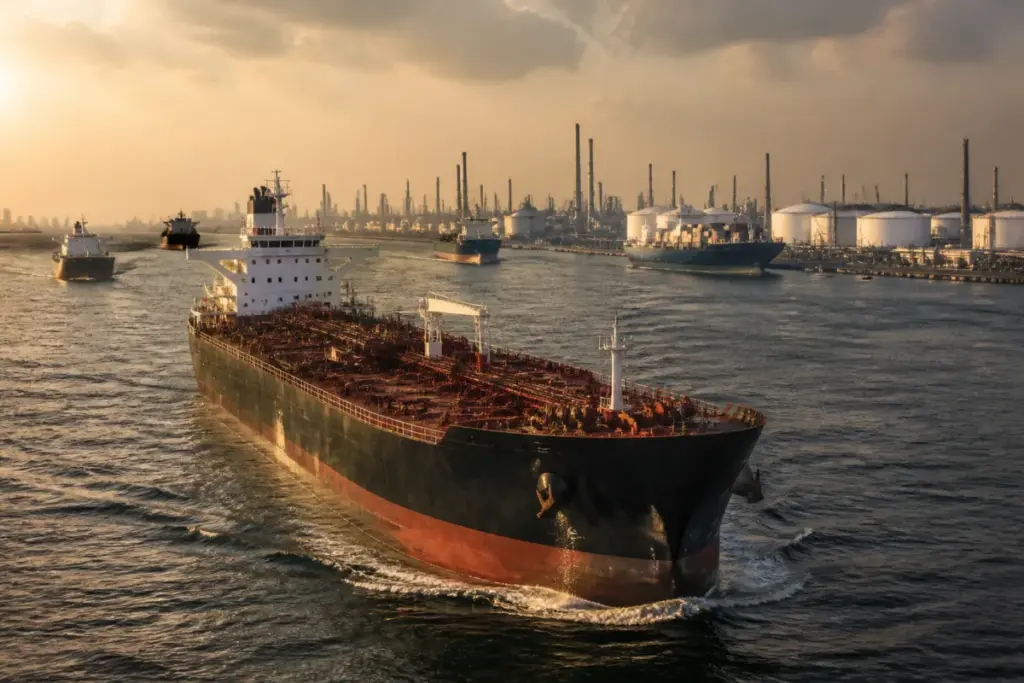
Goldman Sachs’ warning that the Brent crude price could reach $140 a barrel in early 2027 if Gulf oil supplies remain severely disrupted is more than a market forecast. It is a signal of how quickly geopolitical risk can move through the systems that keep cities functioning: fuel distribution, public transport, construction, food supply and municipal operations.
The bank’s report presents two possible paths. Its base case assumes that Middle East oil supplies recover and the risk premium in energy markets moderates. Under that scenario, Brent crude could fall to $90 a barrel by the end of 2026, while European natural gas prices could reach €70 per megawatt-hour. But if average Gulf oil output remains 5 million barrels per day below February 2026 levels, Goldman Sachs said Brent could rally to $140 in early 2027 and average about $125 a barrel during the year.
That range matters because oil is not only a financial-market commodity. It is an input into the daily operation of urban economies. Fuel moves buses, trucks, construction equipment and emergency vehicles. Petroleum-linked products are used across infrastructure and building activity. Food and other essential goods depend on transport networks whose costs rise when diesel, marine fuel or aviation fuel becomes more expensive.
The report therefore places the question of energy security alongside the question of urban affordability. Cities may not control international oil supply, but their residents and institutions absorb its consequences through household expenses, transport fares, construction prices and the cost of delivering public services.
The immediate trigger identified in the report is the escalation of attacks on shipping in and around the Strait of Hormuz. Goldman Sachs said damage to energy infrastructure and a prolonged disruption to Gulf oil supplies could drive prices sharply higher. Reuters reported that Brent futures rose $1.61, or 1.5 per cent, to $110.40 a barrel, while US West Texas Intermediate gained $1.45, or 1.5 per cent, to $99.27 a barrel at 0630 GMT on the day covered by the report.
The price movement was taking place alongside uncertainty over diplomatic efforts and falling US crude and fuel inventories. Reuters cited Suvro Sarkar, head of energy research at DBS, who described oil prices as having experienced a “wild ride” over the preceding sessions. He attributed the fluctuations to profit-taking, hopes of a Qatar- or Pakistan-brokered agreement, uncertainty over whether a deal remained distant, and continued drawdowns in US crude and petroleum-product inventories.
This combination is important for cities because volatility can be disruptive even when a price spike is temporary. Municipal agencies, transport operators, contractors and logistics companies plan budgets and contracts before costs are fully known. Rapid changes in fuel prices can complicate procurement, operating-cost estimates and project scheduling. The supplied evidence does not establish how any particular Indian city or agency would respond, but it shows why the risk is relevant to urban administration beyond the trading floor.
Maritime insecurity adds a physical constraint to the market. Ship-tracking firm Kpler recorded at least 18 vessel attacks over the preceding two weeks, according to the report. LSEG analysts warned that attacks on tankers had extended beyond the Strait of Hormuz into the Gulf of Oman, threatening regional oil loadings and ship-to-ship transfers. The report also said the Houthis had claimed responsibility for attacks on a Saudi Aramco site in Yanbu, the Shaybah oilfield and airports in Riyadh and Abha.
These incidents illustrate the difference between a normal commodity-price fluctuation and a supply-chain disruption. A market can respond to expectations, but physical attacks affect whether ships, cargoes and transfers can move through the system at all. If disruptions persist, the risk is no longer limited to a higher price for crude. It includes delays, rerouting, tighter availability of refined fuels and higher insurance or shipping costs, although the supplied material does not quantify those additional costs.
The effect on construction would likely operate through several linked channels. Higher fuel prices can raise the cost of moving aggregates, cement, steel and equipment between suppliers, plants and project sites. Energy-intensive production can also become more expensive when power or gas markets tighten. The Goldman Sachs report separately warned that European natural gas prices could reach €150 per megawatt-hour by the end of 2026 if Gulf liquefied natural gas exports remain depressed and winter temperatures become substantially colder than average.
That matters because the built environment depends on more than crude oil. Construction materials are produced, processed and transported through energy-intensive networks. A prolonged energy shock can therefore put pressure on project budgets even where the construction site itself does not use large quantities of petrol or diesel. Whether those costs are absorbed by contractors, passed on to buyers or reflected in delayed work would depend on contracts and local market conditions, which are not established in the report.
Food systems face a similar exposure. Goldman Sachs said agricultural commodities were facing risks from the Iran and Russia-Ukraine conflicts, possible restrictions on food exports and a potential severe El Niño weather pattern. The agriculture component of the Bloomberg Commodity Index had risen 19 per cent year-on-year, according to the bank.
The report also identified fertiliser shipments through the Strait of Hormuz and grain exports through the Black Sea as potential pressure points. It said a strengthening El Niño had a greater than 81 per cent probability of reaching “super” El Niño conditions, with possible droughts and floods disrupting crop production across key agricultural regions. For cities, this creates a combined logistics and affordability problem: energy costs can raise the price of moving food, while supply disruptions or weather damage can tighten availability at the same time.
The urban consequences of such a shock are not distributed evenly. Households that spend a larger share of their income on commuting, cooking fuel and food have less capacity to absorb price increases. Workers who depend on long-distance travel may face higher daily costs before any formal change in fares. Small businesses that rely on delivery vehicles can experience higher operating expenses, while construction workers and contractors may face reduced activity if project costs rise beyond approved budgets. These are transmission pathways rather than outcomes confirmed for a specific location, and the Goldman Sachs report does not provide city-level estimates.
Municipal and public-transport institutions would also face difficult administrative choices in a prolonged energy disruption. Transport systems need to maintain service while managing fuel and electricity costs. Road and infrastructure projects depend on predictable material movement. Waste collection, water pumping and emergency response require continuous vehicle and energy use. The report does not identify policy measures by any Indian municipal body, but its price scenarios show why fuel exposure is an institutional risk that cannot be treated solely as a private-sector concern.
The report’s base case remains less severe than its disruption scenario. Goldman Sachs expects Middle East supply recovery and a reduction in the risk premium to bring Brent down to $90 a barrel by the end of 2026. That assumption places the duration of the disruption at the centre of the outlook. The difference between moderation and a sustained spike is not simply the difference between two market prices; it is the difference between a manageable budget adjustment and a broader planning problem for energy-dependent systems.
Other commodities add another layer to the outlook. Goldman Sachs expects copper to average $15,400 per tonne in 2027, supported by demand from electrification, data centres and artificial intelligence, while constrained mine supply limits availability. The bank expects gold to reach $5,400 per ounce by the end of 2027, driven by central-bank purchases and diversification. The Bloomberg Commodity Index had generated a 36 per cent total return year-to-date, outperforming equities and bonds, according to the report.
Copper’s projected strength is particularly relevant to urban infrastructure because electrification and data-centre development require extensive electrical networks and equipment. However, the supplied material does not specify how copper prices would affect a particular project, city or national programme. Its significance lies in the possibility that the same period could combine expensive energy with strong demand for materials needed to expand urban and digital infrastructure.
The evidence therefore points to a fragmented commodity outlook rather than a single inflation story. Oil and gas could moderate if Gulf supplies recover. They could rise sharply if disruption persists. Agricultural commodities face conflict, export and weather risks. Copper is supported by structural demand and constrained mine supply, while gold is being supported by central-bank purchases and diversification. For cities, the common factor is exposure: essential systems depend on markets whose risks are created well beyond municipal boundaries.
What remains uncertain is the duration and scale of the disruptions. The Goldman Sachs base case assumes recovery, while its higher-price scenario depends on Gulf output remaining 5 million barrels per day below February 2026 levels. Reuters’ reporting indicates that market participants were weighing both diplomatic possibilities and continuing maritime and inventory risks. The next phase of the story will depend on whether physical energy flows recover, whether attacks continue to affect shipping and whether weather and geopolitical pressures tighten agricultural supplies at the same time.
The central urban lesson is not that a $140 Brent crude price is inevitable. It is that city budgets, mobility systems, construction activity and food distribution are linked to a global energy network whose disruptions can arrive suddenly. The immediate developments to monitor are the restoration of Middle East supply, the security of tanker routes, the direction of US inventories, European winter conditions and the persistence of risks to fertiliser and grain shipments.


