

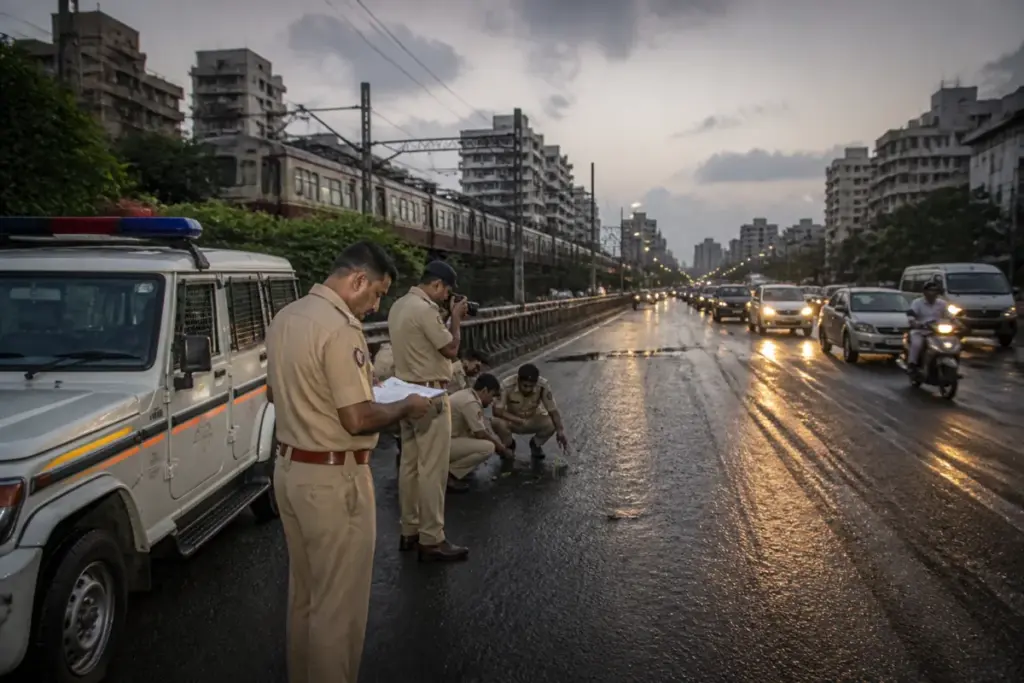
The investigation into the October 18 firing at actor Tiger Shroff’s car in Mumbai has revealed a crime operation that crossed several State boundaries before and after the attack. According to details attributed to Mumbai Police, the Delhi Police Special Cell and Kota Police, investigators are examining a chain involving surveillance in Juhu, a firearm allegedly transported from Punjab, encrypted communications, an abandoned motorcycle, app-based travel and a planned escape through Rajasthan and possibly Nepal.
The case therefore extends beyond the shooting itself. It shows how an urban crime investigation can depend on coordination between city police forces, railway security units, transport records, CCTV systems and digital leads generated by a single phone call. It also raises questions about how quickly information can move between agencies when suspects use multiple forms of transport and attempt to keep their phones switched off.
The central incident took place near the Pushpa Narsee football ground in Juhu, where investigators say three suspected attackers had been monitoring Shroff’s movements for nearly a month. Reports cited by The Hindu said the suspects were particularly tracking his Sunday visits to the ground. CCTV footage and call records reportedly placed them near the location during an earlier attempt on October 11, when the actor did not appear and the plan was allegedly abandoned.
Investigators are also examining the preparation of the escape vehicle. According to the report, Hrithik Kumar alias Roshan, one of the suspects later arrested in Kota, purchased a Pulsar motorcycle for about ₹25,000 on September 11. The motorcycle had changed hands several times, while its ownership documents had not been transferred. Police subsequently traced its ownership history through a resident of Jogeshwari and two later buyers.
On October 18, the three suspects allegedly reached the football ground around 4.30 p.m. and repeatedly checked whether Shroff was present. At about 7 p.m., two gunmen allegedly fired at the actor’s BMW as it left the ground, while a third suspect waited nearby with the motorcycle. Mumbai Police DCP (Detection) Raj Tilak Roshan said the attackers allegedly fired five to six rounds. The report also said one firearm may have malfunctioned.
The incident caused injuries to Shroff, his driver Firdous Ibrahim Baloch and a pedestrian, according to the supplied report. The actor was reported to have sustained injuries to his chest and right hand, while his driver suffered a gunshot injury to his left wrist and a fracture to his right ring finger. The attackers then allegedly fled towards Andheri West railway station and abandoned the motorcycle.
The alleged movement of the weapon into Mumbai is a separate focus of the investigation. A press note issued by the Delhi Police Special Cell on October 20, as reported by The Hindu, said Kunal, 21, travelled to Amritsar to collect a pistol and 20 rounds of ammunition after allegedly receiving instructions from Anil Pandit through an encrypted messaging application. He was accompanied by Sumit, 19.
Police alleged that Kunal later persuaded Radha, 23, to travel to Mumbai with the firearm. Radha and Babita, 23, reached Dadar railway station on October 17 and checked into a hotel. A minor boy allegedly collected the bag containing the weapon from Radha near the hotel. Investigators are still examining how the firearm was delivered to the suspected shooters and what role the minor may have played.
This part of the case illustrates the difficulty of investigating urban crime when the operational chain is distributed across locations and participants. The alleged weapon procurement took place in Punjab, the transport route passed through Delhi and Mumbai, and the suspected shooters were arrested in Rajasthan. Each stage generated a different evidence trail: railway journeys, hotel stays, vehicle ownership, CCTV footage, mobile-phone activity and communications through an encrypted platform.
The alleged escape route relied on frequent changes in transport. After abandoning the motorcycle, the suspects reportedly boarded a suburban train towards Borivali. They then arranged an app-based cab to Surat, where they were dropped near the bus stand. They later travelled to Surat railway station and boarded the Pune-Jaipur Superfast Express. According to Kota Police, they intended to travel towards Delhi and eventually escape to Nepal.
The investigation’s breakthrough came through an ordinary transport interaction. One of the suspects briefly switched on a mobile phone near Borivali railway station to contact the cab driver after the booked vehicle failed to locate them. Police had reportedly identified the suspects through CCTV footage and technical surveillance and had obtained a mobile number linked to one of them. The phone had remained switched off after the shooting.
The brief call gave investigators a way to identify and question the driver, who reportedly confirmed that he had transported three passengers from Borivali to Surat. Police then examined CCTV footage around the drop-off point, traced the suspects to Surat railway station and identified the train and compartment in which they were travelling. Mumbai Police alerted Rajasthan Police with descriptions of the suspects and details of their expected arrival at Kota.
The arrest operation at Kota demonstrates the importance of inter-state coordination once a suspect’s route has been established. On the morning of October 19, DCP Roshan reportedly contacted Kota Superintendent of Police Tejaswani Gautam. Kota City Police, the Anti-Gangster Task Force and railway security units were deployed around the platforms and station exits. The three suspects were apprehended when the train arrived, in an operation that reportedly lasted about 15 minutes.
The suspects were identified as Phool Singh, 18, Rehan alias Sukka, 18, and Hrithik Kumar alias Roshan, 22. Although one suspect initially gave a date of birth suggesting that he was nearly 18, DCP Roshan clarified that none of the three was a minor. The accused were produced before a judge in Kota and granted 48-hour transit remand before being handed over to Mumbai Police. No firearms were recovered from them at the time of arrest, according to the report.
The investigation widened on October 20, when the Delhi Police Special Cell arrested four more suspects allegedly connected with the planning and logistics. They were identified as Kunal and Sumit from Sonipat, and Radha and Babita from Uttar Pradesh. The arrests were made at New Delhi Railway Station and in Sonipat. A Maharashtra Police CID team subsequently sought permission to interrogate and formally arrest them, and the court granted three days’ transit remand.
The alleged role of Anil Pandit remains under examination. Investigators have described him in reports as a U.S.-based gangster who allegedly directed the operation through encrypted communications. Kota Police inputs reportedly placed him in contact with Rehan, while the Delhi Police Special Cell linked him to the alleged weapons procurement process. The complete chain of command, the motive, financial transactions and the identities of other possible facilitators have not been publicly established in the supplied material.
Claims linking the attack to the Lawrence Bishnoi gang also remain unresolved. A purported audio message and social-media posts claiming responsibility have surfaced, but police have not independently established their authenticity or confirmed the gang’s involvement. That distinction is important in a case where investigators are still separating verified evidence from material circulating online.
The Juhu firing also exposes the limits of treating urban security as a local policing issue. The attack occurred in a dense Mumbai neighbourhood, but its planning, logistics and escape route allegedly moved through multiple jurisdictions and transport systems. The investigation depended on agencies sharing information quickly enough to convert a partial vehicle trail and a short phone call into a coordinated search at a railway station hundreds of kilometres away.
What the available evidence confirms is that seven people have been arrested in connection with different alleged roles, while the wider network remains under investigation. What is not yet established is the full chain linking the suspected handler, the weapon suppliers, the person who allegedly collected the firearm in Mumbai and the shooters. The Mumbai Crime Branch’s Anti-Extortion Cell is continuing to examine those links, along with the weapon trail, financial transactions and the alleged motive.


