

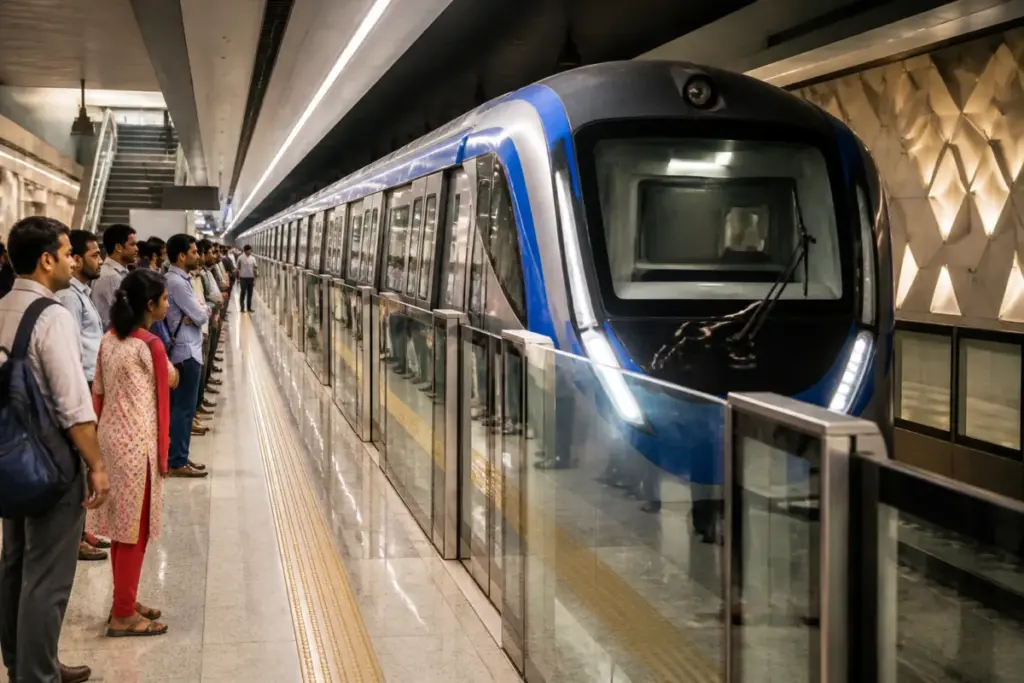
Chennai Metro Phase II has begun passenger services with driverless Metropolis trains on Corridor 4, connecting Poonamallee Bypass with Light House through a 26-km route and 28 stations. The new service adds a fully automated train operation to Chennai’s expanding urban transport network and is intended to improve links between residential, commercial and cultural areas.
The corridor includes 18 elevated stations and 10 underground stations. The trains have been configured for driverless operation and can travel at speeds of up to 80 kmph, according to details reported by Deccan Chronicle. Their entry into passenger service marks the operational start of one of the major train-supply components of Phase II.
Alstom has completed manufacturing 36 Metropolis trainsets, comprising 108 cars, for the corridor. The final trainset is scheduled for delivery by the end of October 2026. Each three-car trainset can accommodate up to 1,000 passengers and is equipped with air-conditioning, regenerative braking, CCTV cameras, real-time passenger information displays and dedicated spaces for women and persons with disabilities.
One entire car has two-thirds of its space reserved for women. The train interiors and exteriors have also been designed with local cultural references. The exterior draws inspiration from Bharatanatyam mudras, while patterns on the platform-screen doors incorporate Tamil Nadu’s traditional kolam art.
The €124-million contract, awarded in 2023, covered the design, manufacture, supply, testing and commissioning of the trainsets, as well as driver training for Chennai Metro Rail Limited personnel. Olivier Loison, managing director of Alstom India, said the commencement of passenger services reflected the company’s partnership with CMRL and India’s engineering and manufacturing capabilities.
The trains were designed at Alstom’s engineering centre in Bengaluru and manufactured at the company’s facility in Sri City, Andhra Pradesh. The production arrangement places the new Chennai Metro fleet within a wider regional manufacturing network while linking the project to local engineering and industrial capacity.
Alstom has supported Chennai Metro since 2010, supplying 208 Metro cars, signalling systems and power systems for Phase I. The first phase spans 54 km across two corridors. The company is also preparing to manufacture 32 additional driverless trainsets, comprising 96 cars, ordered in 2025 for Chennai Metro. Production of those trainsets is scheduled to begin at the Sri City facility.


