

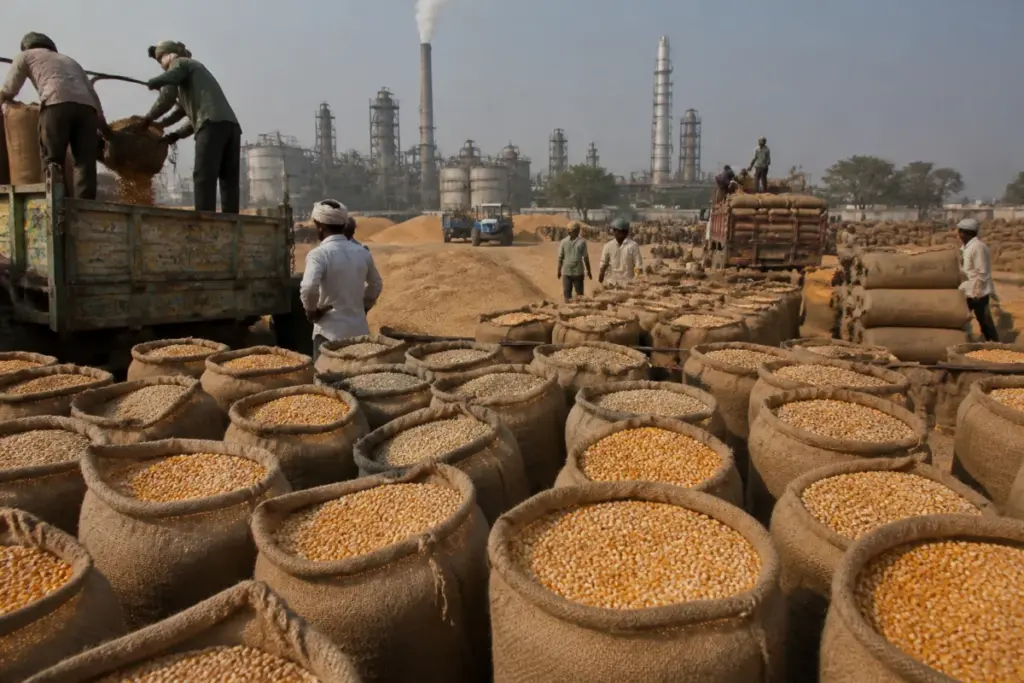
The E20 ethanol programme is entering a more difficult phase as the government shifts the burden of fuel production away from sugarcane-based feedstock and towards grains. The decision may help protect domestic sugar availability, but it also brings the fuel market into sharper competition with poultry, dairy, starch and other industries that depend on maize.
The immediate trigger is the government’s October 16 direction that oil marketing companies stop procuring ethanol made from sugarcane juice, sugar syrup and B-heavy molasses for the next ethanol supply year. C-heavy molasses, a lower-sugar by-product left after sugar extraction, remains eligible. On the same day, Bharat Petroleum Corporation Limited issued a tender seeking bids for about 11 billion litres of ethanol for the November 2026-October 2027 supply year.
That combination has created a substantial supply challenge. Industry estimates cited in the report suggest ethanol production may require about 16 million tonnes of maize in 2026-27, compared with approximately 13 million tonnes in the current supply year. The additional requirement comes as the maize market is already serving feed manufacturers, starch producers and other industrial users.
The policy reflects a direct conflict between two objectives. The ethanol-blending programme was designed to reduce dependence on imported crude oil and increase the use of domestic feedstocks. At the same time, the government has cited concerns over domestic sugar availability while directing that sugar diversion for ethanol production be reduced to zero. Protecting sugar supplies therefore increases dependence on other agricultural commodities, particularly maize.
The numbers indicate why the adjustment is difficult. The government has capped the use of surplus rice held by the Food Corporation of India at 7.2 million tonnes. At an assumed conversion rate of 450 litres of ethanol per tonne of rice, that quantity could yield about 3.25 billion litres of ethanol. Damaged foodgrains could add another 1.25 billion litres at maximum, up from an estimated 700 million litres in the current supply year, according to agricultural markets expert GK Sood.
C-heavy molasses can provide only a limited additional volume. Sood estimates that production from the feedstock could rise from about 2.2 billion litres in the current supply year to around 2.6 billion litres in 2026-27. However, C-heavy molasses is also used by the alcohol and other industries. Only about 0.5 billion litres may be available to oil marketing companies, compared with 0.17 billion litres used in 2025-26.
Taken together, these sources leave a significant gap against the 11-billion-litre tender. The report estimates a shortfall of around 6 billion litres. At a conversion rate of 380 litres of ethanol per tonne, meeting that gap would require about 16 million tonnes of maize. This is not simply a procurement problem for fuel companies; it is a question of how one agricultural commodity is allocated among competing users.
Maize already occupies a central position in India’s feed economy. The report cites industry estimates that maize accounts for more than 55% of poultry feed and that poultry consumes roughly 60% of domestic maize. Maize supplied about 4.1 billion litres of ethanol in the current supply year, making it the largest single feedstock, according to Deepak Pareek, founder of agri consultancy HnbY.
The projected demand from different sectors shows the scale of the contest. Poultry-feed demand is estimated at 21.26 million tonnes in 2026 and more than 22 million tonnes in 2027. The starch industry uses about 6.5 million tonnes annually, while dairy-feed demand accounts for another 5-6 million tonnes. Overall maize demand, including feed, ethanol, starch and other uses, could reach about 55.7 million tonnes in 2027, up from an estimated 49-50 million tonnes in 2026.
Supply conditions add another layer of pressure. The market is reportedly preparing for production to fall by 15%, or about 8 million tonnes, from the 55 million tonnes produced last year. Pareek linked the risk to the impact of El Nino on output. The report does not establish the eventual size of the crop loss, but the possibility of lower production alongside higher industrial demand has already influenced market sentiment.
Maize prices in key mandis were hovering at ₹26-28 per kg on Monday, above the minimum support price of ₹24.1 per kg. Industry representatives also reported prices of ₹30-31 per kg in some markets, depending on location, freight and other costs. These prices show how the pressure is being registered before the next ethanol supply year begins.
For poultry, the exposure is particularly high because feed represents an estimated 65-70% of production costs. Ricky Thaper, joint secretary of the Poultry Federation of India, said the sector could face prolonged tight supply and higher prices if crop losses materialise in key maize-producing states. Higher feed costs can reduce farmers’ margins or be passed on through the prices of eggs and chicken.
This is where the ethanol decision becomes a wider urban economy issue. Fuel policy is being transmitted through agricultural markets into food production, livestock operations and household consumption. The effects will not be limited to distilleries or oil marketing companies. They may also be felt by poultry farmers, dairy producers, food processors and consumers if feed costs remain elevated.
The institutional choices are equally important. The government sets the eligibility of feedstocks and the prices paid by oil marketing companies. BPCL’s tender establishes the scale of procurement demand, while the Food Corporation of India controls access to surplus rice and damaged foodgrains held in public stocks. Poultry associations have asked the government to allocate about 5 million tonnes of broken rice and suitable damaged foodgrains from FCI stocks to the poultry sector at an affordable rate, subject to quality and food-safety standards.
That request connects two different policy objectives: using surplus public grain stocks and reducing pressure on maize. The report states that FCI held about 84.38 million tonnes of foodgrains on October 1, 2026, including 38.10 million tonnes of rice and 46.28 million tonnes of wheat. This was above the prescribed buffer norm of 30.77 million tonnes. However, the availability of stocks does not automatically make them suitable for feed or ethanol. Quality, safety, allocation rules and conversion efficiency determine how much can actually be used.
The prices offered by oil marketing companies also show how the procurement system may shape feedstock choices. For 2026-27, OMCs will pay ₹57.97 per litre for ethanol from C-heavy molasses, ₹64 per litre for ethanol from damaged foodgrains, ₹60.32 per litre for ethanol from surplus FCI rice and ₹66.07 per litre for ethanol from maize. These rates create different incentives for producers, but they do not remove the physical limits on the supply of each feedstock.
The evidence therefore points to a substitution problem rather than a simple switch from sugar to grain. Sugar-based ethanol can be reduced, but replacing it requires sufficient quantities of rice, damaged foodgrains, molasses or maize. Each alternative has competing uses, different conversion rates and separate supply constraints. A decision that eases pressure on sugar can intensify pressure elsewhere in the food and industrial system.
The programme’s longer-term credibility will depend on how this trade-off is managed. The report notes that the E20 programme has already faced criticism over vehicle life and fuel efficiency, particularly because most vehicles are not E20 compliant. The new feedstock shift adds another test: whether the blending target can be pursued without creating an unsustainable burden for industries dependent on maize.
What is established is that the 2026-27 procurement plan creates a potential maize requirement of around 16 million tonnes to address the estimated ethanol shortfall, while demand from poultry, dairy, starch and other users is also rising. What remains uncertain is the actual maize harvest, the quantity of alternative feedstocks that will be available, and how much C-heavy molasses will be diverted to oil marketing companies rather than other industries.
The next supply year will therefore be monitored through several linked indicators: the final maize crop, mandi prices, the availability of FCI grain, procurement volumes under the BPCL tender and the ability of poultry and dairy producers to absorb higher feed costs. The central policy question is no longer only how India reaches E20. It is how the country allocates scarce agricultural feedstocks when fuel, food and industrial demand rise together.


