

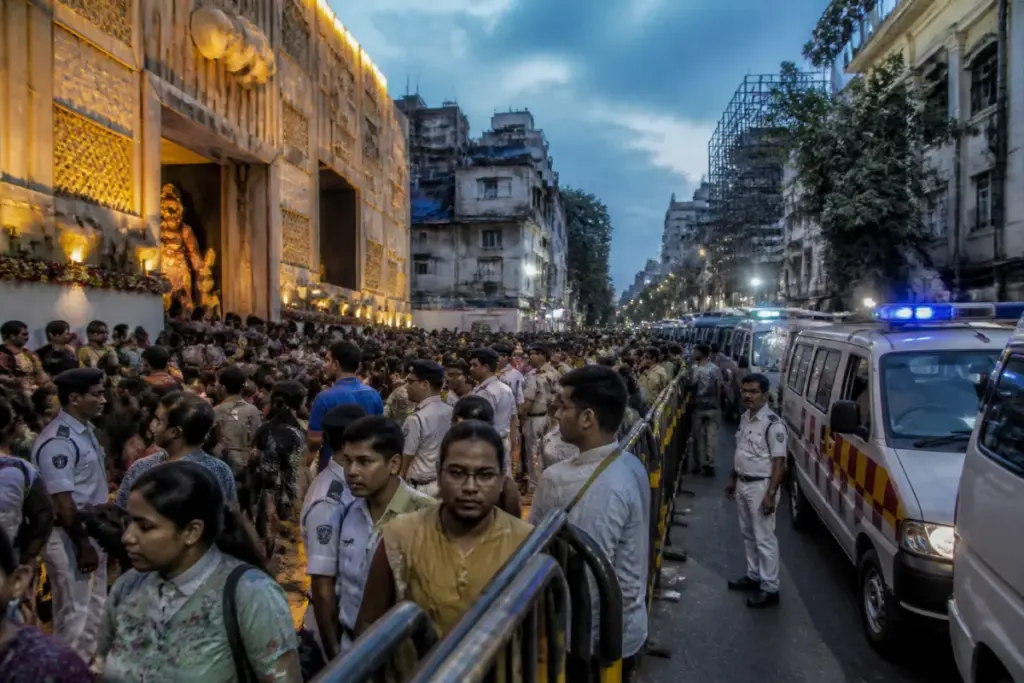
The Chorbagan stampede, which killed 19 people and injured 25 others during Durga Puja in North Kolkata, has moved beyond the immediate question of how the crowd surge occurred. The official response now points to a wider urban safety challenge: how large religious gatherings are monitored, how quickly injured people are moved to appropriate hospitals, how evidence is secured and how authorities communicate during a crisis.
The incident took place at Chorbagan Sarbojanin at around 7.40 pm on October 17. The deaths and injuries made it one of the most serious crowd-related disasters reported during the festival. On Tuesday, Chief Minister Suvendu Adhikari visited the families of victims and spoke about the investigation, the handling of the injured and the circulation of allegedly fake videos about the incident.
The response has created several parallel tracks. The state has constituted a Special Investigation Team, is seeking the consent of a retired judge for a probe, and has included officials from the State Disaster Management Department, Bengal Police and the National Disaster Response Force in the investigation committee. The government has said the inquiry will also produce recommendations for the next Durga Puja.
This structure matters because a stampede is rarely only an on-site crowd event. It is also a test of coordination between organisers, police, disaster-management authorities, hospitals, ambulance services and local administration. The information supplied about Chorbagan does not establish the full chain of events that led to the deaths. It does, however, show that the official response is examining the incident through multiple institutional lenses rather than treating it only as an isolated emergency.
The first unresolved issue concerns what happened at the venue. Questions were raised about the absence of CCTV footage at the location where an announcement was made. Adhikari said he would not interfere with the investigation and that the SIT would examine the matter. He also said he had received substantial footage but would not disclose everything at that stage.
That response highlights the importance of evidence management in crowded public spaces. CCTV systems, public-address announcements, mobile recordings, entry and exit records, police logs and medical transport records can help investigators reconstruct how a crowd moved and where control was lost. The existence of footage alone does not answer those questions; investigators must establish its timing, location and continuity. The chief minister’s decision not to release all material immediately indicates that authorities are treating at least some of it as part of the ongoing inquiry.
The second issue is emergency medical capacity. According to Adhikari, 25 injured people were shifted to a private hospital because it had better healthcare facilities than the government hospital receiving patients. He said some doctors at Calcutta Medical College had questioned the decision and that the health department would check whether they were on duty at the time.
The account places hospital choice at the centre of the disaster response. In a mass-casualty incident, survival depends not only on the number of ambulances available but also on triage, the speed of transfer, the availability of emergency beds, clinical staff and the ability of hospitals to handle a sudden concentration of patients. The source material does not provide a detailed comparison of the facilities at the government and private hospitals, nor does it establish how long individual patients waited. It does record the government’s stated explanation: injured people were transferred to the private facility because it was considered better equipped to save lives.
Adhikari said the government hospital would require another one and a half years to reach the level of the private hospital to which patients were sent. That statement points to a capacity gap within the public health system, although the available account does not specify which departments, equipment or services require improvement. It also raises a governance question about emergency preparedness: whether hospitals close to high-footfall festival sites are assessed and equipped for sudden surges before major events begin.
The role of ambulance drivers, doctors and nurses has also emerged in the official account. The chief minister praised the medical staff and ambulance drivers who worked on the night of the incident. Recognition of their work is separate from the institutional question of whether the emergency system was adequately planned. Both issues need to be examined independently if the inquiry is to distinguish individual performance from systemic preparedness.
The third track concerns the circulation of misinformation. Hours before the chief minister’s Tuesday remarks, the West Bengal Police Special Task Force arrested a man from Cooch Behar district for allegedly spreading misinformation on social media about the stampede toll. Adhikari later said that fake videos had originated from Bangladesh and were circulated by people in Bengal. He said 135 people had shared or commented on such material and that police had been instructed to book them under non-bailable sections.
These claims are attributed to the chief minister and do not, on the evidence supplied, amount to an independently established account of the origin, reach or legal status of every video. The arrest is described as relating to an allegation of spreading misinformation. Any further action will depend on the police investigation and the applicable charges.
Still, the episode shows how a public disaster now produces a second emergency in the information space. Unverified casualty figures and videos can intensify panic, obstruct official communication and cause distress to families searching for information. At the same time, the use of stringent legal provisions requires clear evidence of what was circulated, who circulated it and how the material met the relevant legal threshold. A credible response therefore requires both rapid official communication and transparent enforcement standards.
The Chorbagan investigation is also significant because the stated mandate extends beyond assigning responsibility for the October 17 incident. The chief minister said the committee would make recommendations for the next Durga Puja and that long-term measures were needed. This shifts the issue from post-incident inquiry to the design of future festival management.
The source material does not provide details of the crowd-control plan at Chorbagan, the venue’s approved capacity, the number of police personnel deployed, the arrangements for entry and exit, or whether a formal risk assessment had been completed. Those details will be essential to understanding whether the disaster resulted from a breakdown in an existing plan, an inadequate plan or circumstances that the authorities had not anticipated.
The institutional composition of the proposed inquiry is notable. The State Disaster Management Department, Bengal Police and the NDRF bring different responsibilities and operational perspectives. Police records can address security, movement and enforcement. Disaster-management officials can examine preparedness and response protocols. The NDRF’s participation can add expertise related to emergency operations, although the supplied report does not specify its exact role. The proposed involvement of a retired judge could provide an independent oversight element if consent is obtained and the terms of reference are clearly defined.
For the recommendations to be useful, they will need to connect venue-level arrangements with city-wide systems. A festival crowd does not remain confined to a pandal. Visitors arrive through roads, public transport, private vehicles and pedestrian routes. They depend on signage, lighting, barricades, police directions, emergency lanes, communications and nearby medical facilities. A failure at any point can increase pressure on the others.
The same applies to hospitals. Emergency capacity is not only a matter of buildings and equipment. It includes staffing, ambulance routing, communication between the venue and hospitals, patient identification, family assistance and the ability to distribute casualties across facilities. The decision to transfer injured people to a private hospital suggests that the city’s emergency network can draw on institutions with different levels of capacity. It also exposes the need to establish in advance how those institutions will be integrated during a mass-casualty event.
The available information does not establish whether the Chorbagan venue had exceeded a permitted capacity, whether a particular announcement triggered the crowd movement or whether any organiser or official breached a rule. Those are precisely the questions the SIT and the proposed broader inquiry must answer. Nor does the report establish the complete sequence between the stampede, the first emergency response and the hospital transfers.
What the official response confirms is narrower but important. Nineteen people died and 25 were injured. The police have taken at least one person into custody over alleged misinformation. The state has announced an SIT, is pursuing a retired judge’s participation and has linked the inquiry to recommendations for future Durga Puja arrangements. The government has also acknowledged a gap between the capabilities of the public hospital and the private hospital used for some injured people.
The larger urban question is whether Kolkata’s festival infrastructure is being planned as a temporary cultural arrangement or managed as a major public-safety system. The answer will depend on the evidence collected, the findings made public and whether future recommendations cover crowd flow, surveillance, communications, emergency medical capacity and accountability across agencies. The next significant developments will be the findings of the SIT, the composition and terms of the proposed inquiry, and the measures adopted for the next Durga Puja.


