

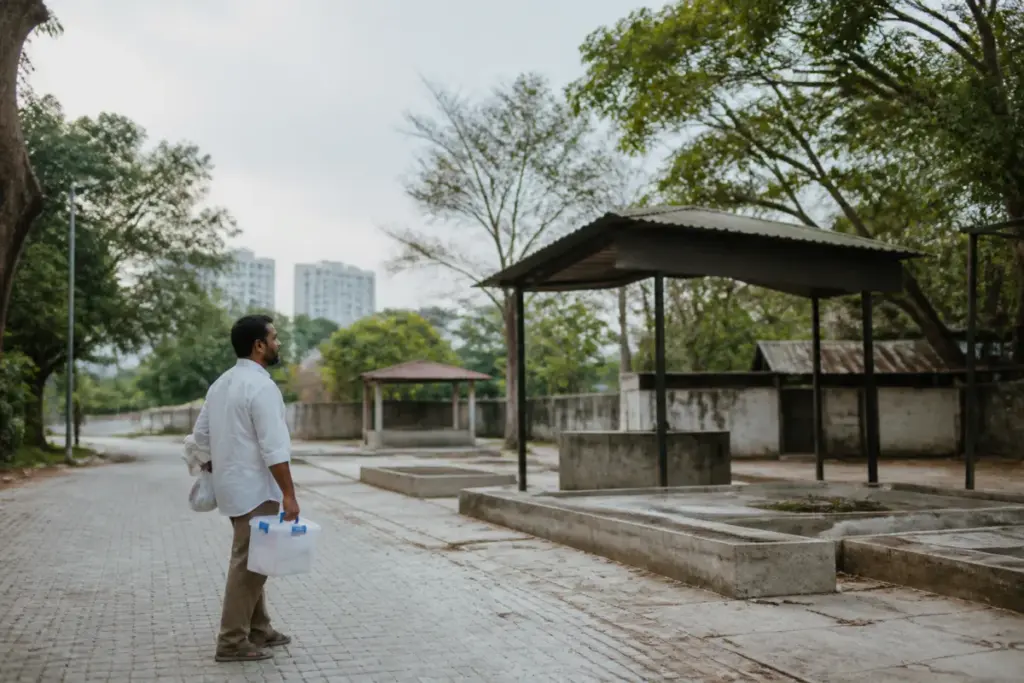
For more than 25 years, S Kanthavelan has performed the last rites of people who died in Coimbatore without anyone to claim their bodies. His work, which includes the burial of victims of road and train accidents, destitute patients, abandoned elders and infants, reveals a civic responsibility that usually remains invisible: ensuring that people who die alone are treated with dignity.
Kanthavelan, 51, heads the Singanallur-based Aathma Charitable Trust. According to his account, he has conducted the last rites of more than 1,800 people whose bodies were not claimed. The number includes 35 people who died of HIV-related illnesses, more than 90 abandoned infants and 375 people during the Covid-19 pandemic. He also manages three municipal cremation grounds and has sheltered 350 destitute elders.
The scale of this work is significant not because it represents a formal public programme, but because it shows how an essential urban service can depend on individuals and voluntary networks. The people Kanthavelan assists often have no relatives available to claim them, or have travelled to Coimbatore for work or medical treatment and died away from their home towns. Their deaths then require coordination between police, hospitals, cremation grounds, burial workers and charitable organisations.
Kanthavelan’s involvement began in 2001 after he encountered the body of an elderly man near Aravaan Medu along the Singanallur–Vellalore Road. Homeless people frequently slept in the area, according to the report. Police took the body to Coimbatore Medical College Hospital, but no one came forward even after two days. With the help of friends, Kanthavelan took the body to the Singanallur cremation ground, completed the last rites and buried him.
That incident became the beginning of a sustained service. Kanthavelan says Aathma Charitable Trust was established the following year. His mother helped fund the work by selling a property, while earnings from a fabrication unit later supported free burials. The account points to the personal financial burden often carried by people who step into gaps in public systems. The trust’s work grew from one burial into a network handling post-mortem clearances, bathing bodies, transporting them and digging graves.
These tasks involve more than the physical act of burial. Before an unclaimed body can be taken to a cremation ground or cemetery, police and hospital procedures must be completed. Kanthavelan and his colleagues—Ramesh, Manikandan and Nandagopal—began handling these stages alongside the last rites. Their role therefore sits between emergency response, hospital administration, police procedure, cemetery operations and social care.
The report says burial costs have risen from Rs 1,300 to Rs 2,500. To manage the increase, the group undertakes more of the physical work themselves, saving around Rs 1,000 per burial. Kanthavelan also refuses the state government’s Rs 1,000 burial assistance. The figures illustrate a practical problem in administering support: a fixed assistance amount may not cover the full cost of a burial, particularly when expenses rise and the deceased has no family to contribute.
The work has also been shaped by the mobility of the urban population. Kanthavelan says many people who die without anyone to claim their bodies are from outside Coimbatore. Some may have come for employment or treatment. A city that attracts workers, patients and transient residents must therefore deal with responsibilities that extend beyond its registered population. When a person dies far from home, the question of who arranges the final rites becomes an administrative and social issue as much as a family matter.
His account of 2008, when the group buried 22 bodies in one day, conveys the intensity of that responsibility. Police have sometimes called the group several times in a single day, he says. During the Covid-19 pandemic, the trust conducted the last rites of 375 people. The pandemic made death-management systems more visible across cities, but the cases handled by Kanthavelan indicate that the need does not disappear when a health emergency ends.
Coimbatore’s municipal cremation grounds form an important part of this chain. Kanthavelan’s management of three such facilities places him in a position where municipal infrastructure and voluntary service intersect. Cremation grounds and burial spaces are often discussed as physical facilities, but their operation also requires workers, documentation, maintenance, access to water and equipment, and procedures for bodies that remain unclaimed. The supplied report does not establish the full municipal framework governing these facilities, but it shows that their functioning depends on more than land and buildings.
The same is true of the people who remain alive but socially abandoned. Kanthavelan has sheltered 350 destitute elders. This broadens the significance of the trust’s work beyond last rites. The group is responding to a continuum of vulnerability that includes homelessness, abandonment, illness, isolation and death without family support. The report does not provide details of the shelter’s capacity, funding or operating model, but the number of elders sheltered indicates that the need is not limited to isolated incidents.
The burial of more than 90 abandoned infants adds another dimension. Infants who are left without a family member to claim them require institutions to coordinate identification, documentation and final rites. The report does not state how these cases are processed by hospitals or police, nor does it describe the legal procedures involved. What it does establish is that voluntary workers are present at the point where an administrative process meets an intensely human absence.
Kanthavelan’s own background helps explain how the service was sustained. His father died when he was five, and he grew up watching his mother raise four children on a school sweeper’s income. He left school after Class 10 to work and eventually established a sock manufacturing unit. His charitable work has been funded partly through his own earnings, even as he continues to manage the trust and municipal cremation grounds.
The account also highlights the social stigma attached to this work. Relatives and others initially mocked him by calling him “Vettiyan”, a term associated with a gravedigger. Kanthavelan says he now wears the name with pride. His response matters because the work involves tasks that many people consider too difficult, polluting or socially degrading to undertake. Yet a city cannot function without people who perform such essential labour.
He now takes his 18-year-old daughter with him during last rites, hoping to pass on the compassion that drives his work. That detail points to the informal transmission of civic labour. While the report documents one individual and one trust, it also raises a larger question about continuity: what happens when such work depends on the health, finances and personal commitment of a small group of people?
The evidence in the report confirms that Coimbatore has a recurring need for systems that address unclaimed deaths, abandoned people and municipal cremation services. It also shows that police, hospitals, local facilities and charitable workers are connected in practice, even though the precise division of responsibility is not detailed. The long-term public question is whether essential end-of-life services can remain dependent on individual sacrifice or whether cities need more visible, properly supported institutional arrangements.
Kanthavelan’s work does not replace those institutions. It makes their overlooked responsibilities visible. Every unclaimed body requires a chain of decisions, labour and care before a burial or cremation can take place. In Coimbatore, that chain has been sustained for more than two decades by a man who began with one abandoned elderly person and continued until thousands of people had received a final farewell.


