

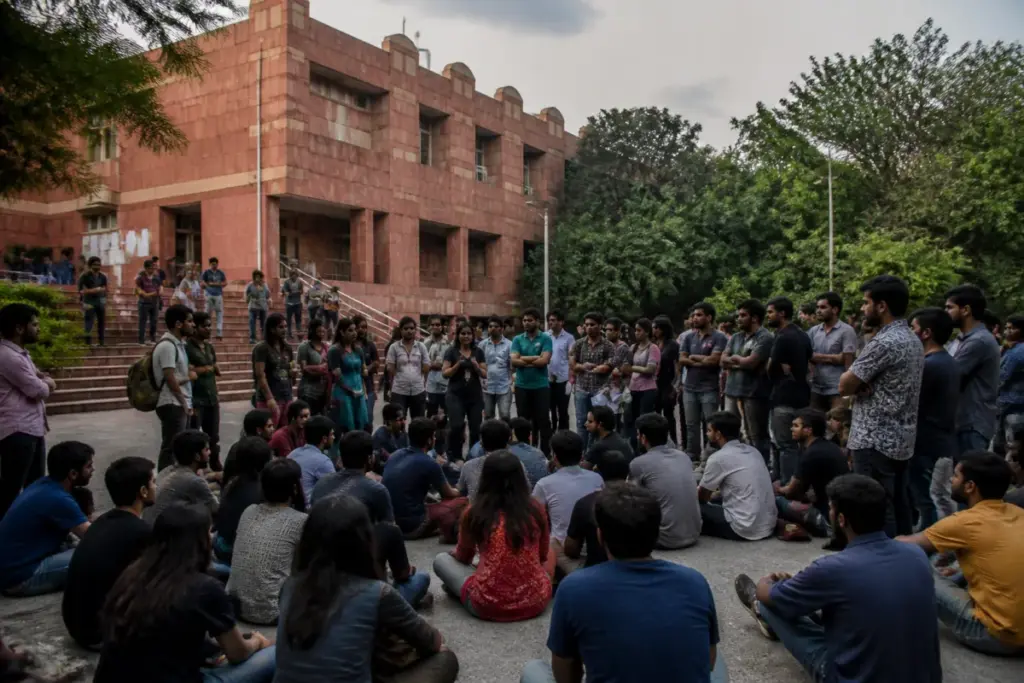
Jawaharlal Nehru University has agreed to revoke the rustication of Jawaharlal Nehru University Students’ Union office-bearers and a former union president after students ended a 17-day indefinite hunger strike over democratic rights, hostel facilities and equitable access to education, according to a statement issued by the union on Tuesday.
The administration has also agreed to withdraw police cases and proctorial enquiries linked to student protests, marking a significant development in the prolonged standoff between student representatives and university authorities. The commitments followed demands raised after a University General Body Meeting on October 1.
The agreement covers disciplinary procedures, admissions, reservations and the functioning of campus offices. The administration has agreed to form committees to review the Chief Proctor’s Office manual, examine the restoration of the Jawaharlal Nehru University Entrance Examination and address concerns related to reservation in hostel allotments.
The university has also committed to providing the Equal Opportunity Office audit report within a week and reorganising the office in consultation with student representatives. These measures are intended to address concerns over equitable access and the institutional mechanisms available to students seeking support.
Several commitments relate directly to campus infrastructure and everyday services. Structural audits have been promised for Tapti and Mahi-Mandavi hostels and the TEFLAS facility. The administration has also said that geysers in all hostels will be made functional within two weeks. The Centre for the Study of Law and Governance canteen is to be reopened, while school library timings are to be extended until 9 pm.
Financial support for students is also part of the discussions. A 25 per cent increase in the Merit-cum-Means scholarship is under consideration, although the report does not state that the increase has been finally approved.
The commitments emerged after the hunger strike, which was launched in response to concerns that included punitive action against elected student representatives, hostel infrastructure and admission procedures. The episode has linked questions of campus democracy with the operation of essential university facilities, including accommodation, food services, libraries and student support offices.
The JNUSU will monitor the implementation of the commitments, with a follow-up meeting scheduled in two weeks. The next meeting is expected to provide an early assessment of whether the promised disciplinary, administrative and infrastructure measures have been initiated.


