

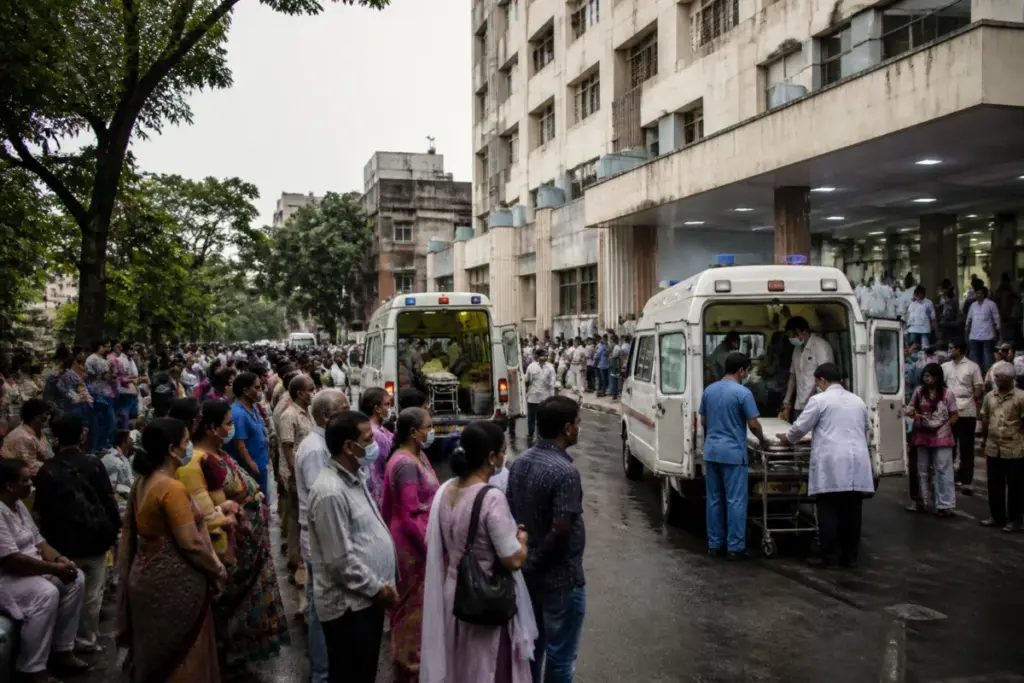
The Chorebagan stampede in Kolkata has exposed a difficult question for West Bengal’s public-health system: can government hospitals absorb a sudden surge of critically injured patients during a mass-casualty event? After 19 people died in the incident, 14 injured patients were reportedly moved from Kolkata Medical College to a private hospital near the Eastern Metropolitan Bypass. The state government has defended the decision as an effort to prevent further deaths, while doctors’ organisations have asked for a clear policy on when and how such transfers should be made.
The incident took place at the Chorebagan Sarbojanin puja mandap on 17 October, when a crowd surge caused deaths and injuries. Many of the injured were initially taken to Kolkata Medical College. According to the report, 14 patients were later shifted to a private hospital and two others were sent to SSKM Hospital. The transfers prompted questions from sections of the medical community because patients from a government hospital were moved to private facilities during a major emergency.
The chief minister, speaking after visiting the control room at Swasthya Bhavan on Tuesday, said the government’s immediate priority had been to prevent additional fatalities. He said the private hospital was chosen because it could provide better facilities than those available at Kolkata Medical College for the injured patients. The chief minister also said that no further deaths occurred after treatment began and described the decision as a rapid response rather than an administrative failure.
That explanation places the Chorebagan episode within a wider admission about the limits of the state’s public hospitals. The chief minister said that government hospitals in West Bengal still lacked several facilities and that bringing their services up to the level of private hospitals would take two years. He specifically cited the absence of allergy testing in the state and said patients had to be sent to Mumbai for the test. The report does not provide a list of hospitals affected, the number of missing facilities or a financial plan for the proposed two-year improvement programme.
This distinction matters because emergency capacity is not limited to the number of beds in a hospital. It also depends on the availability of specialist departments, diagnostic services, trained staff, medicines, monitoring equipment and the ability to coordinate care when several patients arrive simultaneously. The Chorebagan transfers indicate that the state’s response system was able to move patients to facilities it considered better equipped. They also raise the question of whether that capacity exists within the public system itself when a large number of patients require treatment at the same time.
## A referral decision with no publicly described framework
The Association of Health Service Doctors’ secretary, Utpal Bandyopadhyay, said the scale of the Chorebagan deaths was unprecedented and that transferring injured patients from a government hospital to a private hospital was also unusual. He referred to two different accounts of how the transfers were arranged. One explanation, he said, was that families had been offered a choice of where the patients should be treated. Another complaint received from junior doctors said they had sent patients to a private hospital near the Bypass on the instructions of their units and department heads.
The differing accounts point to an administrative gap. The report does not mention a written emergency referral protocol that defined which patients would remain at Kolkata Medical College, which would be transferred and who would authorise the decision. Bandyopadhyay said the state should issue guidelines identifying the patients who could be treated in government hospitals and those who would need to be moved elsewhere. Without such instructions, he warned, similar situations could create confusion in the future.
A protocol would not merely be a medical document. It would also clarify responsibility between the hospital administration, treating doctors, government officials, private hospitals and patients’ families. It could establish how clinical urgency is assessed, how ambulances and beds are coordinated, how treatment costs are handled and how information is communicated to relatives. None of these operational details is set out in the supplied report, but the absence of a publicly cited framework became central to the criticism following the transfers.
The question is especially important in a city such as Kolkata, where public hospitals are major points of access for patients from across the metropolitan region and beyond. A mass-casualty incident does not test only the hospital closest to the site. It tests the ability of the entire urban health network to distribute patients, share information and maintain treatment continuity. In the Chorebagan case, the movement of patients between Kolkata Medical College, a private hospital and SSKM Hospital shows that multiple institutions became part of the emergency response. The report does not establish whether this was a pre-planned network response or an improvised decision made during the crisis.
## The public system’s capacity problem
The chief minister’s comments make infrastructure the central issue. He acknowledged that government hospitals could not currently provide services equal to private hospitals in all areas and estimated that two years would be needed to improve them. His reference to allergy testing suggests that the gap is not confined to trauma care or emergency medicine. It may also involve diagnostic services that are routine in some settings but unavailable locally, forcing patients to travel outside the state.
However, the supplied evidence does not establish the scale of the problem. There are no figures on the number of government hospitals without particular diagnostic facilities, no data on emergency-bed capacity, no details of equipment shortages and no account of staffing levels during the puja period. Nor does it identify the proposed funding source, procurement process or administrative agency responsible for completing the improvements within two years. The commitment is therefore significant as an official acknowledgement, but its implementation framework remains unspecified.
The response from doctors and health-sector groups reflects this concern. Debashis Haldar, described in the report as one of the figures associated with the RG Kar movement, said government hospitals had long suffered from infrastructure shortages. He also alleged that the supply of essential medicines had declined after the change in government and that even common medicines were now unavailable. Those claims are attributed to Haldar and are not independently established in the report.
The Medical Service Centre’s secretary, Biplab Chandra, said promises had been made by earlier governments as well and that the current administration should demonstrate improvements that benefit all residents. His comment underlines the difference between acknowledging a capacity deficit and fixing it. Public hospitals require more than announcements: they need reliable medicine supplies, functioning equipment, trained personnel, maintenance systems and an operating model for sudden demand surges. The report provides no evidence that a detailed plan covering these areas has yet been published.
## Emergency care beyond the hospital gate
The Chorebagan incident also shows how public safety and hospital capacity are connected. The event occurred at a crowded puja venue, and the state subsequently activated medical teams at major puja sites. The chief minister said many doctors and health workers had cancelled their festival leave to assist with the response. This indicates that the government treated the incident as requiring a wider deployment of health personnel beyond the hospital system.
Yet the report does not describe the number, location or equipment of these medical teams, nor does it explain how they were linked to ambulance services and receiving hospitals. Those connections determine whether first aid at a crowded venue can be converted into timely hospital treatment. A medical team at a festival site may stabilise patients, but the outcome also depends on transport time, bed availability, diagnostic support and clear communication with the receiving facility.
The decision to use a private hospital also raises a public-administration question without, by itself, proving that the decision was wrong. In a mass-casualty situation, authorities may choose the facility that can provide the fastest or most comprehensive treatment. But when public hospitals are unable to absorb patients, the state must explain the terms of that arrangement and ensure that access does not depend on a family’s ability to pay. The supplied report does not state who bore the treatment costs for the transferred patients or whether a government-private hospital agreement was activated.
Several patients had reportedly been discharged by the time of the chief minister’s statement, and doctors’ organisations said they hoped the patients had not suffered serious consequences. The report does not provide a final medical account of the injured, their treatment outcomes or the clinical reasons for each transfer. That information would be necessary to assess whether the referral decisions matched the severity of the injuries and whether government hospitals could have treated some patients safely.
The Chorebagan episode therefore leaves two separate questions. The first is immediate: whether transferring injured patients helped prevent further deaths after the stampede. The chief minister says it did, and no additional death was reported after treatment began. The second is institutional: whether West Bengal’s public hospitals can manage a similar surge without relying on private capacity, and whether a transparent protocol governs such decisions. The first question concerns the outcome of one emergency. The second concerns the resilience of Kolkata’s urban health system.
The government has said that improving public-hospital services will take two years and that work has begun on the deficiencies identified by the chief minister. Doctors’ organisations have called for written referral guidelines, while health-sector groups have demanded measurable improvements rather than assurances. The next significant test will be whether the state publishes a capacity-building plan, clarifies the emergency referral process and provides an account of how public and private hospitals are expected to work together during future mass-casualty events.


