

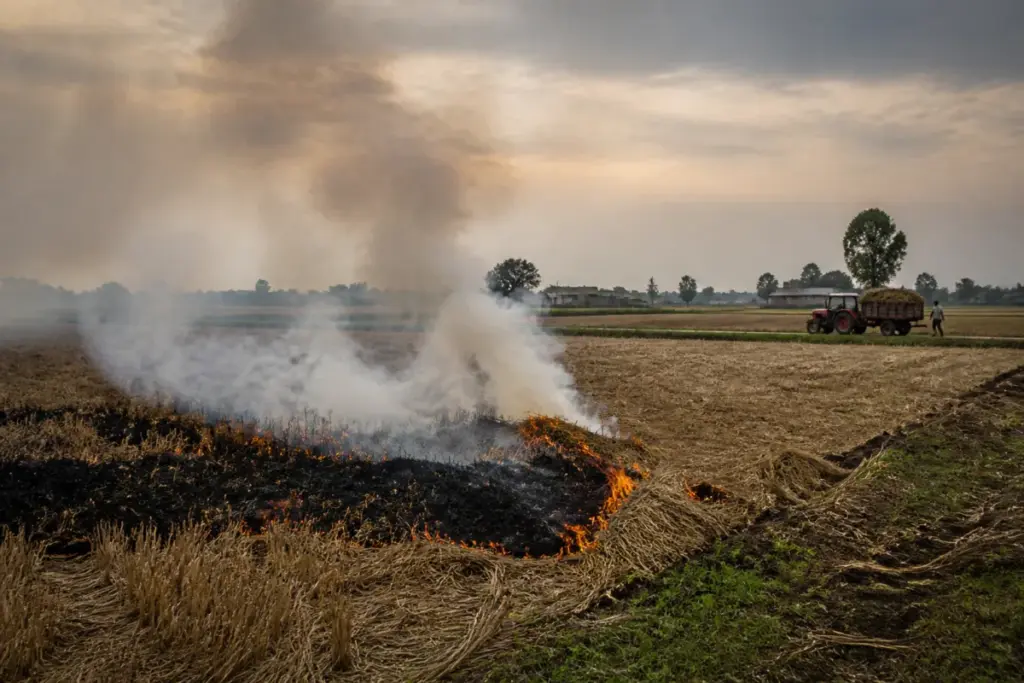
Punjab’s rise to 404 reported stubble-burning cases, ahead of Madhya Pradesh’s 388, is more than a change in the seasonal ranking of farm fires. It shows how a recurring rural practice becomes a regional urban-governance problem when enforcement expands without eliminating the conditions that produce the fires. The latest figures also reveal a concentrated geography of non-compliance: Tarn Taran and Amritsar together account for 315 cases, while penalties, FIRs, land-record entries and notices are being deployed across the state.
The figures reported until October 20 cover seven states and total 1,265 crop-residue-burning cases. Punjab accounts for 404 of them, followed by Madhya Pradesh with 388, Rajasthan with 215, Uttar Pradesh with 187, Uttarakhand with 61, Haryana with nine and Delhi with one. On Tuesday alone, the five states reporting fresh cases recorded 94 farm fires: Punjab reported 36, Madhya Pradesh and Rajasthan 18 each, Uttar Pradesh 12 and Uttarakhand 10.
That distribution matters because the problem is not evenly spread across the agricultural belt. Punjab has reported farm fires in 18 of the 123 districts identified by the Consortium for Research on Agroecosystem Monitoring and Modelling from Space. Within Punjab, Tarn Taran has recorded 198 cases and Amritsar 117. The two border districts together represent nearly four-fifths of Punjab’s reported cases in the figures supplied, making them the immediate focus of enforcement and administrative attention.
The concentration also complicates the idea that a state-wide prohibition or general warning can produce uniform results. When a relatively small number of districts account for a large share of reported incidents, the effectiveness of the response depends on local monitoring, the conduct of field officers, the availability of alternatives and the speed with which violations are recorded and acted upon. The figures do not establish why individual farmers chose to burn residue, but they clearly show where the administrative response is being tested most intensely.
The Commission for Air Quality Management in the National Capital Region and adjoining areas has sent a high-level team to parts of Punjab and issued directions for all-out efforts to eliminate farm-fire cases. Its intervention places the Punjab figures within a wider air-quality governance system rather than treating them as an isolated state enforcement matter. The seven-state count, which includes Delhi and several states outside the immediate Punjab-Madhya Pradesh comparison, also indicates the scale of coordination required when seasonal emissions cross administrative boundaries.
Yet the current response is heavily measured through action taken after a fire is detected. Punjab has registered 27 FIRs under Section 223 of the Bharatiya Nyaya Sanhita for disobedience to an order duly promulgated by a public servant. Tarn Taran accounts for 15 of these FIRs, Amritsar and Jalandhar for three each, Gurdaspur for two, and Fazilka, Ferozepur, Sangrur and Patiala for one each.
Environmental compensation has been imposed in 126 cases, with the total assessment at Rs 6.40 lakh and Rs 2.60 lakh realised so far. The difference between the amount imposed and the amount collected is an important administrative detail: penalties can be announced quickly, but recovery is a separate stage. The supplied figures do not explain the status of the remaining amount, the average penalty per case or whether the compensation has changed behaviour in the highest-incidence districts.
Land-record action has also been used. Red entries have been made in 100 cases: 70 in Tarn Taran, 19 in Amritsar, six in Ferozepur, four in Jalandhar and one in Sangrur. Warning or show-cause notices have been issued to 152 nodal and supervisory officers. Together, these measures extend accountability beyond the person or land parcel associated with a fire. They also create a parallel administrative question: whether enforcement is being judged by the number of notices, FIRs and entries issued, or by a measurable reduction in fires over time.
The available numbers show that enforcement has intensified alongside the increase in reported cases. They do not, however, establish a causal relationship between the two trends. A higher count can indicate more burning, more effective detection, or both. The report does not provide a comparison of detection coverage, satellite-monitoring methods, the number of inspections conducted or the proportion of detected incidents that resulted in action. Without those details, the case figures are a reliable record of reported incidents but not a complete measure of the underlying scale of residue burning.
This distinction is central to evaluating policy. A state may record more cases because its monitoring has improved, while another may show fewer because fewer incidents were detected or entered into the system. The supplied material does not provide evidence to rank the states on enforcement quality. It does show that Punjab has moved ahead of Madhya Pradesh in the reported count and that the difference is 16 cases as of October 20.
The district data provide a stronger basis for understanding the immediate administrative challenge. Tarn Taran’s 198 cases are more than half of Punjab’s state total, while Amritsar’s 117 cases make it the second major hotspot. The remaining 89 cases are distributed across the rest of the state. This concentration suggests that statewide totals alone can conceal sharply different local conditions. A state may appear to be facing a broad seasonal crisis, while the operational burden is concentrated among particular district administrations, field officers and farming communities.
The response architecture described in the report includes several layers: detection by a research consortium, directions from the CAQM, FIRs under a legal provision, environmental compensation, land-record entries and notices to supervisory officials. These mechanisms operate at different points in the chain. Detection identifies an incident; police action creates a legal record; compensation creates a financial consequence; land-record entries create an administrative consequence; and notices assign responsibility within the bureaucracy.
What is not established in the supplied evidence is how these layers interact. There is no information on the time between detection and action, the number of cases successfully prosecuted, the recovery rate of compensation beyond the amount realised, or the response of officers who received notices. There is also no detailed account of whether farmers were offered or used non-burning residue-management options. Those omissions do not invalidate the enforcement figures, but they limit what can be concluded about the performance of the overall policy.
The urban relevance lies in this gap between where the fire is lit and where its governance consequences are felt. The reported cases are concentrated in agricultural districts, but the CAQM’s involvement places them within a regional air-quality framework that includes the National Capital Region. This makes farm-fire management a coordination problem involving rural land use, state administration, policing, environmental compensation and regional air-quality oversight.
The numbers also show why seasonal action cannot be assessed through a single headline comparison. Punjab’s 404 cases exceed Madhya Pradesh’s 388, but Rajasthan, Uttar Pradesh and Uttarakhand together contribute another 463 cases. The combined total of 1,265 across seven states is therefore the more relevant regional indicator for coordination, even as Punjab’s district-level concentration determines where immediate intervention is most visible.
For policymakers, the evidence raises a precise question: is the objective to maximise detected violations and penalties, or to reduce the number of fires before they occur? The reported enforcement measures demonstrate that the first objective is active. The supplied material does not yet show whether the second is being achieved. That distinction should guide how subsequent official updates are read, particularly in Tarn Taran and Amritsar, where the largest concentration of cases has been recorded.
The current data confirm three things. Punjab has recorded the highest reported total among the seven states listed, its cases are heavily concentrated in two border districts, and the state has expanded punitive and supervisory action. They do not establish the causes of the district variation, the effectiveness of each penalty, or the extent to which improved detection has influenced the numbers. The next meaningful measure will be whether the reported case count declines as the season progresses and whether official updates provide clearer evidence on recovery, prosecution, field accountability and prevention.


