

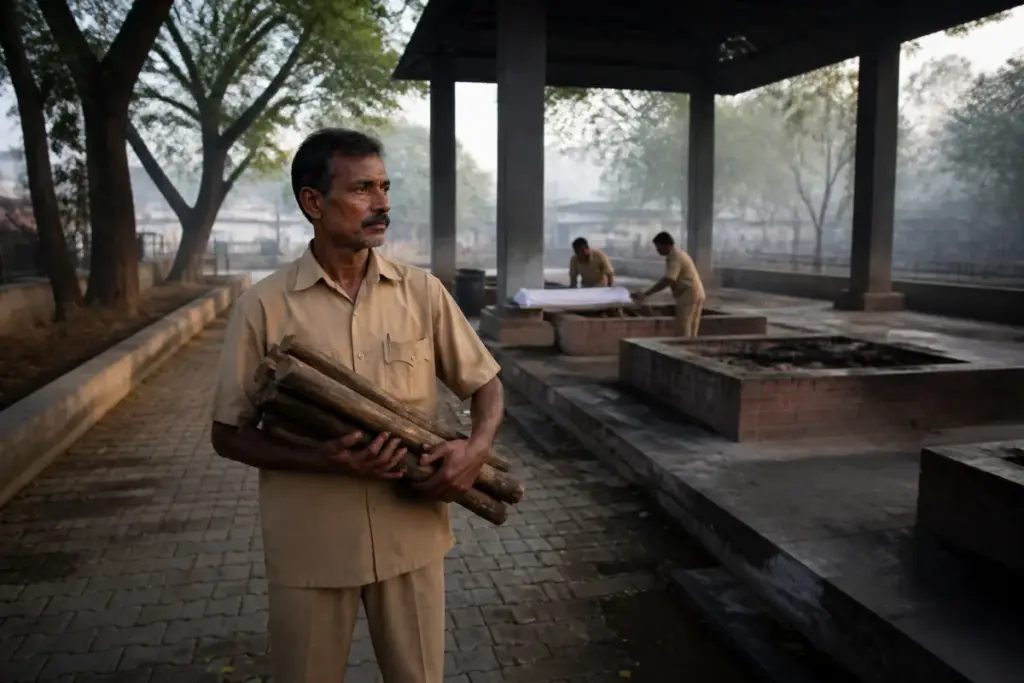
For more than two decades, S Kanthavelan has performed the last rites of people who died without anyone to claim them in Coimbatore. His work, involving police clearances, hospital procedures, cremation grounds and burial labour, offers a rare view of the civic responsibilities that begin where family support and social visibility end.
Kanthavelan, who heads the Singanallur-based Aathma Charitable Trust, says he has performed the last rites of more than 1,800 people over 25 years. They included victims of road and train accidents, destitute patients, elderly people abandoned by their families, people who died of HIV-related illnesses and infants who were left without anyone to care for them.
He also performed the last rites of 375 people during the Covid-19 pandemic. The number illustrates the scale of a service that is often invisible in ordinary accounts of urban infrastructure. A city’s public systems are usually measured through roads, water supply, transport and waste collection. The management of death, particularly when no relative comes forward, is another essential civic function, but one that rarely enters public discussion.
Kanthavelan’s involvement began in 2001, when he was working on temple renovation near Aravaan Medu along the Singanallur–Vellalore Road. Homeless people often slept in the area. After an elderly man died nearby, police took the body to Coimbatore Medical College Hospital. Nobody came forward to claim it even after two days. With the help of friends, Kanthavelan took the body to the Singanallur cremation ground, performed the last rites and buried him.
That episode became the starting point for Aathma Charitable Trust, which was established the following year. Kanthavelan says his mother helped fund the trust by selling a property. His own early life had been shaped by economic hardship: his father died when he was five, and his mother raised four children while working as a school sweeper. Kanthavelan dropped out after Class 10 and later established a fabrication unit, using its earnings to support free burials.
The story of an unclaimed body is not limited to the moment of death. It moves through a chain of administrative and physical tasks. Kanthavelan and his friends Ramesh, Manikandan and Nandagopal began handling post-mortem clearances, bathing bodies, arranging transport, digging graves and conducting the final rites. Each step requires coordination between the police, hospitals, cremation or burial grounds and the people willing to do the work.
That chain also has a financial dimension. Kanthavelan says burial costs rose from Rs 1,300 to Rs 2,500. By undertaking more of the physical work themselves, the group saved around Rs 1,000 per burial. He also refuses the state government’s Rs 1,000 burial assistance, according to the report. His decision means the trust continues to depend substantially on its own labour and resources rather than treating the assistance as the basis of its operations.
The figures reveal how death in a city is connected to mobility, migration and access to institutions. Kanthavelan says many people whose bodies go unclaimed had come to Coimbatore for work or medical treatment and died alone. This includes people who may have no immediate family in the city, as well as those whose families cannot be traced or are unable to intervene quickly.
In this sense, the unclaimed body is also a record of urban disconnection. People move to cities for livelihoods and treatment, but the systems that receive them do not necessarily preserve their social links. When a person dies without an available relative, the city still has to establish identity where possible, complete legal and medical procedures, provide a place for the body and ensure that the final rites are conducted. The responsibility does not disappear because the person has no visible claimant.
Kanthavelan says there have been days when the police called the trust several times. In 2008, the group buried 22 bodies in one day. The figure suggests that the need is not occasional, even if it remains largely absent from public debate. It also shows why such work cannot be understood simply as private charity. The trust is filling a practical gap at the point where formal procedures require hands, time and local capacity.
The same pattern extends beyond burials. Kanthavelan now manages three municipal cremation grounds and has sheltered 350 destitute elders. These activities connect end-of-life services with the wider problem of people who are abandoned, homeless or cut off from family support. The cremation ground becomes not only a final destination but also part of a broader network involving hospitals, police stations, civic authorities, charitable organisations and informal caregivers.
Yet the account does not establish the total number of unclaimed bodies handled by Coimbatore’s public institutions, the time taken for identification, or the division of responsibility between government agencies and charitable groups. Those details matter because the experience of one trust, however extensive, cannot by itself describe the entire city system. What it does provide is a ground-level account of the work that becomes necessary when formal systems cannot immediately connect a dead person to a family.
The institutional process is also shaped by the condition in which a body is found. Accident victims, abandoned patients, elderly people and infants may require different forms of identification, documentation and medical clearance. The report records that Kanthavelan’s group handles post-mortem clearances and the practical preparation of bodies, but it does not specify a single uniform procedure for every case. That absence is a reminder that the civic response is likely to involve multiple authorities and circumstances rather than one standard service.
The pandemic made this hidden responsibility more visible in many cities, as hospitals and cremation grounds faced extraordinary pressure. In Coimbatore, Kanthavelan says he conducted the last rites of 375 people during Covid-19. The figure places voluntary labour within a period when public health emergencies required rapid handling of bodies, while families and institutions faced restrictions, fear and logistical difficulties. It also demonstrates how essential services can rely on individuals whose work is rarely recognised as infrastructure.
There is a social cost to this invisibility. Kanthavelan was initially mocked by relatives who called him ‘Vettiyan’, or gravedigger. He says he now wears the name with pride and describes the work as his calling. The stigma attached to burial work can make it harder for cities to recruit, retain and publicly acknowledge people who perform it. When a service is treated as socially inferior, its workers may remain outside the formal recognition given to other civic occupations even when the service is indispensable.
Kanthavelan’s decision to take his 18-year-old daughter with him during last rites introduces another dimension: the transmission of civic responsibility across generations. He says he wants to instil the compassion that drives his work. That personal choice does not resolve the institutional questions surrounding unclaimed deaths, but it shows how the city’s most difficult tasks are often sustained through values and relationships rather than through visible public programmes alone.
Coimbatore’s experience, as reflected in Kanthavelan’s work, raises a basic question about how urban administration defines care. A city does not only provide services to residents who can pay, complain or produce documents. It also has to respond to people who are homeless, sick, abandoned, unidentified or dead without relatives present. The procedures may be administrative, but the outcome is deeply connected to dignity.
The evidence in this account confirms the scale of one organisation’s contribution: more than 1,800 last rites over 25 years, 35 people who died of HIV-related illnesses, more than 90 abandoned infants, 375 Covid-19 deaths and 350 destitute elders sheltered. It does not establish whether existing municipal and state arrangements are sufficient, or how consistently similar services operate across the city. Those are the questions that deserve closer institutional documentation.
For now, Kanthavelan’s work makes visible a civic duty that usually remains at the edges of urban reporting. The city’s responsibility does not end at hospitals, police records or cremation grounds. It extends to ensuring that people who have become socially invisible are not denied a final measure of care.


