

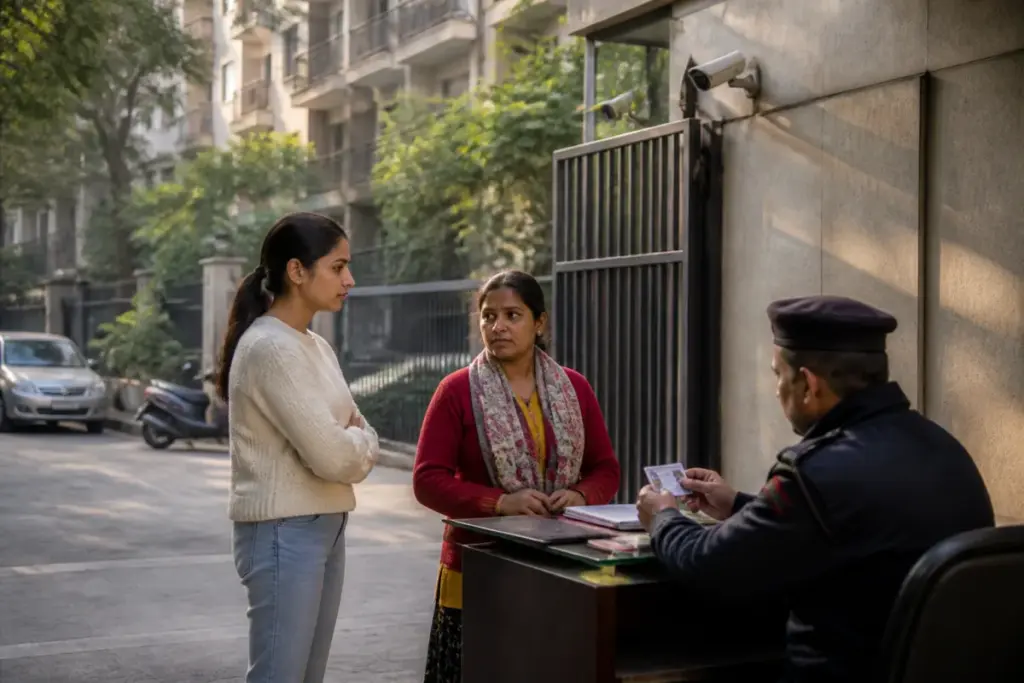
Delhi’s household theft cases involving domestic workers point to a security problem that begins before a crime is committed: the absence of reliable systems for verifying people hired to enter private homes. Police recorded 208 arrests in 173 employee-related theft cases over 18 months, according to a report by the Times of India, while officers continue to urge employers to check antecedents and maintain basic identity and contact records.
The figures do not establish that domestic workers as a group are responsible for rising crime. They show that, in a number of investigated cases, employees allegedly used or shared their access to household routines, valuables and security arrangements. That distinction is important in a sector where millions of urban households depend on informal hiring networks and where a police advisory can be easier to issue than a practical, trusted verification system is to implement.
The cases described by Delhi Police show how access becomes a security vulnerability. Employees may know when residents leave for work, where cash or jewellery is kept, how gates and locks operate, and which parts of a home have limited surveillance. In some cases cited in the report, investigators alleged that workers acted alone. In others, police said employees were linked to organised gangs that used household access to plan thefts or facilitate entry.
That alleged role does not make employment itself the risk. The deeper issue is that domestic work is frequently arranged through personal recommendations, local contacts or private agencies without a consistent process for checking identity, previous addresses and family contacts. When documents are forged or supplied without verification, an employer may have no dependable way to establish who has entered the household or where that person can be traced.
The scale reported by the police is substantial enough to demand attention. Till August this year, police recorded 62 cases and 69 arrests linked to employee-related thefts. In 2025, they recorded 111 cases and 139 arrests. Together, these figures amount to 173 cases and 208 arrests across the 18-month period cited by the report. Arrest figures are not the same as convictions, and the report does not establish how many complaints, prosecutions or convictions arose from these cases. They nevertheless indicate the operational burden created when household hiring systems fail and alleged offences have to be investigated after the fact.
The incidents also demonstrate that the exposure is not limited to a particular type of residence. In one case, a businessman’s employee allegedly staged a robbery involving Rs 36 lakh near Zakhira flyover. In another, a domestic worker allegedly stole from a home in Bharat Nagar while the employer was abroad. The report also describes a June theft at a Karol Bagh mobile phone shop, where police alleged that a trusted employee masterminded a heist involving valuables worth nearly Rs 1 crore. Police said the accused used a duplicate key, while presenting himself as an innocent employee and witness the next morning.
A separate case at a bungalow in Golf Links illustrates the consequences of inadequate checks even more starkly. Police said a domestic worker hired barely a week earlier, using a fake identity and without verification, allegedly opened the main gate for an armed gang. The family was held hostage for nearly 15 minutes and valuables worth Rs 25-30 lakh were allegedly taken. The account, as reported, remains based on the police investigation and allegations against the accused; it should not be treated as a finding of guilt before due process.
These cases reveal three weaknesses in the urban household security chain. The first is fragmented recruitment. Unlike formal workplaces, homes generally do not have a standard human-resources process. A worker may be introduced by an existing employee, neighbour, driver, security guard or informal intermediary. The arrangement can be made quickly because households need care, cleaning, cooking or security services, but the information collected may be limited to a name and phone number.
The second weakness is documentary uncertainty. A senior police officer told the Times of India that lack of verification makes it difficult to establish employees’ criminal backgrounds or determine whether submitted documents are genuine. This is not simply a question of whether an Aadhaar card or address is produced. A document can identify a person without independently confirming the person’s current residence, employment history or connection to the references supplied.
The third weakness is the absence of a clear accountability mechanism. If a worker is hired through an informal referral and disappears after an alleged offence, the household may have little usable information beyond a mobile number or an incomplete address. Police have therefore advised employers to maintain family contacts, Aadhaar cards, home addresses and bank details. Officers said such records can help trace workers. The report does not indicate that Delhi has a single mandatory, citywide system through which every household can complete and verify these checks.
That institutional gap matters because the domestic work relationship occupies an unusual space between employment and private life. The workplace is a home, the employer is usually an individual family, and the worker may have access to spaces that even building security staff cannot enter. Formal security at the gate, CCTV cameras or locked doors cannot fully address a risk created by trusted access and knowledge of household routines.
At the same time, verification policies can create new risks if they are implemented without safeguards. Domestic workers are often part of an informal labour market, and poorly designed checks could exclude people who lack standard paperwork or push employers towards discriminatory screening. The supplied report does not provide data on workers’ backgrounds, the scale of informal domestic employment in Delhi, or the effect of police verification drives. It therefore cannot support conclusions that link crime to any particular community, migration status or class of workers.
The evidence instead supports a narrower conclusion: police investigations repeatedly identify failures in the information available at the point of hiring, while organised groups allegedly exploit those failures. The police response has focused on prevention through antecedent verification and record-keeping. That response addresses traceability, but the report does not describe how employers should authenticate documents, how quickly checks are completed, which authority maintains the information, or what process exists when a worker changes residence or employer.
This is where the issue moves beyond private household caution and becomes a question of urban governance. A city’s safety system includes not only police patrols and criminal investigations but also the everyday systems through which residents, workers, buildings and institutions interact. Domestic work is largely managed inside individual homes, yet the consequences of weak documentation can extend to gated communities, neighbourhoods, shops and police stations.
The reported cases also show why arrest numbers alone are an incomplete measure of the problem. They indicate police action, but not the number of attempted thefts, unreported incidents, disputed allegations or cases that did not involve employees. Nor do they reveal whether verification would have prevented each offence. A stronger public understanding would require consistent data on the total number of employee-related complaints, the nature of the alleged offences, the use of forged identities and the outcomes of prosecutions.
For households, the immediate lesson from the police advice is administrative rather than technological: collect and retain verifiable information before granting access, rather than after a theft occurs. For authorities, the unresolved question is how to make that process reliable without turning informal workers into permanent subjects of suspicion. The report establishes the scale of arrests and the recurring role alleged by investigators, but it does not establish whether existing verification practices are being followed consistently or whether they are effective.
Delhi’s household theft cases therefore expose a gap between the private nature of domestic employment and the public responsibilities of urban safety institutions. Police can investigate alleged offences and advise residents to maintain records. Preventing the next case, however, depends on whether identity verification, worker documentation and employer awareness become practical and trustworthy parts of the city’s everyday governance. The next developments to watch are official data on case outcomes, the procedures available to employers for verification, and whether authorities introduce a clearer framework for documenting domestic workers without weakening their rights or access to employment.


