

Bahraich’s development story is increasingly being defined not by a single flagship project but by the steady construction of systems that rural households and enterprises depend on: piped water, roads, transport links, health facilities and livelihood support. The district’s progress over the past nine years shows how basic infrastructure can become the foundation for a broader rural economy, provided the assets deliver reliable services after construction is complete.
As one of Uttar Pradesh’s Aspirational Districts, Bahraich has worked within a framework launched in 2018 that focuses on health and nutrition, education, agriculture and water resources, financial inclusion and skill development, and basic infrastructure. These priorities are closely connected in a predominantly rural district. A water connection affects household health and sanitation; a road affects access to a school, hospital or market; and market access determines whether agricultural production or traditional craft can generate better incomes.
The clearest measure of the infrastructure push is the expansion of household tap-water connections under the Jal Jeevan Mission. According to the Uttar Pradesh Jal Jeevan Mission dashboard cited in the supplied report, Bahraich has a target of 5,54,464 rural household tap connections, of which 5,43,947, or 98.10 per cent, have been provided. The programme covers 1,082 villages.
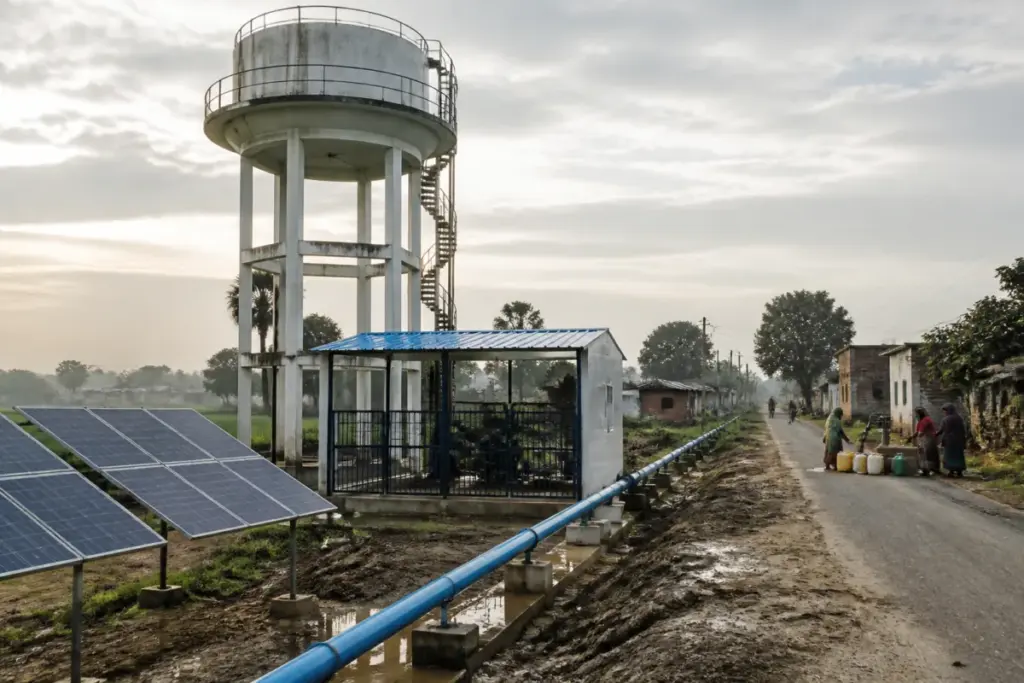
The physical network behind those connections is also substantial. Nearly 9,701 km of pipeline has been laid against a target of 9,848 km. Of 783 targeted tubewells, 780 have been completed, while 771 of 783 pump houses have been completed. Solar plants have been incorporated into the rural water-supply infrastructure, alongside treatment and chlorination systems, overhead tanks, pumping facilities and road restoration.
These details matter because rural water infrastructure is not simply a matter of extending a pipe to a household. It is a network that must draw, treat, pump and distribute water, while also maintaining energy supply and the roads disturbed during construction. The dashboard figures indicate the scale of the build-out, but the long-term test will be whether these systems continue to provide regular and safe water after the construction phase.
Water quality has been a specific part of the district’s infrastructure challenge. Of the 216 villages identified as arsenic-affected in a 2016 assessment, the Jal Jeevan Mission dashboard says all have been covered by piped-water schemes. Work has been completed in 213 villages and remains underway in three. Seven villages identified as affected by Japanese Encephalitis or Acute Encephalitis Syndrome have also been covered by piped-water schemes.
This represents a shift from dependence on scattered local sources towards a networked public water-supply system. It also places greater responsibility on institutions responsible for testing, treatment, chlorination, pumping and maintenance. A connection can reduce the time households spend collecting water and can improve the conditions for sanitation, but those benefits depend on service quality rather than coverage alone.
Road connectivity provides the second part of the district’s development platform. For farmers, artisans, students and workers, the value of infrastructure is measured partly in the time and cost required to reach a market, school, hospital or administrative centre. The report says proposals were made in 2025 for the reconstruction of 668 rural connectivity roads at an estimated cost of ₹999.27 crore under the State Road Fund. Another rural road programme involving ₹6.80 crore was initiated for roads in selected areas.
At the regional level, official district notices include the construction of a Bahraich bypass connecting the Lucknow–Bahraich road with the Bahraich–Gonda road. The bypass is intended to improve traffic movement and strengthen the district’s regional connectivity. Its significance lies not only in reducing movement through the town but also in linking rural production and settlements to wider transport routes.
The Pradhan Mantri Gram Sadak Yojana III framework, cited in the report, emphasises connections between rural habitations and agricultural markets, schools and hospitals. That approach reflects an important change in how rural roads are understood. They are not only physical links between villages; they are part of a service and economic network. A road can reduce the cost of taking produce to a mandi, make a hospital more reachable and allow workers or students to travel more reliably.
However, roads and water systems produce stronger development outcomes when they connect with local economic activity. Bahraich’s economy remains closely linked to agriculture, while its One District One Product identity is centred on wheat-stalk handicrafts. The official ODOP portal describes the district as having a strong agricultural base and traditional rural craftsmanship, with food processing identified as an emerging agro-based activity.
Wheat-stalk craft illustrates the connection between local resources and rural enterprise. The craft uses agricultural residue to make decorative and utility products, giving an existing rural skill a potential market beyond the village where it is produced. The report says recent ODOP activity has included training initiatives for wheat-stalk craft and food processing. The next institutional requirement is to connect these skills with finance, design, packaging, digital commerce and larger markets.
This is where infrastructure policy becomes more than an asset-creation exercise. Water, roads, power or solar systems and market access can support enterprise, but only when programmes are coordinated. A farmer may need irrigation and a road to move produce. An artisan may need training, packaging and digital access. A food-processing unit may need reliable power, transport and a market. The report’s account of Bahraich points towards this convergence, even though it does not provide outcome data on incomes or enterprise growth.
The same logic applies to women’s participation in the rural economy. Initiatives highlighted in the report include bamboo-based markets involving women’s Self-Help Groups, multi-layer farming and agricultural procurement activities. These examples suggest an effort to link physical infrastructure with household-level livelihoods. They also show that rural development is not limited to farming output; it includes the ability of households to diversify their sources of income.
Health and education provide another way to assess whether infrastructure is functioning as intended. Better roads can reduce the difficulty of reaching hospitals and schools, while piped water can improve household hygiene and reduce the burden associated with collecting water. The report also refers to continuing health infrastructure activity, including recruitment of medical officers under National Health Mission programmes in 2026.
The Aspirational District framework gives these interventions a common administrative structure. Its five focus areas encourage districts to treat basic infrastructure, agriculture, water, health, education, skills and financial inclusion as related development priorities. For Bahraich, the practical challenge is to ensure that the departments and programmes responsible for these areas work towards connected outcomes rather than isolated completion figures.
The available numbers show considerable progress in building the water network: 98.10 per cent of the targeted rural household tap connections have been provided, nearly the full targeted pipeline length has been laid, and most targeted tubewells and pump houses have been completed. The road proposals and bypass plans show that connectivity remains an active infrastructure agenda rather than a completed one. The figures do not, however, establish how regularly households receive water, whether all systems are fully operational, or how infrastructure has changed household incomes.
That distinction is important for the next phase. Coverage is a necessary foundation, but service reliability, water quality, maintenance and institutional accountability determine whether infrastructure becomes a durable public service. Similarly, road construction must be assessed not only by kilometres built or reconstructed but by whether travel to markets, hospitals and schools becomes easier and less costly.
Bahraich therefore offers a useful example of a rural development model moving from gap-filling towards economic enablement. The first task has been to address basic deficits in water supply and connectivity. The emerging task is to make those systems support agriculture, food processing, traditional craft, women’s enterprises, health and education.
The evidence supplied confirms the scale of the infrastructure build-out and the breadth of the development framework. It does not yet establish the full economic or service outcomes. The issues that deserve continued monitoring are whether the remaining water works are completed, whether completed schemes provide dependable supplies, how the bypass and rural road programmes progress, and whether ODOP and livelihood initiatives convert improved infrastructure into sustained rural economic opportunity.


