

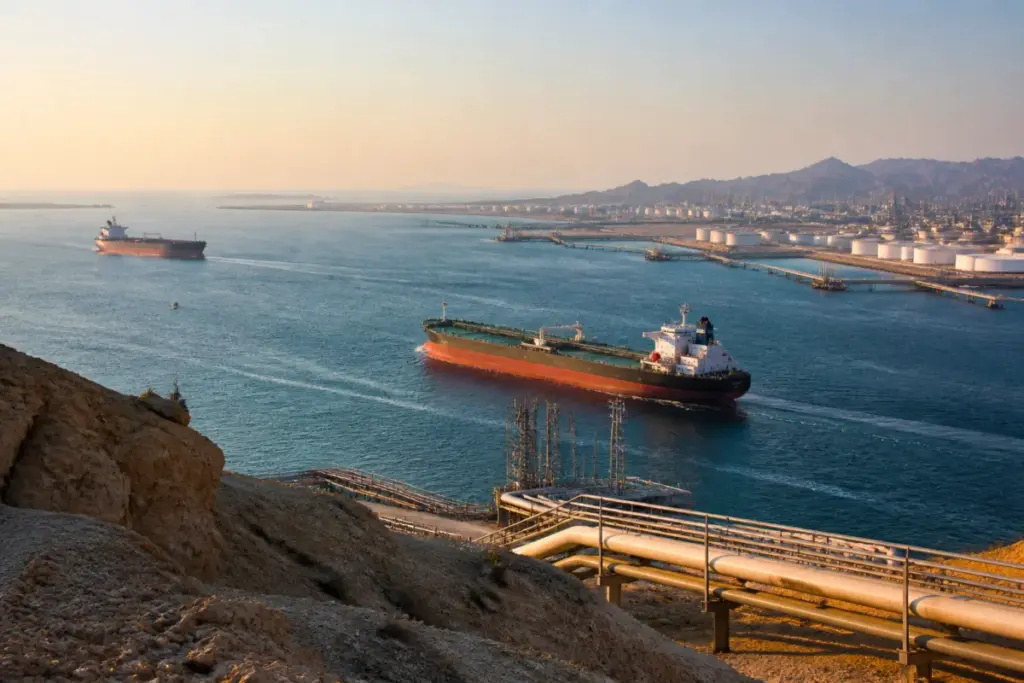
The Strait of Hormuz has long functioned as one of the world’s most important energy gateways, carrying a fifth of global oil and liquefied natural gas trade, according to the report. The conflict in the Middle East has now exposed the vulnerability created by that concentration, pushing Gulf countries to consider whether pipelines, ports and alternative logistics corridors can reduce their dependence on the waterway.
The possible shift is not simply an energy-sector response. It could reshape the geography of infrastructure investment across the Gulf and the wider Middle East, North Africa and Turkey region. If production centres can be connected more directly to ports outside the strait’s route, the region’s energy system would become less dependent on a single maritime passage. That would require large-scale capital, new construction and coordination between energy companies, port authorities, governments, financiers and logistics operators.
The immediate trigger is the conflict and the disruption risks surrounding Hormuz. Georges Elhedery, group chief executive of HSBC, said at the HSBC Future Forum in Dubai that countries in the region could invest in alternative logistics corridors and energy pipelines over the next five years. His assessment was that the region could recover and continue growing, but only with substantial investment.
“Over the next five years, countries in the region could invest in alternative logistics corridors and energy pipelines to loosen their dependence on the strategic waterway and keep oil and gas flowing,” the report said. Elhedery also said that Hormuz could become “redundant” in about five years, although the report presented this as his assessment rather than as an adopted government policy or confirmed project programme.
That distinction matters. The material supplied does not identify a specific new pipeline, port, corridor, construction contract or government approval. It describes a potential direction for regional investment at a time when Gulf states are considering ways to limit disruption and strengthen their ability to move energy supplies through routes other than the strait. The infrastructure response is therefore at the level of investment strategy and project pipeline, not confirmed implementation.
The scale of the region’s existing project pipeline provides the financial and construction context for that discussion. An HSBC report published on Monday, citing data from Dubai-based construction industry market intelligence platform MEED, identified $872 billion in individual project packages across the Middle East, North Africa and Turkey. These packages form part of a wider $1.4 trillion pipeline of infrastructure projects that have been planned but not yet awarded.
The distinction between planned and awarded projects is central to understanding the numbers. A planned project pipeline signals possible future demand for construction, engineering, logistics and finance, but it does not guarantee that every project will proceed. Projects must still secure funding, receive approvals, complete procurement and reach contract award. The infrastructure opportunity is therefore substantial, but the final physical network will depend on which schemes survive those stages.
For the Gulf, the strategic attraction of alternative routes is clear from the structure of the current energy system described in the report. A large share of oil and liquefied natural gas trade passes through Hormuz, making the waterway a critical point for producers and buyers. Pipelines connecting production centres to ports could allow some shipments to bypass the strait, while alternative logistics corridors could provide additional routes for the movement of energy and other goods.
Such a transition would involve more than laying pipelines. It would require port capacity capable of handling redirected shipments, storage facilities, pumping and processing infrastructure, road and rail connections, security systems and reliable power and water services for new industrial sites. The supplied report does not quantify these requirements or name specific corridors. It does, however, place energy infrastructure within a wider regional project pipeline that includes large packages not yet awarded.
The proposed shift also highlights the relationship between infrastructure resilience and urban development. Energy corridors are commonly anchored in or connected to ports, industrial zones and urban centres. New terminals, storage areas and processing facilities can change land-use patterns, create demand for workers and services, and require additional transport links. At the same time, the report does not provide details on the locations, environmental conditions, land requirements or municipal impacts of any future projects. Those questions remain open until specific schemes are identified.
The financial environment is equally important. HSBC’s survey of more than 1,600 business leaders and around 820 global institutional investors found that respondents continued to regard the Gulf as an attractive investment hub despite the conflict. That perception could support the financing of alternative infrastructure, particularly if investors see route diversification as both a security measure and a long-term economic strategy.
However, the investment case exists alongside a weakened regional outlook. The World Bank forecast cited in the report expects the Middle East, North Africa and Pakistan region to contract by 1.3% this year after recording growth of 3.3% in 2025. The forecast anticipates a strong but uneven recovery in 2027. These figures underline the tension facing infrastructure planners: governments may need to invest more in resilience precisely when conflict is weakening economic activity and making implementation more difficult.
The postponement of Saudi Arabia’s flagship investment conference adds another layer to that uncertainty. The event, which Elhedery was expected to attend, was postponed until 2027 after deadly strikes in Riyadh by Yemen’s Iran-backed Houthis, according to the report. The postponement illustrates how regional insecurity can affect not only physical supply routes but also the meetings, financing discussions and investment platforms through which major projects are developed.
For infrastructure institutions, the possible move beyond Hormuz would shift the emphasis from a single maritime chokepoint to a network model. The objective would not necessarily be to replace maritime transport altogether, but to create enough alternative capacity to reduce the consequences of disruption. That means assessing pipelines, ports and logistics corridors as parts of one interdependent system rather than as isolated construction projects.
The evidence currently supports three conclusions. First, the conflict has increased pressure on Gulf countries to reduce their dependence on the Strait of Hormuz. Second, the region already has a large planned infrastructure pipeline that could attract investment, including $872 billion in individual project packages within a wider $1.4 trillion pipeline. Third, the economic and security environment remains unstable, with a projected regional contraction and the postponement of a major investment conference.
What remains uncertain is whether the investment pipeline will translate into awarded contracts and completed infrastructure, which countries will finance and control the alternative routes, and how quickly new pipelines and port connections could be delivered. The next significant developments will be the identification of specific projects, financing commitments, approvals and contract awards. Until then, the possibility of making Hormuz less central remains a strategic direction rather than an established infrastructure outcome.


