

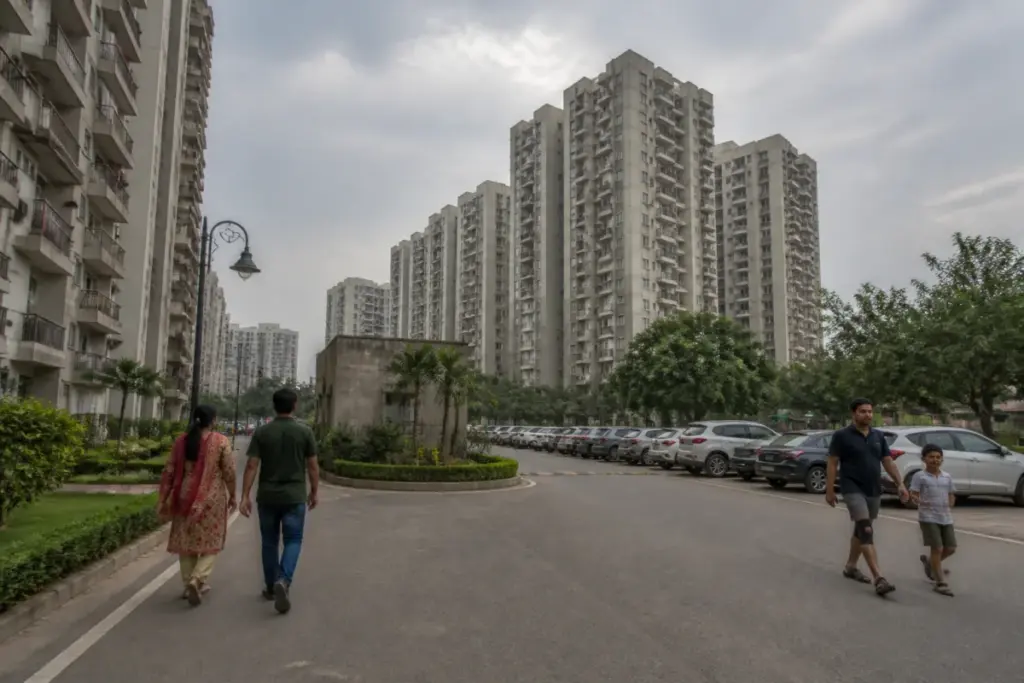
The Punjab and Haryana High Court has preserved an important avenue for Gurgaon Greens buyers seeking interest for delayed possession, but its ruling also sends them back to the regulator to prove that their complaints were filed within a reasonable period. The outcome captures a larger problem in India’s housing market: possession may end a construction delay, but it does not necessarily end the buyer’s struggle for statutory compensation.
Nearly 50 buyers in Emaar’s Gurgaon Greens project in Sector 102 are still pursuing interest claims linked to homes that were delivered after their promised deadlines. According to the Indian Express report, each has spent more than 20% of the claim amount on litigation. Their claims range from Rs 20 lakh to Rs 40 lakh, in addition to the home loans and equated monthly instalments they paid while waiting for possession.
For buyers such as Jyotsna Kumar, the dispute has lasted 14 years. She booked a flat in 2012, with possession promised by 2016, but received the keys only in December 2018. She is still waiting for compensation. Her account illustrates the distance between receiving a home and receiving legal closure: the physical asset may be handed over, while the financial consequences of delay remain unresolved.
The High Court’s ruling is significant because it rejected the idea that possession or execution of a conveyance deed automatically extinguishes a homebuyer’s right to seek interest. Justice Jagmohan Bansal held that handing over possession or executing a conveyance deed does not take away an allottee’s right to file a complaint seeking interest. The court also rejected the developer’s argument that the contract ends entirely when the buyer accepts the home.
That principle matters because possession is often accepted under pressure. A buyer who has waited years for a home may have already paid most of the consideration, serviced a loan and arranged a life around the promised delivery date. Refusing possession could create another set of financial and practical risks. The court’s reasoning recognises that acceptance of the flat is not, by itself, proof that the buyer has voluntarily abandoned a statutory claim arising from delay.
The limitation question, however, has become the next barrier. The court said a complaint seeking interest should be filed within a reasonable period, which would depend on the facts of each case. It identified three years from the date of taking possession as the standard limitation period, excluding the Covid-19 period between March 15, 2020, and February 28, 2022.
Because the High Court was hearing a large batch of appeals, it did not determine the possession and filing dates for every buyer. Instead, it remanded the cases to the Haryana Real Estate Regulatory Authority, or HRERA, to establish whether each complaint was filed within the permissible period. The buyers have been directed to appear before HRERA on October 16, and the cases are to be disposed of within four months.
That remand reveals the institutional structure of the dispute. The High Court settled the legal question in principle, but the regulator must now apply that principle to individual timelines. Each buyer’s case may turn on the date promised in the buyer’s agreement, the date of the offer of possession, the date when possession was actually handed over, the date of the conveyance deed and the date when the complaint was filed.
The case of Poonam Goel shows how those dates interact. Her agreement with Emaar was signed in April 2013, and construction began in June that year. Possession was promised by November 2016. Emaar obtained the occupation certificate in May 2019 and offered possession at that point. The flat was handed over in December 2019, and the conveyance deed was executed by February 2020.
Poonam and her husband filed a complaint before HRERA in September 2022, seeking interest for the delay. In August 2024, the Authority directed Emaar to pay interest at 11% per annum for every month of delay, from the November 2016 due date until the May 2019 offer of possession. The total sale consideration was stated as Rs 96.40 lakh, while the buyer ultimately paid Rs 98.39 lakh.
Emaar challenged the HRERA order in July 2026, but the Haryana Real Estate Appellate Tribunal dismissed the appeal. It held that delivery of possession or execution of a conveyance deed did not extinguish the allottees’ statutory rights. The developer then approached the High Court.
The dispute also demonstrates the gap between the compensation that may be legally due and the amount offered at the time of possession. The report states that, in some cases, buyers calculated statutory interest liabilities of more than Rs 40 lakh, while the developer had paid only Rs 5 lakh to Rs 6 lakh. The High Court observed that a builder could not escape statutory liability unless the buyer had explicitly confirmed in writing that a smaller amount was accepted as full settlement.
This distinction is central to the functioning of the real-estate regulatory framework. A payment made when possession is offered can be described as compensation, but its legal effect depends on whether it was accepted as a final settlement and whether the buyer knowingly waived further rights. The court’s approach prevents the mere act of signing possession-related documents from becoming a blanket release of claims.
At the same time, the limitation rule places a premium on legal awareness. Buyers who do not know that they can claim interest, or who assume that a delayed-possession dispute can be pursued whenever they are financially able to do so, may face an avoidable procedural obstacle. The court has not declared that every claim filed after possession is valid. It has protected the right to claim while requiring the regulator to examine when that right was exercised.
The case therefore exposes two different kinds of delay. The first is construction delay, which affects the buyer’s housing and financial plans. The second is adjudicatory delay, which begins after the buyer approaches the regulator or court. A homebuyer may wait for possession, then wait for compensation, and finally spend years defending the claim through appeals and remand proceedings.
The buyers’ expenditure on litigation is especially important in an affordable or middle-income housing context. Advocate Jagdeep Sheroan, who represented the lead case and is general secretary of the Gurgaon Greens Residents’ Welfare Association, said financial security had influenced the buyers’ ability to continue. He pointed to the need to pursue claims, adjudication and execution proceedings before relief is actually received.
This creates a form of unequal access to statutory protection. The right to claim interest may exist on paper, but exercising it requires documents, legal representation, repeated appearances and the ability to wait. The Indian Express report quotes the buyers as saying that shared experience among affected residents helped them understand their rights and sustain the fight. Collective organisation can reduce some costs, but it cannot remove the underlying time and money demands.
The RERA framework was created to provide a regulatory route for homebuyers, separate from a wholly court-based process. Yet the Gurgaon Greens dispute shows that the regulator’s existence does not automatically make enforcement simple. A case can move from HRERA to the appellate tribunal and then to the High Court, before returning to HRERA for a factual determination on limitation.
That sequence is not merely a legal technicality. It determines when a buyer receives money, whether the buyer can continue paying litigation costs and whether a developer faces an enforceable financial consequence for delayed delivery. The High Court’s direction that HRERA dispose of the remanded cases within four months establishes the next administrative milestone, although the report does not state whether all claims will be resolved within that period.
The decision also leaves important factual questions for the regulator. HRERA must examine the dates for individual complaints and determine whether they fall within the reasonable period identified by the High Court. The exclusion of the Covid-19 period will also affect the calculation for cases involving possession or filing dates during that period.
For Gurgaon Greens buyers, the ruling is therefore both a legal gain and a continuation of the dispute. They no longer face the argument that accepting possession automatically ended their right to seek interest. But they must still prove that their complaints were filed within the applicable period. The next phase will be decided case by case, based on records that include agreements, possession offers, conveyance documents and complaint dates.
The larger urban question is what home ownership means when delivery, payment and legal closure occur at different times. The project’s buyers obtained homes after delay, but many have not obtained compensation for the period during which the promised homes were unavailable. Their experience shows that housing regulation is not only about construction standards or project registration. It is also about whether ordinary buyers can enforce time-bound obligations without spending a substantial share of their claim on litigation.
The High Court has confirmed that possession does not by itself erase a delayed-possession claim. The immediate responsibility now rests with HRERA to apply the limitation standard to each buyer and dispose of the remanded cases within the directed period. The outcome will determine how the Gurgaon Greens buyers’ statutory claims move from a legal principle to an enforceable remedy.


