

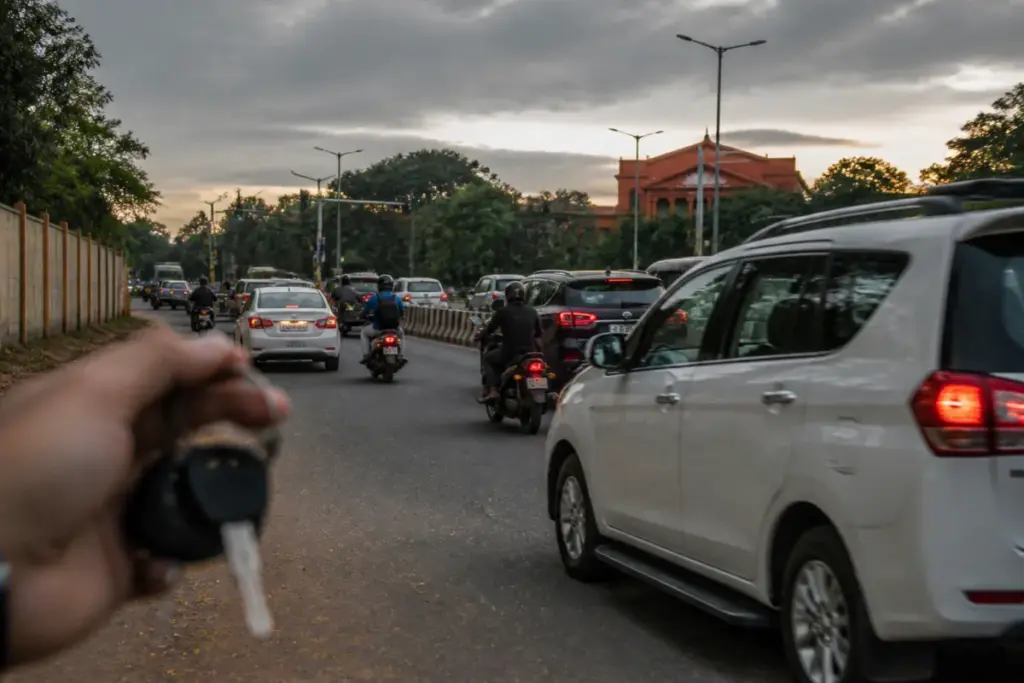
The Karnataka High Court’s decision to allow culpable homicide proceedings against the father of a 14-year-old driver places parental control over private vehicles at the centre of a wider urban road-safety question: when does allowing a minor to drive become more than a private act of negligence? The court’s answer, as reported in the order dated October 16, is that responsibility cannot be avoided simply because the person behind the wheel was a child.
The case arises from a December 2020 crash on the old Bengaluru-Mysuru road in which a couple and their five-year-old son died. The teenager was driving a Volkswagen Vento that had been entrusted to his father by his employer. The father, identified in the report as Nadeem-Ur-Rehman, had challenged the rejection of his discharge plea by a trial court and sought the quashing of proceedings against him under Section 304 Part II of the Indian Penal Code, which concerns culpable homicide not amounting to murder.
The High Court refused to end the proceedings at this stage. Justice M Nagaprasanna observed that “the steering wheel of a motor vehicle cannot become a plaything in the hands of a child, nor can a public road become the playground for such indulgence”. The court’s remarks frame the case not only as a question of the child’s conduct, but also of the adult decision that allegedly enabled the child to access and operate the vehicle.
That distinction is important because the court has not, according to the supplied report, finally determined the father’s guilt. The issue before it was whether the proceedings should be quashed and whether the allegations could support a charge under Section 304 Part II. The court held that the question of whether the father’s conduct amounted to negligence or culpable knowledge should be decided at trial.
The legal dispute therefore turns on the circumstances in which the vehicle was made available. The father contended that his son had taken the vehicle without his knowledge. He argued that the case could, at most, involve an offence based on rashness or negligence and should not be elevated to culpable homicide. The public prosecutor opposed the petition, submitting that the material on record indicated that the father had handed the car keys to his son and permitted him to drive. The prosecution also alleged that this had happened on earlier occasions.
The competing versions show why the court treated the matter as one requiring a trial rather than summary dismissal. If the vehicle was taken without the father’s knowledge, the basis for attributing responsibility would be different from a situation in which the keys were knowingly handed over. The supplied report does not establish which version will ultimately prevail. It does establish that the court found enough material for the proceedings to continue.
The judgment’s wider urban significance lies in the way it treats a car as a controlled source of public risk. A private vehicle may be owned or possessed by an individual, but its operation takes place on a public road shared with pedestrians, cyclists, motorcyclists, passengers and other drivers. The court’s language links the private decision to give a child access to a vehicle with the public character of the road on which the decision has consequences.
This is also an accountability question inside the household. Road safety is often discussed through enforcement against the person physically driving, but the case highlights the role of those who control access to the vehicle. A minor may not have independent control over the car, its keys or the decision to use it. The court’s observation that a parent who knowingly hands car keys to a child cannot “retreat behind the minority of that child when the adventure ends in catastrophe” shifts attention to the adult chain of responsibility alleged by the prosecution.
That does not remove the need to establish facts through the trial. Nor does the order, as described in the supplied report, create a final finding against every parent whose child drives. Its immediate effect is narrower but consequential: where the record indicates that an adult knowingly enabled a minor to drive, the allegation may be examined through a culpable homicide proceeding instead of being dismissed at the preliminary stage.
The case also exposes a gap between the formal status of a vehicle and the everyday way access to cars can be treated. Cars are regulated machines requiring a licence and the ability to operate safely in traffic. Yet within homes and informal settings, keys can be treated as objects of convenience or experimentation. The High Court’s reasoning rejects that casual treatment when a child is involved, particularly where the vehicle is taken onto a public road.
The reported figures cited by Justice Nagaprasanna add a state-level dimension. Karnataka recorded 751 accidents involving minors in 2025-26 and ranked sixth among all states, according to the order as reported by The Times of India. The supplied material does not specify how these accidents were classified, how many involved children driving vehicles, or how many resulted in deaths. Those limits matter: the figure cannot by itself be used to establish a direct causal link between parental permission and all minor-involved crashes.
It does, however, show why the court placed the individual case against a broader road-safety backdrop. The crash occurred in December 2020, while the statistics cited in the order relate to 2025-26. The figures are therefore not a description of the specific incident. They are contextual evidence used by the court to indicate that accidents involving minors remain a wider concern in Karnataka and across India.
The institutional responsibilities visible in the case are divided. The criminal court must determine the facts and assess the applicable offence. The High Court, in the petition before it, examined whether the proceedings could continue. The prosecution presented the material it said supported the allegation that the father had enabled the driving. At the same time, the case illustrates how road safety depends on conduct outside the immediate control of traffic enforcement: who has access to a vehicle, who gives permission and whether earlier instances of minor driving are ignored.
The order also separates two questions that are often merged in public discussion. The first is whether a child was driving and whether the crash caused deaths. The second is whether an adult’s conduct satisfies the legal threshold for culpable homicide. The first set of facts does not automatically answer the second. The court’s refusal to quash the case means that the second question remains open for examination at trial.
For cities and highway corridors, this distinction is significant because road risk is produced through a chain of decisions rather than only at the moment of impact. Vehicle ownership, household supervision, access to keys, licensing rules and enforcement all form part of that chain. The case does not provide evidence on how frequently such decisions lead to crashes, but it makes the responsibility of vehicle owners and custodians visible in a way that a simple account of a minor-driver accident would not.
The Karnataka High Court’s decision therefore matters less as a final verdict than as a statement about where accountability may begin. It confirms that the minority of the person driving does not automatically end scrutiny of the adult who allegedly enabled the act. It also leaves the central factual and legal questions unresolved: whether the father gave his son the keys, whether he knew of earlier driving, and whether the evidence ultimately proves culpable knowledge rather than negligence. Those questions will be determined at trial, where the proceedings the father sought to quash will continue.


