

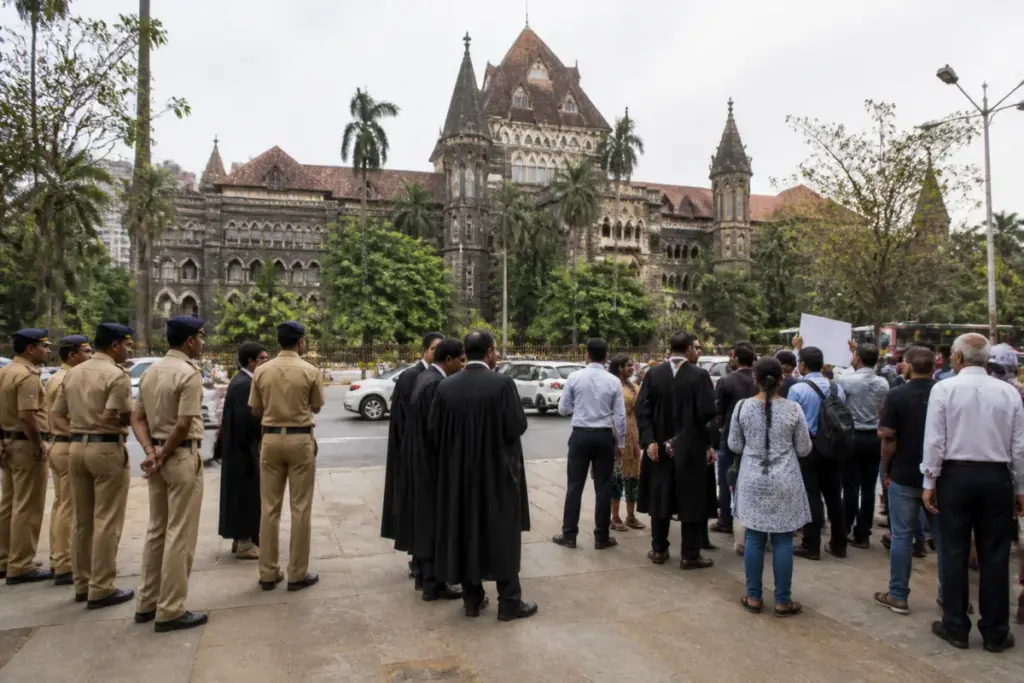
The Bombay High Court’s intervention in a petition alleging illegal detentions during anti-CEC protests in Mumbai has brought a recurring urban conflict into focus: how a city protects the constitutional right to peaceful assembly while managing public access, police discretion and competing claims over public space. The court has sought the Maharashtra government’s response, while the state has maintained that there were no illegal detentions.
The petition relates to protests held in Mumbai on October 10 and 11, 2026. At least seven individuals have filed affidavits alleging that Mumbai Police detained them illegally. Some have said they were picked up from their homes even though they had not participated in the demonstrations. The allegations have not been finally adjudicated, and the court has asked the petitioners and the state government to respond to the complaints.
The case is significant because the dispute is not limited to what happened at a protest venue. It raises questions about how policing operates before, during and after demonstrations, and about the threshold at which preventive action becomes a restriction on personal liberty. It also places the management of public spaces such as Shivaji Park within a constitutional dispute over who can use them, under what conditions and through which authority.
During the hearing, the bench orally observed that peaceful demonstrations are a fundamental right, but said that the antecedents of protesters and inconvenience to the public must be considered before blanket orders restricting police action are attracted. The court also said that people have the right to agitate, provided the agitation remains peaceful, and remarked that criminals should not participate under the guise of innocent civilians.
These observations show the institutional balance the court is being asked to maintain. The petitioners, represented by senior counsel Mihir Desai, have argued that the proceedings are intended to ensure accountability and safeguard constitutionally guaranteed rights. The state, on the other hand, has said that there were no illegal detentions. The court must therefore examine not only the existence of police action, but also its stated basis, duration, location and connection to the protests.
The affidavits before the court make the alleged conduct more specific. Seven individuals have claimed that they were detained, while an application submitted for four others said they were held for an entire day after taking part in a peaceful march. According to the submission made by senior counsel Gayatri Singh for the interveners, those individuals were sent home and then placed under house arrest. The allegations remain part of the proceedings and are awaiting responses from the relevant parties.
The case also includes an intervention by residents of Shivaji Park in central Mumbai, where protests were held. Two lawyers representing residents claimed that a High Court order prohibited demonstrations at the venue. Their applications introduce a second dimension to the dispute: residents’ concerns about the use of a neighbourhood public space and the legal status of restrictions governing it.
That conflict is typical of dense cities, where a single public space may serve several functions at once. A venue used for political assembly can also be surrounded by homes, roads, businesses and public transport routes. A protest can therefore create inconvenience for residents and other users even when it remains peaceful. At the same time, the possibility of inconvenience cannot by itself settle whether restrictions or detentions are lawful. The proceedings place those competing claims before the court rather than treating public order as a question decided only through police action.
The court’s comments also point to the importance of distinguishing between peaceful participation and alleged criminal conduct. The bench referred to protesters’ credentials and antecedents, but the supplied report does not set out the individual records, grounds for detention or evidence relied upon in each case. Those details will be central to assessing whether action was directed at specific, legally supported concerns or applied broadly to people associated with a demonstration.
For Mumbai’s policing system, the dispute concerns the use of discretion. Police authorities must decide whether a proposed or ongoing demonstration presents a threat to public safety, violates an existing order or causes disruption that requires intervention. The petition asks the court to examine the limits of that discretion when the individuals affected deny participating in the protest or allege that they were detained at home.
For the state government, the immediate institutional task is to answer the allegations and explain the basis of the police action. The court has taken the affidavits on record and directed the petitioners and the government to respond to the complaints. The proceedings therefore shift the issue from public statements about the protests to a document-based examination of individual claims, police conduct and applicable orders.
The role of residents is equally important to the case’s urban dimension. Their intervention indicates that disputes over demonstrations are also disputes over access to public land and the responsibilities attached to particular venues. Residents’ concerns cannot automatically displace the right to peaceful assembly, just as the right to assemble does not automatically remove the need to consider the effects on people living around a protest site.
What the material currently establishes is that the High Court is examining allegations of detention, the state denies illegal detention, and different parties are contesting the conditions governing protests at Shivaji Park. What remains unresolved is whether the alleged detentions occurred as described, what legal grounds were recorded for them, whether any house-arrest direction was issued and how the earlier order concerning demonstrations at the venue applies to these events.
The next hearing is scheduled for November 19. The responses filed by the petitioners and the Maharashtra government, along with the applications from Shivaji Park residents and the interveners, will determine how the court assesses the competing claims over protest rights, police powers and public-space management in Mumbai.


