

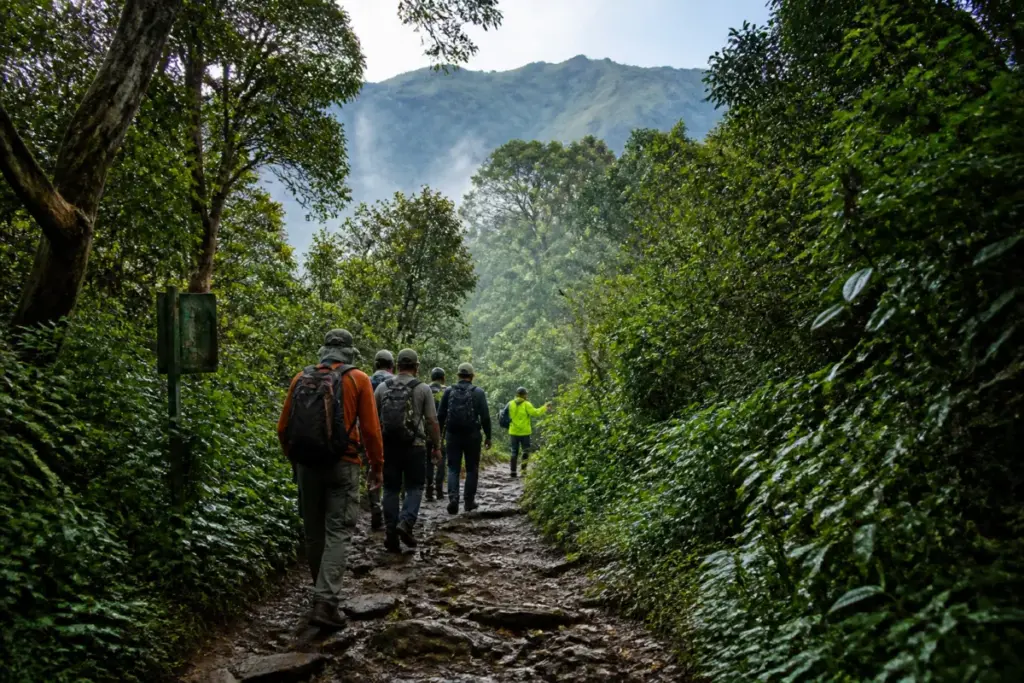
Kumara Parvatha trekking has resumed after several months with online bookings capped at 300 people a day, mandatory guided groups and new tracking and emergency systems on the Beedalli route, forest officials said.
Access is currently permitted only through the Kumaralli-Beedalli route in the Pushpagiri wildlife range. The destination lies at the junction of Kodagu, Hassan and Dakshina Kannada districts. The authorised trek covers seven kilometres from Beedalli to the summit, making the round trip 14 kilometres.
Pushpagiri wildlife range forest officer K Dinesh said permission was granted after a recommendation from local forest officials. The reopening follows a state-wide suspension of trekking after a series of incidents, including a fatal leopard attack at Male Mahadeshwara Hills, a trekker going missing at Tadiandamol and the death of a 15-year-old girl from Kerala in the Chandra Drona range in Chikkamagaluru district in April.
Following those incidents, a team of senior forest officials prepared a standard operating procedure focused on tourist safety. Trekking has since resumed on most of Karnataka’s 39 trails after the guidelines were formulated, according to the report.
Under the new arrangements, trekkers must travel in groups of 10, with each group accompanied by a guide. Entering the forest alone or in a small unguided group is prohibited. The forest department has trained 90 guides, including 30 assigned to the Beedalli route.
The safety measures combine on-ground supervision with basic communications and location systems. Dense undergrowth along the trail has been cleared, while guides have been equipped with short-range walkie-talkies with a coverage radius of about two kilometres. They will also wear high-visibility, radium-coated jackets to improve visibility during the trek.
Signboards have been installed along the route, including at four or five locations where mobile connectivity is available. A GPS tracking system is operational, allowing the movement of trekking groups to be monitored. Emergency arrangements involve forest personnel, police, the State Disaster Response Force, drones and local residents.
The revised system also places responsibility on visitors to follow the access rules. Violators will face disciplinary action and may be blacklisted, officials said. The combination of advance booking, daily visitor limits, group-based movement and designated guides is intended to regulate access to a forest landscape where communication and rescue can be difficult.
The department is also preparing to recommend the reopening of the 24-kilometre Kukke Subramanya route. Permission for that route is likely to be considered by the end of October. It is in high demand because of better bus and train connectivity and greater availability of accommodation.
The Beedalli route, by contrast, has inadequate connectivity and no overnight accommodation. That difference means the current reopening is not only a safety decision but also an operational one: authorities must manage visitor access within the limits of transport, communication, accommodation and emergency response available at the trailhead.
For now, trekkers seeking access to Kumara Parvatha must use online booking, follow the Beedalli route and remain with an assigned guided group. Further expansion of access will depend on official permission for additional routes, including the proposed Kukke Subramanya trail.


