

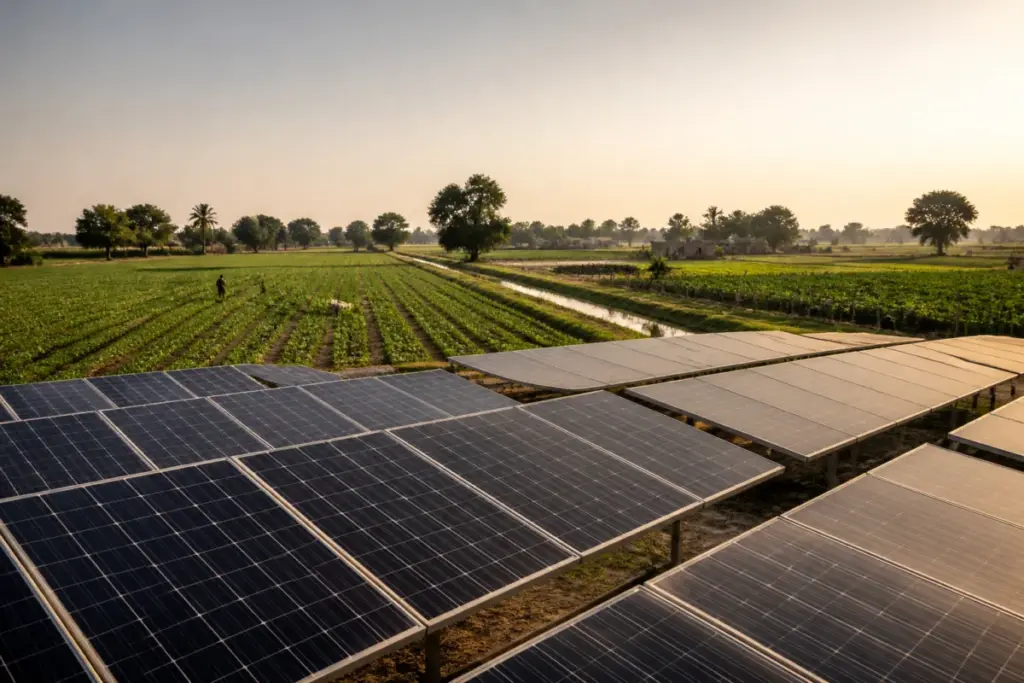
Gujarat is considering curbs on solar panels over fertile agricultural land after a state agriculture department study found that farmers in the Charotar region are increasingly leasing productive plots to solar developers. The emerging policy debate is not simply about where renewable energy should be installed; it is about how the state balances clean-power expansion with food production, farm incomes, soil fertility and the rural supply chains that connect agriculture to livestock and dairy.
The issue is particularly significant in Anand and Vadodara districts, where fertile alluvial soils, irrigation networks and intensive multi-crop farming have traditionally supported agricultural production. According to the report, farmers are being drawn to solar leasing because it offers assured long-term income at a time when cultivation is exposed to rising input costs, uncertain yields, adverse monsoon conditions and fluctuating crop prices.
A senior government official said the state was considering a proposal to curb solar installations on fertile agricultural land because the agriculture department had raised concerns about the possible long-term effect on agricultural productivity. The proposal, as described in the report, is still under consideration. No final policy, implementation date or defined land classification has been announced in the supplied material.
The economics of leasing explain why the practice is gaining traction. Solar developers are offering annual rentals of Rs 60,000 to Rs 65,000 per acre under contracts lasting 30 years, with a 5% annual increase. Some agreements also provide landowners with supervisory employment at solar installations, paying Rs 12,000 a month. For small and medium landholders, that combination can appear more predictable than farming, particularly when the cost of cultivation rises while crop returns remain uncertain.
This difference between predictable rent and variable farm income is central to the policy challenge. A restriction on solar panels may protect agricultural land, but it could also limit an income option that farmers have chosen in response to financial pressure. The report does not establish how many acres have already been leased, how many farmers are involved, or how much solar capacity has been proposed or installed on fertile land. Those missing figures will matter if the government moves from a broad concern to a specific regulatory framework.
The agriculture department study distinguishes between immediate and long-term effects. Over one to five years, the diversion of farmland could produce localised reductions in the availability of fertile plots. Over 10 to 30 years, the study projects a risk of permanent loss of topsoil fertility. The distinction is important because the land-use decision is being made through contracts that can last for three decades, while the consequences for soil and food production may accumulate gradually and become visible only after the original agreement has been signed.
The concern is not limited to the physical footprint of solar panels. Converting cultivated land can affect the wider agricultural system that depends on that land. The study cautions that a sustained reduction in cultivable acreage could deepen the impact on foodgrain production. The immediate effect may be marginal, but continued diversion could produce a regional deficit over 10 to 30 years and increase dependence on foodgrain brought in from other regions.
That projection places local land-use decisions within a wider food-supply question. Anand and Vadodara are described in the report as areas with fertile soils, irrigation and multi-crop farming. If such land is removed from cultivation for long periods, the state may gain renewable generation capacity while becoming more reliant on agricultural output from elsewhere. The supplied material does not quantify that potential deficit, but it identifies the institutional trade-off clearly: the benefit of energy infrastructure is immediate and contractually visible, while the cost to food production may be delayed and distributed across the regional economy.
The study also links the loss of cultivated acreage to livestock feed. Crop residues and other agricultural by-products are used as fodder, and a decline in their availability could aggravate fodder scarcity. This creates a second-order effect for the region’s dairy economy. A source quoted in the report said that any sustained decline in milk production could affect the dairy cooperative network, which depends on steady milk supplies from village-level producers. Lower procurement volumes could then put additional pressure on the cooperative supply chain.
This chain of effects shows why the question cannot be treated as a narrow dispute between farmers and solar developers. Agricultural land performs several functions at once: it produces crops, supports livestock, generates farm employment and feeds processing and cooperative networks. Solar installations also serve a wider public purpose by adding renewable-energy capacity. The policy problem is therefore one of spatial planning and institutional coordination, not merely land ownership.
The government’s possible response appears to be driven by the agriculture department, but implementation would require decisions across multiple administrative domains. Any effective policy would need to determine how fertile land is identified, which authority classifies it, whether existing leases are treated differently from new proposals, and how competing land uses are assessed. The report does not specify whether the proposed curbs would be a blanket restriction, a zoning mechanism, a permit condition or a protection for particular categories of agricultural soil.
The absence of these details is significant because land productivity is not uniform. The report specifically refers to fertile agricultural land and to the alluvial soils and irrigation networks of Anand and Vadodara. A policy that treats all agricultural land identically could overlook differences in soil quality, cropping intensity, irrigation access and local dependence on dairy or crop residues. Conversely, a policy that relies on a narrow classification system would need credible surveys and transparent enforcement to prevent disputes over which plots qualify for protection.
The 30-year lease period also raises a question about how the state values reversibility. A solar installation may occupy land for a defined contractual period, but the agriculture department study warns that topsoil fertility could be permanently affected over a 10-to-30-year horizon. The supplied report does not explain whether lease agreements contain restoration obligations, who would bear the cost of returning land to cultivation, or how soil quality would be monitored during the life of a project. These are unresolved issues rather than established failures, but they are central to any policy designed around long-term land stewardship.
For farmers, the policy debate will also be judged against the risks that make solar leasing attractive in the first place. The report identifies rising cultivation costs, uncertain crop yields, climate-related losses, adverse monsoon conditions and fluctuating crop prices as pressures on farm incomes. Unless those pressures are recognised, a land-protection policy could address the visible outcome—solar panels on farmland—without addressing the economic conditions that encouraged leasing.
At the same time, the rental terms show why the decision is difficult for landowners. Annual payments of Rs 60,000 to Rs 65,000 per acre, a 5% yearly increase and possible monthly employment income create a defined revenue stream. Farming income, by contrast, depends on production and prices. The report does not compare the total lifetime value of cultivation with the rental arrangements, nor does it state how costs, taxes, maintenance responsibilities or contract risks are distributed. Without that information, it is not possible to conclude that leasing is uniformly beneficial or harmful to farmers.
The policy therefore sits at the intersection of three planning priorities. The first is renewable energy, which requires land and grid access. The second is agricultural continuity, particularly in regions where soil, irrigation and multi-crop farming support established production systems. The third is rural economic resilience, including the ability of small and medium landholders to withstand climate and market volatility without permanently changing the use of their land.
The evidence supplied so far establishes a clear trend and a set of projected risks, but not the eventual scale of the transformation. The report does not provide the acreage already diverted, the number of solar projects involved, the capacity connected to the grid, or a district-wise estimate of future leasing. It also does not state whether the agriculture department’s projections have been independently reviewed. Those data points will be necessary to distinguish isolated land-use changes from a structural shift in the Charotar agricultural economy.
Gujarat’s pending decision will ultimately reveal whether land-use policy can treat energy, agriculture and rural livelihoods as connected systems. The immediate question is whether fertile plots should be protected from new solar installations. The larger question is how the state will identify land that is strategically important for food and dairy production while ensuring that farmers are not left with fewer secure income choices. The next important developments are the form of the proposed policy, its treatment of existing leases and the evidence the government uses to define fertile agricultural land and measure long-term soil impact.


