

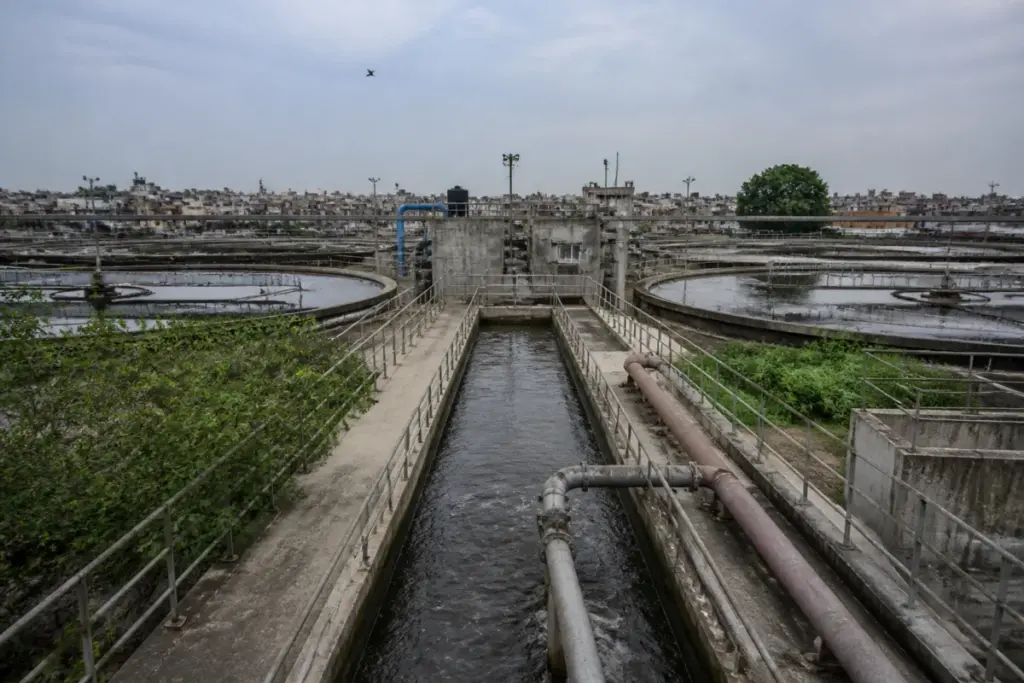
Seven sewage treatment plants in Delhi failed prescribed discharge standards for total suspended solids, biochemical oxygen demand and faecal coliform levels in September, according to the latest monitoring report of the Delhi Pollution Control Committee.
The DPCC tested samples from the inlet and outlet points of more than 30 sewage treatment plants across the national capital. The findings show that treated discharge from facilities in Yamuna Vihar, Mehrauli, Okhla, Keshopur, Ghitorni and Vasant Kunj did not meet the prescribed limits for one or more parameters.
The most significant violations were recorded at the sewage treatment plant in Yamuna Vihar Phase III. Its outlet sample recorded a faecal coliform level of 64,000 MPN per 100 millilitres, compared with the permissible limit of 230 MPN per 100 millilitres. The same sample showed total suspended solids of 109 milligrams per litre against the prescribed limit of 10 milligrams per litre, while its biochemical oxygen demand was 42 milligrams per litre against the permissible level of 10 milligrams per litre.
Faecal coliform is an indicator of contamination by bacteria associated with human and animal waste. High levels in treated discharge point to inadequate treatment or problems in the operation of the treatment process. Total suspended solids measure particles remaining in water, while biochemical oxygen demand indicates the amount of oxygen required to break down organic matter. Both are used to assess the quality of treated wastewater.
The STP at Mehrauli also recorded a faecal coliform level of 11,000 MPN per 100 millilitres, along with elevated total suspended solids and biochemical oxygen demand. The plant at Ghitorni recorded faecal coliform levels of up to 17,000 MPN per 100 millilitres, while the Vasant Kunj facility recorded 8,100 MPN per 100 millilitres.
The other facilities identified as failing to meet prescribed limits were located at Yamuna Vihar Phase I, Okhla and Keshopur. The report, as cited by Press Trust of India, does not provide details in the supplied material on the duration of each plant’s non-compliance, the operating agencies responsible for the facilities or any enforcement action taken after the samples were collected.
The DPCC conducts periodic monitoring of sewage treatment plants to assess treatment efficiency and compliance with environmental norms. The monitoring is intended to support efforts to reduce pollution entering the Yamuna River and other water bodies. The latest findings therefore place attention not only on the number of treatment plants operating in the city, but also on whether their outlet water consistently meets the standards prescribed for discharge.
The report does not establish whether the recorded failures were isolated sampling events or indicative of longer-term performance problems. Further action and subsequent monitoring results will determine whether the identified plants return to compliance and whether the discharge quality improves at the affected locations.


