

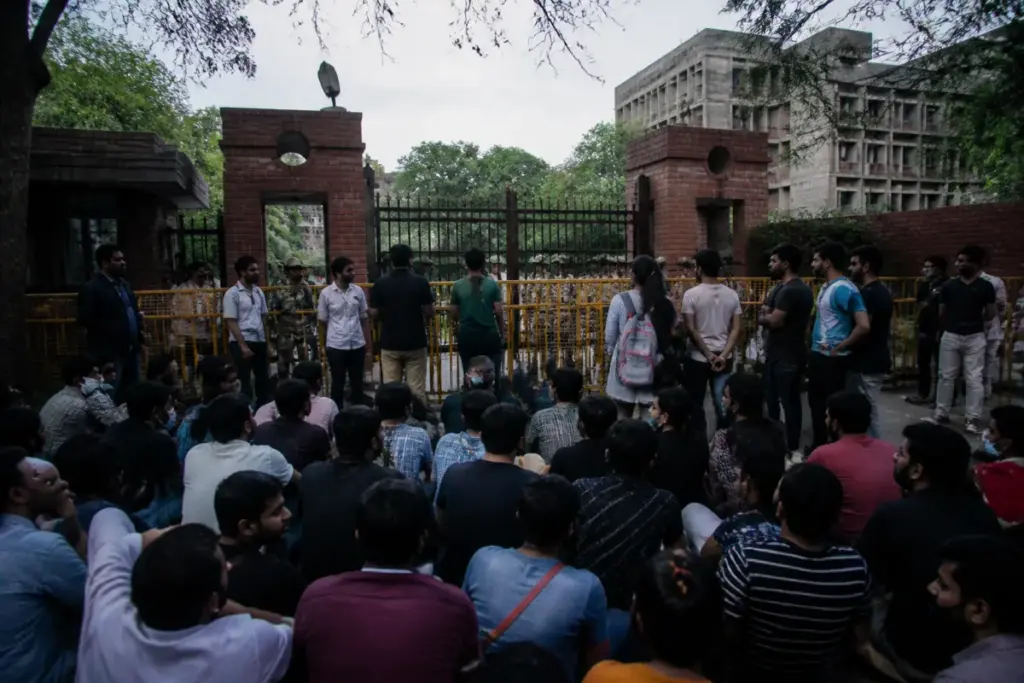
Delhi university protests at Jawaharlal Nehru University, Jamia Millia Islamia and Ambedkar University Delhi have moved beyond isolated campus disputes. Hunger strikes, sit-ins, suspensions, rustications, restricted access and allegations of administrative overreach now point to a wider conflict over how public universities govern space, representation, discipline and dissent.
The immediate disputes differ. At JNU, students are opposing the chief proctor’s office manual, infrastructure conditions, the absence of certain institutional safeguards and the replacement of the university’s entrance examination with the Common University Entrance Test. At Jamia, students are demanding the restoration of union elections that were dissolved in 2006. At AUD, the dispute centres on a closed main gate, iron barricades, student participation in decision-making, faculty recruitment and campus facilities.
What links the three cases is the way ordinary institutional questions have become connected to physical access and democratic representation. The protests are not only about policies written in administrative documents. They concern who can enter a campus, who can speak for students, how disciplinary decisions are made and whether university infrastructure supports the academic community it is intended to serve.
The latest developments also show how quickly a disagreement over governance can become a question of safety and control. At JNU, an indefinite hunger strike that began on October 3 had entered its 16th day on Monday, according to the Times of India report. Eighteen students, including office-bearers of the Jawaharlal Nehru University Students’ Union, initially began the strike near Sabarmati T-point. Nine students remained on hunger strike at the time of the report.
The students’ demands followed a university general body meeting that unanimously called for the withdrawal of the chief proctor’s office manual, which they said penalises protests on campus. They also sought action on crumbling infrastructure, restoration of the Gender Sensitisation Committee Against Sexual Harassment, an equal opportunity cell under the proposed Rohith Vemula Act, an inquiry into alleged recruitment irregularities and the reinstatement of the university entrance examination instead of CUET.
The health consequences of the protest have made the dispute more urgent. The report said several students were hospitalised, while JNUSU president Aditi Mishra reportedly lost more than 6.4 kg and vice-president Gopika Babau lost 6.2 kg. The students alleged that those who had been rusticated and declared out of bounds were denied medical check-ups. JNU’s administration disputed that account, saying medical examinations were being conducted twice daily. It also said a committee had held two rounds of discussions with protesters and that two groups had ended earlier hunger strikes after an October 9 meeting and assurances.
JNU has separately accused rusticated students of damaging public property worth Rs 20 lakh. That allegation, like the students’ claims regarding medical access and disciplinary rules, is part of the institutional contest over which version of events is formally recognised. The supplied report does not establish the outcome of the competing claims, but it shows that the dispute has acquired both a welfare dimension and a property-management dimension.
At Jamia Millia Islamia, the central issue is representation. Students began a hunger strike on October 12 to demand the restoration of union elections, which were dissolved in 2006. The long gap is important because it means the current protest is not simply a response to a recent administrative order. It reflects a prolonged absence of a university-wide elected student body and the question of whether departmental subject-association elections provide an adequate substitute.
The university has argued that such subject-association elections already offer students a democratic platform. Students, however, are seeking a broader institution-wide mechanism. That difference is fundamental: a departmental structure may allow representation within academic units, while a union can aggregate concerns relating to campus access, disciplinary policy, welfare, infrastructure and administration.
The dispute intensified after protesters alleged that security personnel forcibly removed them from campus before dawn. Videos later showed protesters pushing against the university’s entrance gate, after which parts of it broke, according to the report. Jamia rusticated one hunger striker for an academic year and suspended two others for six months, barring all three from campus. The Zakir Husain and Old libraries remained closed on Sunday because of security concerns. On Monday, the university constituted a seven-member committee to engage with the protesters and examine their demands, while also citing previous incidents of campus violence.
The Jamia episode illustrates how the management of a campus entrance can become central to institutional legitimacy. Once access is restricted, the gate is no longer only a security installation. It becomes the visible point at which the university defines who may enter, assemble and protest. The closure of libraries also demonstrates how a conflict involving a limited group of protesters can affect facilities used by a much wider student population.
At Ambedkar University Delhi, access has been a core issue from the beginning of the indefinite sit-in that started on September 28. Students said the main gate had been shut for more than a year, forcing them to use a back alley. They also demanded the removal of iron barricades restricting campus movement, faculty recruitment, infrastructure improvements, restoration of a PhD fee waiver and student representation in decision-making bodies.
The protest escalated on October 13 after a confrontation with security personnel during a documentary screening on campus. The university suspended 11 students on October 14, barred them from campus and referred the matter for disciplinary inquiry. It cited alleged indiscipline, damage to university property and a scuffle with staff. The All India Students’ Association, whose student council members were among those suspended, called the action arbitrary and said some students were suspended despite not being present during the incident.
The AUD dispute places the relationship between campus design and institutional governance in sharp relief. A main gate that remains closed for an extended period, a back-alley entrance and physical barricades do not merely change movement patterns. They alter how students experience the university as a public institution. The report does not provide the original administrative reasons for keeping the gate closed, nor does it establish whether the access arrangements complied with institutional rules. It does, however, make clear that access has become one of the protest’s defining grievances.
Across the three universities, infrastructure is therefore not a separate technical subject. It appears alongside disciplinary rules, representation and welfare. At JNU, students have linked crumbling infrastructure to the wider governance dispute. At AUD, the main gate, barricades and facilities are direct demands. At Jamia, the closure of libraries has become an operational consequence of the security conflict. The common pattern is that the built environment is shaping how students exercise rights and how administrations respond to mobilisation.
The institutional response has largely followed a security and disciplinary framework. Suspensions, rustications, campus bans, inquiries, closed facilities and allegations of property damage have been used alongside committees and discussions. These measures may address immediate safety concerns, but they also raise a procedural question: whether universities have credible mechanisms to resolve disputes before they reach hunger strikes, prolonged sit-ins or confrontations at gates.
The available evidence does not show that the administrations have adopted identical policies or that the disputes have a single cause. Nor does it establish the validity of every allegation made by students or university authorities. The JNU administration says medical checks are taking place and discussions have been held. Jamia says past violence justifies its security concerns and points to subject-association elections. AUD cites alleged indiscipline, property damage and a scuffle, while AISA disputes the suspensions. These positions need to remain distinct.
The data in the report nonetheless indicates an escalation in institutional cost. At JNU, the hunger strike had continued for 16 days, with nine students still participating and several reportedly hospitalised. At AUD, 11 students were suspended. At Jamia, three protesters faced suspension or rustication, two libraries were closed and a seven-member committee was created after the confrontation. These figures do not measure the full impact on the universities, but they show how quickly unresolved governance disputes can affect health, access, learning facilities and administrative capacity.
The larger urban question is how public universities function as shared civic spaces. Delhi’s universities are not sealed corporate campuses detached from the city. They are large institutions where students, staff, security personnel and visitors interact through gates, roads, libraries, hostels, classrooms and administrative offices. Decisions about access and movement therefore have a spatial dimension, while decisions about discipline and representation have a civic dimension.
What the current protests confirm is that campus infrastructure and campus governance cannot be managed as entirely separate systems. A gate, barricade or library closure can become a political fact when students believe that access is being restricted without meaningful representation. Conversely, a protest can create safety and property concerns that administrations are required to address. The unresolved issue is whether existing committees, elections, grievance systems and disciplinary procedures are capable of handling that tension without producing prolonged hunger strikes and escalating exclusion.
The next developments will depend on the discussions initiated by the universities. JNU’s engagement with protesters, Jamia’s seven-member committee and the disciplinary inquiry at AUD are the formal processes now in motion. Their outcomes will determine whether the immediate conflicts remain episodes of campus unrest or become prompts for wider changes in student representation, access management, welfare safeguards and institutional accountability.


