

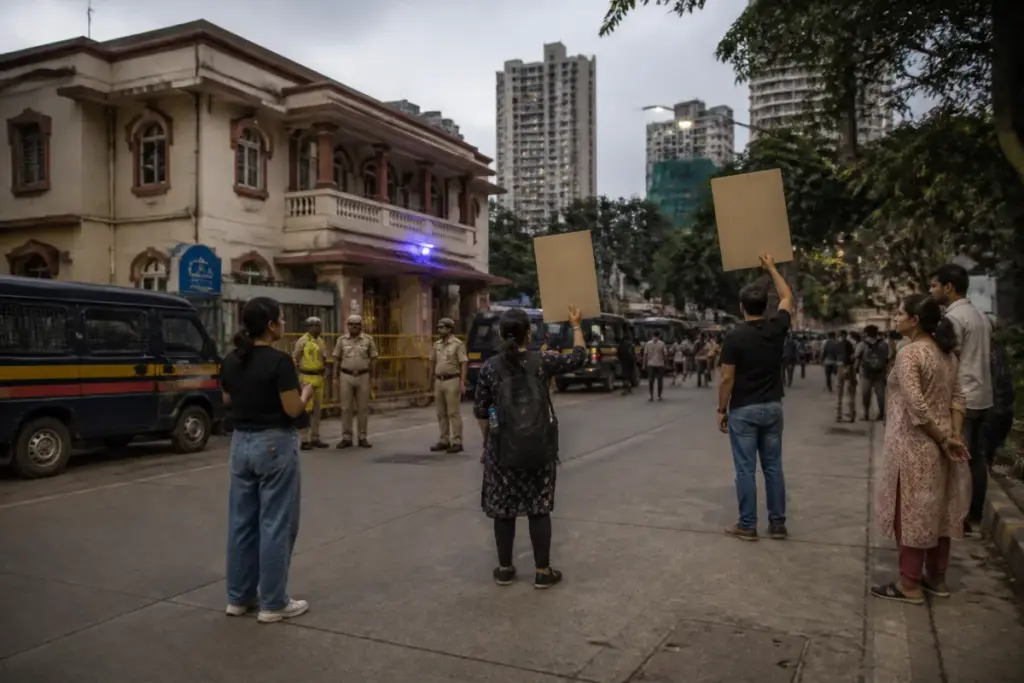
The detention of people travelling to a proposed solidarity walk in Mumbai has raised questions about how the police are managing public assemblies, although the number of people detained remains unclear in the available report and the central claims require verification.
The Cockroach Janta Party, or CJP, had announced a “solidarity walk” at Carter Road in Bandra on Sunday evening. The proposed event was described as a “no slogan” march, with participants expected to carry placards. According to the report, several people were detained before the walk could begin.
Kunal Kamerkar, identified as the CJP’s Thane coordinator, said police intercepted cabs carrying protesters before they reached Carter Road. Kamerkar alleged that he was travelling with activist Anjali Damania when their cab was stopped at Khar subway. He said they were subsequently taken to the DN Nagar police station.
Kamerkar also said that other participants were detained and taken to police stations in the Vakola, Bandra and DN Nagar areas. He questioned how the police had obtained information about the protesters’ travel plans. The report does not provide documentary evidence supporting that allegation or establish whether the police had issued prior instructions to the organisers.
A senior police officer cited in the report gave a different account of the events. The officer said the protesters had not obtained the necessary police permissions and had not informed the police about the proposed gathering. The officer confirmed that two protesters had been taken to the DN Nagar police station and said there were protesters in Vakola and Bandra as well.
The officer’s account is the only police response included in the supplied material. The report does not identify the officer, specify which permissions were required, state whether an application had been filed by the organisers, or provide a copy of any police communication concerning the walk.
The scale of the detentions is also not established. The report says that a crowd of more than 500 protesters was expected, but it does not say how many people actually assembled or attempted to travel to Carter Road. Its final reference to the number detained appears as “3036 protesters”, which is ambiguous and may reflect a formatting or transcription error. Until the police or another authoritative record clarifies the figure, the number should not be treated as confirmed.
That uncertainty is significant because the detention of two people at a police station and the detention of several dozen or more participants would represent materially different levels of police intervention. The available report does not establish which of those descriptions applies. It also does not state how long anyone was held, whether anyone was formally arrested, whether notices were issued, or whether the individuals were released.
The episode therefore turns on two separate questions. The first is whether the organisers had obtained or sought the permissions required for the proposed gathering. The second is whether the police response was limited to action against an unauthorised event or extended to people who had not yet reached the proposed venue. The supplied material records competing accounts but does not resolve either question.
The location details suggest that the police action occurred across several parts of Mumbai rather than only at Carter Road. Kamerkar referred to an interception at Khar subway, while the police account referred to people at Vakola, Bandra and DN Nagar. The report does not establish whether these actions were coordinated under a single order, whether separate police units were involved, or whether the people detained were all participants in the same proposed walk.
The account also leaves unanswered whether the “no slogan” format had any legal or administrative significance. The organisers described the walk as a placard-only event, but the police officer’s statement focused on permissions and prior intimation rather than the format of the protest. No official order, restriction notice or explanation of the applicable conditions is included in the report.
For Mumbai residents, the incident illustrates the importance of clear public information around planned gatherings. The available material does not show whether the organisers were informed in advance that the walk would not be permitted, whether alternative conditions were offered, or whether participants were told why they were being taken to police stations. Those details are necessary to assess how the decision was implemented on the ground.
The report also does not include responses from the Mumbai Police public relations office, the organisers beyond Kamerkar’s account, or the individuals allegedly detained. It does not provide the names of all police stations involved, the relevant legal provisions, or the status of any complaint or case. These omissions prevent a definitive account of the legal basis and operational scope of the action.
What is established from the supplied report is that the CJP announced a solidarity walk at Carter Road, that police said the organisers lacked necessary permissions and had not informed them, and that at least two protesters were taken to the DN Nagar police station. What remains unresolved is the total number detained, the status of those individuals, the existence of any prior communication with organisers, and the precise basis for intercepting people before the proposed event.
Those facts should be clarified through the police record, any permission application or written refusal, and statements from the detained participants and organisers. Until then, the incident can be reported as a disputed account of pre-emptive action around a proposed Mumbai protest, not as a conclusively established figure of mass detention.


