

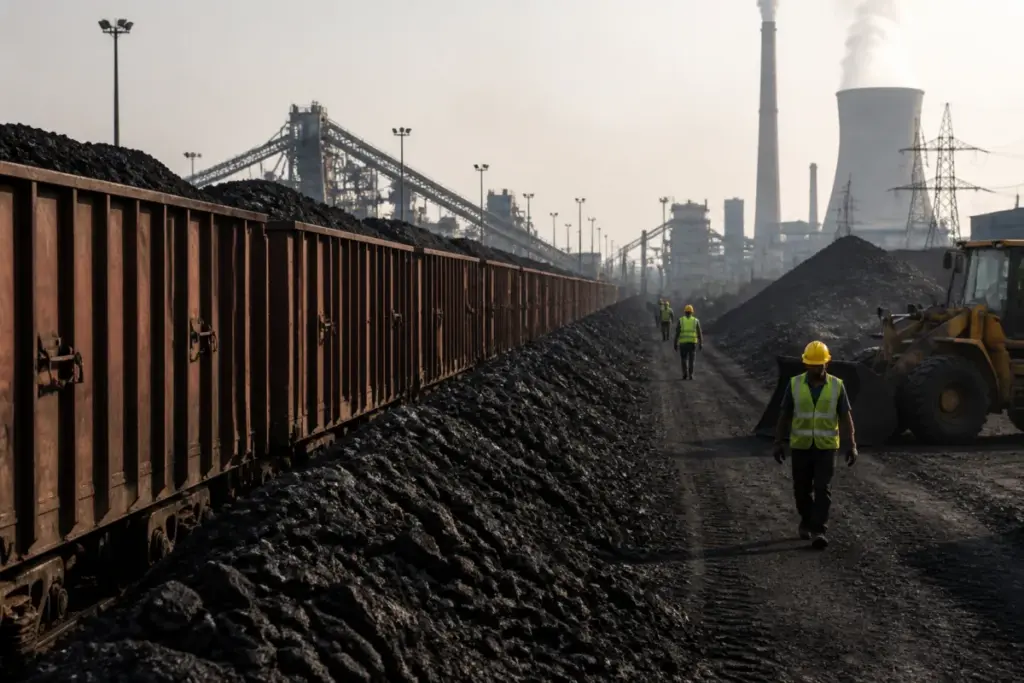
India’s decision to shelve a proposal requiring power plants to blend imported coal has exposed the difficult choices facing a power system caught between high electricity demand, depleted domestic inventories and rising import costs. Instead of using seaborne coal to quickly reinforce stocks, policymakers are relying on Coal India Ltd. to raise output and on the railway system to move fuel to power stations on time.
The immediate problem is not simply that India has less coal at power plants. It is that several parts of the electricity supply chain have come under pressure at the same time. Coal inventories have fallen to their lowest level in nearly five years, while power demand has remained elevated because temperatures stayed high beyond the usual summer period. Below-normal monsoon rainfall also reduced hydropower generation, increasing the burden on coal-fired plants.
The resulting strain is visible in the condition of generating stations. Data from the power ministry showed that nearly half of the country’s power plants had critical fuel inventories as of October 17, with less than a quarter of the coal required for normal operations. India’s electricity deficit also rose sharply in September, making it the worst power-shortage month for September in nearly a decade, according to the report.
The government had considered asking power plants to blend imported coal with domestic supplies. Such a measure has been used during previous periods of coal scarcity, but the economics are now less favourable. Seaborne coal prices have risen, while a weaker rupee has made imports more expensive in domestic currency. Benchmark thermal coal prices were at their highest level in three years, according to Bloomberg data cited by Economic Times. Higher oil prices have also increased India’s energy import bill, limiting the appeal of another large import-dependent response.
This leaves domestic production and logistics as the central parts of the current strategy. Policymakers have asked Coal India, the state-owned mining company, to increase output. They have also asked the railways to ensure that coal reaches power stations on time. The distinction matters because a coal shortage at a generating station can reflect more than mine production. Fuel must be extracted, loaded, transported and delivered in sufficient quantities to the right plant before its inventory falls to a critical level.
The episode therefore highlights the importance of coordination between institutions that operate under different responsibilities. Coal India controls much of the domestic mining response, the railways are responsible for a crucial part of the transport chain, and the power ministry must balance generation requirements with available fuel. A failure at any one stage can reduce the benefit of capacity elsewhere. Additional coal at mines cannot immediately solve a shortage at a power plant if train availability, route capacity or scheduling delays hold up movement.
Weather has added another layer of uncertainty to this system. High temperatures sustained demand for cooling and irrigation, while weak rainfall reduced hydropower output. Coal plants consequently had to supply more of the electricity system at a time when their reserves were already under pressure. The report also notes that cooler weather is expected to reduce consumption, although temperatures are still forecast to remain above the 30-year normal over the following two weeks.
There are early signs that the immediate pressure may be easing. Average daily coal depletion at domestic coal-burning facilities during the first 17 days of October was about 48,000 tonnes, according to Bloomberg calculations based on power ministry data. That was roughly one-fifth of the rate recorded in September. The slowdown suggests that the pace at which inventories are being consumed has moderated, but it does not by itself establish that reserves have returned to comfortable levels.
This distinction is important for understanding the policy response. A fall in daily depletion can reduce the urgency of importing coal, but it does not remove the underlying exposure of the power system to demand spikes, weak rainfall or transport disruptions. The government is effectively betting that lower electricity consumption and higher domestic production will allow inventories to recover without incurring the cost of imported fuel.
India’s coal strategy has long involved managing a tension between energy security and import costs. Domestic coal offers protection from international price volatility and currency movements, but its usefulness depends on production, quality, dispatch and rail connectivity. Imports can provide an additional source of supply, yet they become more burdensome when global prices rise or the rupee weakens. The shelved blending proposal shows how quickly a physical supply problem can become a cost problem for generators and the wider electricity system.
The episode also demonstrates why power reliability cannot be assessed only through installed generation capacity. A plant may exist on paper and still face operational constraints if its fuel stock is inadequate. Similarly, national coal output may not translate into reliable electricity if dispatch and transport are not synchronised with demand. For consumers, the effect appears as a risk of shortages or supply restrictions; for the system, it appears as a coordination challenge across mining, railways, generation and weather-sensitive demand.
The available evidence does not establish how long it will take for power-plant inventories to return to normal or whether the import proposal will be reconsidered if prices remain high. It does show that the immediate response is centred on domestic production and timely railway movement, while policymakers expect cooler conditions to slow demand. The next indicators to watch are the recovery of coal stocks, the performance of domestic output and rail dispatch, electricity demand as temperatures change, and hydropower availability after a below-normal monsoon.


