

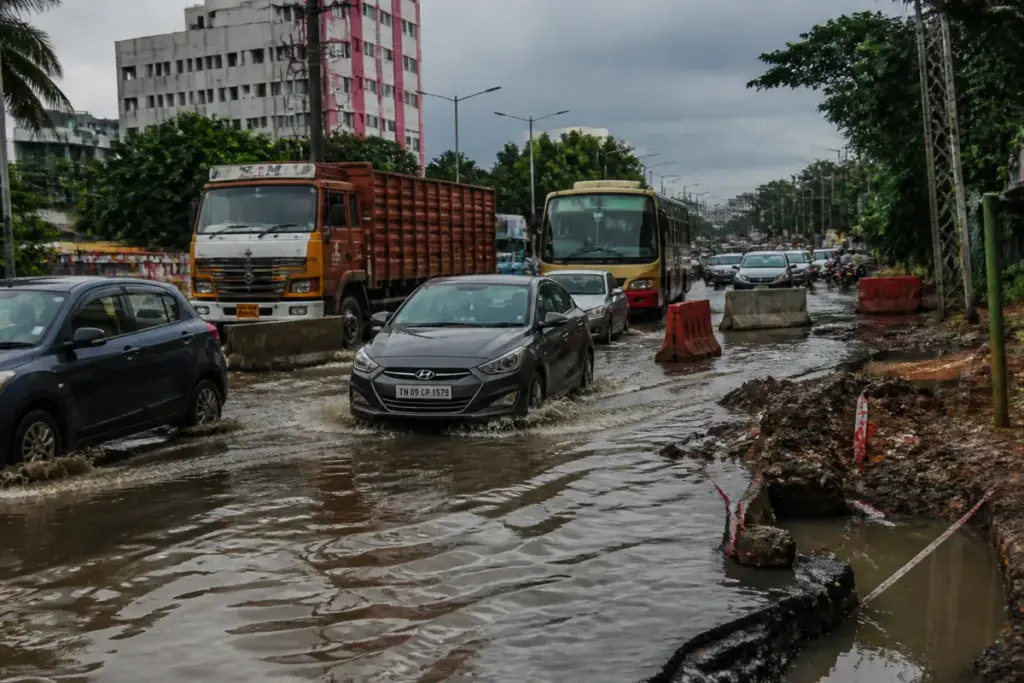
Unrestored road cuts on the East Tambaram-Velachery Road became a serious traffic and road-safety hazard after heavy overnight rain, with water-filled excavations trapping cars, goods lorries and a Metropolitan Transport Corporation bus on the Chennai suburban corridor.
The road cuts were made for drinking water pipeline work under the Tambaram Municipal Corporation. According to a report by Deccan Chronicle, motorists alleged that several excavated sections had not been properly refilled or restored even after work had been completed.
Rain on Saturday night collected in the damaged portions of the road, concealing pits and uneven surfaces from approaching drivers. The submerged road cuts made it difficult for motorists to judge the depth and condition of the damaged sections, leading to vehicles getting stuck and slowing traffic along the route.
The disruption affected commuters travelling from East Tambaram towards Velachery. Cars, goods vehicles and an MTC bus were reported to have become stranded, while other vehicles moved slowly through the affected stretch. Two-wheeler riders also faced difficulty negotiating the waterlogged and uneven sections.
The incident highlights the immediate operational risks created when utility excavation is not followed by prompt road restoration. Pipeline projects often require work to be carried out beneath existing roads, but the temporary condition of the carriageway can become especially hazardous during heavy rain. In this case, motorists said the combination of open or poorly restored cuts and stagnant water made the defects difficult to see.
Motorists blamed the contractors handling the drinking water pipeline work, alleging that they had failed to refill the excavated portions properly and restore the road surface after completing the work. The allegations were reported in connection with the damaged stretches under the jurisdiction of the Tambaram Municipal Corporation.
Road users said the problem was particularly dangerous during the northeast monsoon, when rainwater can conceal deep pits, abrupt level changes and loose surfaces. They warned that such conditions could leave vehicles immobilised and increase the risk of accidents, especially for two-wheeler riders who have less stability when crossing damaged or flooded road sections.
The traffic disruption also exposed the wider coordination challenge involved in carrying out utility work on active urban roads. A pipeline excavation affects not only the construction site but also the movement of public transport, commercial vehicles, private cars and pedestrians using the corridor. Until the surface is restored, even a completed underground work package can continue to impose costs on daily travel.
Motorists have urged the authorities to direct contractors to refill the dug-up portions without delay, restore the road surface and ensure safe passage for traffic during heavy rainfall. They also called for attention to the affected stretch so that concealed pits and uneven sections do not continue to obstruct vehicles or expose road users to further danger.


