

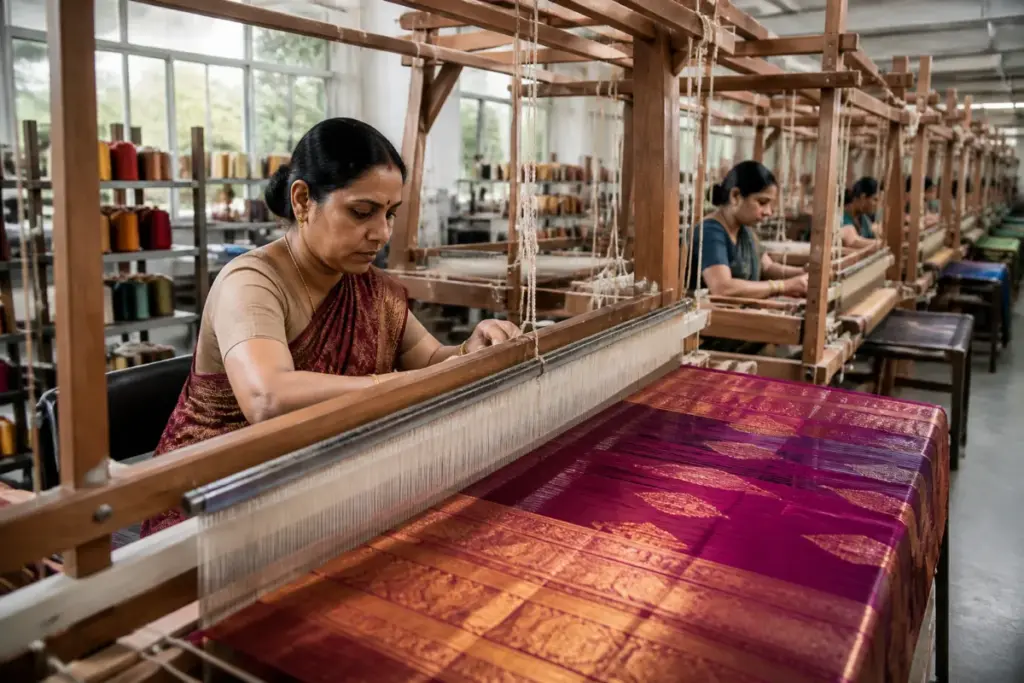
Union minister Nitin Gadkari has set a target of taking Nagpur’s Dhapewada silk to international markets while expanding the handloom initiative into a potential source of employment for 5,000 women. He announced the plans at the inauguration of a new building for Dhapewada Textile Producer Udyog Company Ltd on Saturday.
The initiative began in 2021 as a social enterprise involving 400 women. Gadkari said the project had developed the capacity to manufacture premium Tussar silk sarees and was now preparing to increase production. He said his aim was to build Dhapewada silk into a distinct brand for the global fashion market, including showcasing it at Cannes in France.
“My dream is to see Dhapewada silk exported across the world and showcased at Cannes in France. We want to develop it into a brand,” Gadkari said at the event.
The minister linked the project to the decline of Nagpur’s traditional handloom economy. He recalled that Gandhibagh, once known for its busy handloom market, had fallen silent, while members of the Halba community associated with weaving were finding it difficult to continue the occupation. Gadkari also referred to earlier government schemes supporting sarees, dhotis and cooperative societies, saying those initiatives had eventually faded.
The Dhapewada enterprise is developing organic colour printing and exploring the use of artificial intelligence to reduce the time required to produce a saree from 10 days to six. The project is also considering garments beyond sarees, including dhotis, jackets and other products. Hema Malini, who attended the event as a chief guest, suggested adding salwar kameez and contemporary garments to widen the market for the fabric.
Union textiles minister Giriraj Singh said the Dhapewada initiative could become a significant development for India’s handloom sector. He announced an income target of Rs20,000 to Rs30,000 per month for every weaver within a year, although the event report did not provide details of the implementation mechanism or funding structure for that target.
Singh said the textile ministry was working with IIT Delhi on real-time monitoring of production processes and the integration of artificial intelligence to reduce errors and improve efficiency. The technology push is intended to support production while retaining the identity of Dhapewada’s traditional weaving practices.
Gadkari also said he wanted to involve tribal communities in Gadchiroli in silk breeding and thread production, potentially linking the Dhapewada initiative with a wider regional supply chain. The proposal would extend the project beyond weaving and retail into raw material and thread production, though no timeline was specified at the event.
Maharashtra textiles minister Sanjay Savkare said a fashion show had been organised to promote Dhapewada’s Karvat Kathi weaving tradition and improve the visibility of locally produced sarees. Hema Malini described the sarees as distinctive and called for India’s diverse weaving traditions to be preserved and promoted. The next steps announced at the event involve scaling production, expanding the product range and developing the Dhapewada label for wider markets.


