

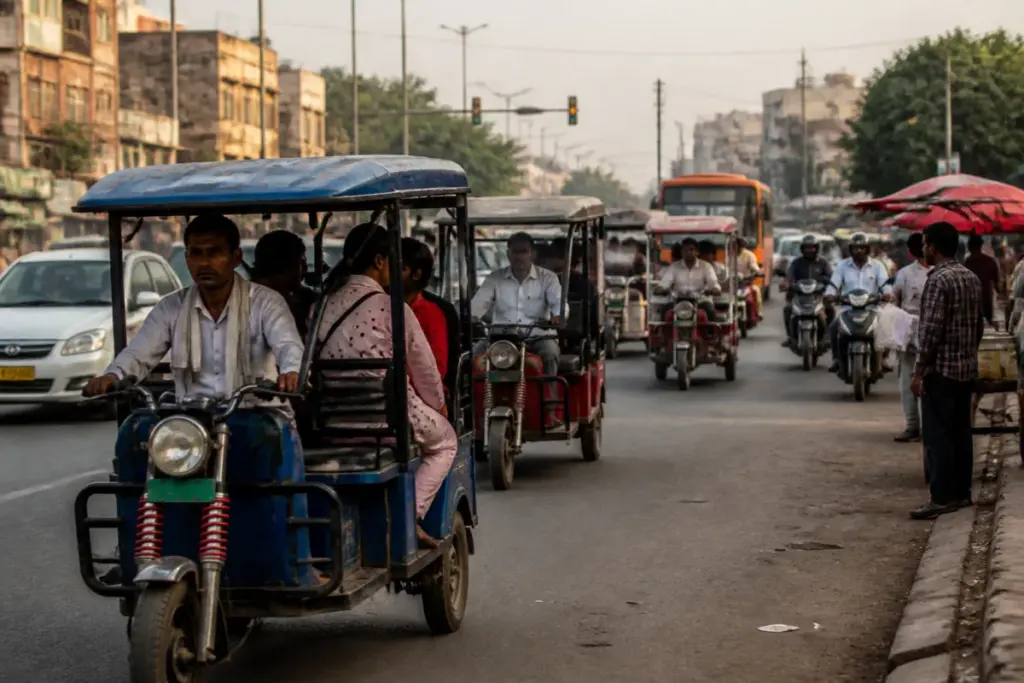
The Delhi government has proposed a city-wide cap of 2.5 lakh e-rickshaws, citing traffic congestion, road safety hazards, air and noise pollution, and the unregulated growth of battery-operated three-wheelers. The proposal is part of the draft Delhi E-Rickshaw (Registration and Operation) Scheme, 2026, which has been opened for public feedback for 30 days.
The draft states that the government has fixed the fleet ceiling at 2,50,000 e-rickshaws in view of “serious concerns” linked to congestion, safety and pollution. No registration would be issued beyond the limit unless the cap is revised by the government.
The proposed rules define an e-rickshaw as a battery-operated three-wheeler with seating for up to four passengers, excluding the driver. The vehicle must have a luggage capacity of 40 kg, a net power output of no more than 2,000 watts and a maximum speed of 25 kmph.
Under the draft scheme, an e-rickshaw would not be permitted to operate unless it is registered as a transport vehicle and holds a valid E-Rickshaw Compliance Certificate, or ECC. The certificate would be issued digitally and remain valid for two years. It would contain details of the vehicle’s registration certificate, the owner and driver, driving licence and public service vehicle badge information, battery compliance, fitness and insurance validity.
Each ECC would be linked to one e-rickshaw and one driver. The draft also proposes that an individual owner who is a Delhi resident may own up to five e-rickshaws. Companies, firms, non-governmental organisations, cooperative societies and driving schools would be allowed to own up to 100 vehicles.
Entities operating larger fleets would face additional operational requirements. Owners with fleets of 25 or more e-rickshaws would have to obtain an aggregator licence. Companies and other permitted entities would also be required to provide adequate charging or battery-swapping arrangements for their vehicles.
The proposed framework places compliance obligations on drivers as well. Every driver would need a valid e-rickshaw driving licence and a public service vehicle badge. A driver would not be allowed to be linked to more than one ECC at a time.
The draft scheme seeks to bring registration, ownership, driver identity, vehicle compliance and charging arrangements into a single regulatory framework. Its proposed fleet cap would also give the government a mechanism to control the future expansion of e-rickshaw registrations in the capital.
Members of the public can submit feedback and suggestions during the 30-day consultation period. The scheme will be finalised after the consultation process, according to the draft released by the Delhi government.


