

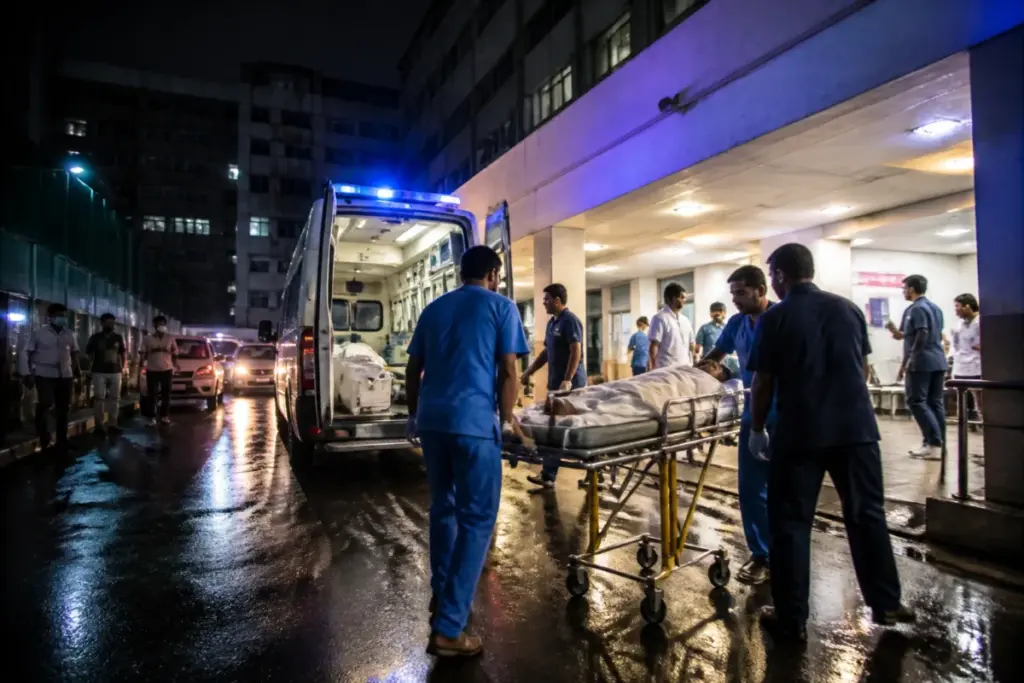
The transfer of stampede victims from Kolkata Medical College and SSKM Hospital to Apollo Hospital has opened a larger question than where the injured were treated: how should a public health system make, document and justify emergency decisions when government hospitals are already caring for patients? The episode, as reported by Anandabazar, has brought clinical judgement, political direction, patient consent and the credibility of state-run hospitals into the same dispute.
According to the report, victims of a stampede at a puja pandal in Chorbagan were brought to Kolkata Medical College from the evening onwards. The report said doctors declared 17 people dead after examining them and admitted 12 injured people under the general surgery department. It also said that two patients were subsequently moved from SSKM Hospital and that 14 injured people were eventually undergoing treatment at Apollo Hospital on the EM Bypass.
The casualty figures in the report are not entirely consistent: a later reference in the account mentions 19 deaths. That discrepancy requires clarification from official records. It does not, however, alter the central institutional question raised by the transfer of patients who had already entered the public hospital system.
The reported sequence shows how quickly emergency decisions can become administratively difficult. The account said the chief minister visited the emergency department at about 9.07 pm and instructed officials to move the injured to SSKM Hospital. Two patients were sent there while preparations were made to transfer 11 others. After 10 pm, the plan reportedly changed and the injured were to be moved to Apollo Hospital instead.
The health minister, health secretary, director of medical education and director of health were reported to have been overseeing the emergency response. A doctor quoted in the report said the initial instruction was to identify patients who specifically required transfer. The account then said officials later instructed that all the injured be moved to the private hospital. The change from a clinically selective transfer to a broader relocation is central to the controversy because it raises questions about who made the decision and what clinical criteria were applied.
In emergency medicine, moving a patient is not simply a matter of arranging another bed. The patient’s condition, the availability of specialist care, transport safety, monitoring during transit and continuity of records all matter. The report said some patients were receiving saline and oxygen and that one patient developed breathing difficulty while being taken to Apollo and had to be brought back to Kolkata Medical College for stabilisation. That account, attributed to junior doctors, illustrates the risks created when a transfer is undertaken during an unstable phase of treatment.
The dispute also exposes the importance of medical documentation. The report said 10 of the 12 patients at Kolkata Medical College had completed admission procedures and had bed-head tickets, while two remained under observation in the emergency department. Doctors were reportedly unsure what reason should be entered in the records for transferring admitted patients.
The usual categories described in the report do not appear to fit this situation neatly. A hospital may record that no bed is available, that a patient has left against medical advice, or that a patient has been discharged against medical advice. None of those descriptions necessarily explains a transfer ordered or facilitated by the administration after admission. The report said the phrase “refer to Apollo Hospital” was eventually used in some records, while the health minister denied that patients had been referred and described the move as a “shift”.
That distinction is more than a dispute over terminology. A referral generally indicates that the treating institution is sending a patient elsewhere because another facility is required or considered more appropriate. A shift can suggest an administrative relocation after treatment or stabilisation. The term used in the record affects how responsibility is understood, whether the receiving hospital is expected to assume care, and how the patient’s clinical history is reconstructed later.
The source account also reported that the government’s explanation was based on family choice. According to the health minister, the chief minister asked relatives where they would be comfortable having the injured treated, and families opted for private hospital care after the trauma of the incident. The minister said the government had fulfilled their preference and that the move should not be called a referral.
Relatives quoted in the report offered a more specific explanation. The brother of one patient said the family was told that several tests were necessary and that not all could be performed at Kolkata Medical College. The report also said one mother initially did not want to move to a private hospital but agreed after being told that she and her daughter could stay together in a VIP cabin.
These accounts point to a complicated form of consent. A family may choose a private facility, but that choice takes place within an emergency, after a mass-casualty event and amid unequal access to information. For consent to be meaningful, relatives need to know whether the transfer is clinically necessary, whether the public hospital can continue treatment, what risks transport involves, and who will bear the cost. The supplied report does not establish how that information was communicated to each family or whether a uniform consent procedure was followed.
The accommodation details at Apollo also show that the move was not limited to high-dependency treatment. The report said seven of the 14 patients were in private deluxe rooms, with others in deluxe, ICU, SICU and HDU beds. These details suggest that the transfer combined different levels of clinical need and comfort-based accommodation. They also explain why the episode has become a test of public confidence: it can be interpreted either as the state ensuring rapid access to additional facilities or as an admission that its own leading public hospitals could not provide adequate care.
The institutional symbolism is particularly strong because Kolkata Medical College and SSKM are not ordinary peripheral facilities. The report described Kolkata Medical College as a leading public medical institution and SSKM as a flagship of the state health system. When patients are moved from such hospitals to a corporate facility, the decision inevitably raises questions about capacity, equipment, specialist availability and emergency preparedness across the public network.
The government’s response, however, was that public hospitals remained heavily occupied because patients were being successfully treated there. The health minister said the hospitals had no vacant beds and that government and private hospitals had comparable mortality rates, although the report did not provide supporting data for that comparison. The minister also pointed to district hospitals as facilities where patients were recovering and returning home.
The disagreement therefore involves two different measures of health-system performance. The medical organisations quoted in the report focused on institutional confidence and the message sent when a public hospital transfers patients to a corporate hospital. The government focused on occupancy, treatment outcomes and family preference. Both are relevant, but neither alone answers the operational question of whether Kolkata Medical College had the required equipment, specialists or beds for these particular trauma patients at that moment.
The episode also reveals the absence of a clearly visible emergency-transfer framework. A mass-casualty response requires more than hospital beds. It requires a command structure, triage protocols, a designated referral network, transport coordination, written clinical criteria and a common record format. When instructions shift from one institution to another within a few hours, the system needs a documented reason for the change. Without that record, later explanations can appear inconsistent even when officials believe they acted in the patients’ interests.
The reported involvement of senior political and health officials adds another layer. The chief minister’s visit, the health minister’s presence and the role of senior health administrators may have helped mobilise resources quickly. But operational decisions in an emergency still need to be traceable to medical and administrative protocols. Otherwise, treating doctors may be left responsible for the documentation and clinical consequences of decisions they did not initiate.
This is where the public-private relationship becomes important. Government payment for treatment in a private hospital can provide additional capacity during an exceptional emergency. It may also help families who are unable or unwilling to navigate another facility after a disaster. But if such arrangements become informal or discretionary, they can create uncertainty over eligibility, costs, accountability and continuity of care. The supplied report does not establish the financial terms of the Apollo treatment or the formal government order under which the transfers took place. Those are important missing parts of the public record.
The dispute also sits within a wider crisis of accountability after a mass-casualty event. Families are not only asking where relatives will receive treatment. They are also seeking explanations for how the stampede occurred, why deaths took place and whether the response was adequate. The health system therefore became part of the state’s immediate crisis response. Moving patients to air-conditioned private rooms may have been intended to offer comfort and reassurance, but the decision also risked appearing to substitute visible hospitality for a transparent account of emergency capacity.
The evidence currently supports several conclusions. Patients injured in the Chorbagan stampede were treated initially in government hospitals and later moved to Apollo Hospital. The transfer process reportedly changed during the night, involved senior officials, created uncertainty over medical records and prompted criticism from junior doctors and medical organisations. The government described the move as a shift based on patient and family preference rather than a referral.
What remains unclear is equally important: the precise clinical condition of every patient, the formal authority behind the transfer order, the documented consent process, the reason for moving patients who had already been admitted, the full financial arrangement with Apollo and the verified casualty count. Those questions should be answered through hospital records, government orders and an account of the treatment pathway for each patient.
The larger urban question is whether a city’s emergency healthcare system can act quickly without becoming opaque. In a mass-casualty situation, speed matters, but so do clinical criteria, written responsibility and public accountability. Kolkata’s hospital-transfer controversy shows that when those systems are not clearly visible, even an intervention presented as patient care can become a test of whether citizens trust the public institutions meant to protect them.


