

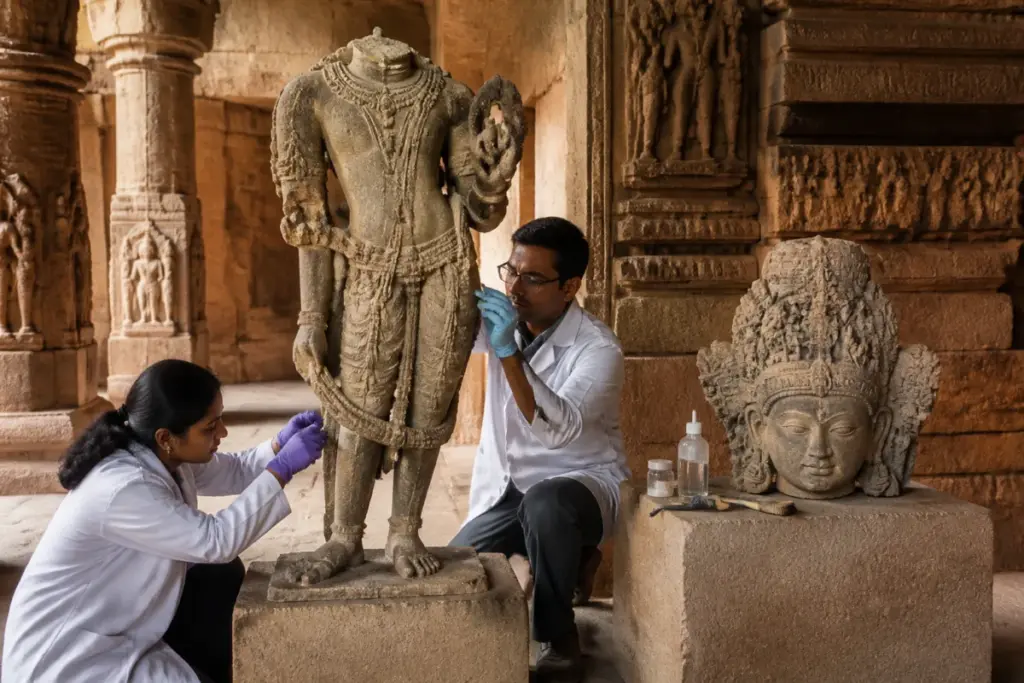
The planned restoration of Khajuraho’s headless Vishnu idol is more than the return of a missing stone fragment. It is a rare example of how the conservation of a historic monument can depend on institutional memory, the systematic examination of stored artefacts and the ability to match a fragment to a surviving sculpture after decades of uncertainty.
The Archaeological Survey of India is preparing to reattach the sandstone head to an 11th-century, seven-foot Vishnu idol at the Javari Temple in Khajuraho by November. The temple is part of the Khajuraho group of monuments, a UNESCO World Heritage site. The head, identified inside an ASI store in Khajuraho, has an elaborate crown known as a kirit mukut and is being held in a secure vault under the agency’s custody.
The identification followed a direction from ASI director general Yadubir Singh Rawat to examine stores and sheds where damaged sculptures and loose fragments had been kept. Shivakant Bajpai, head of the ASI’s Bhopal circle and previously head of its Jabalpur circle, traced the sandstone head to one of these storage locations and compared it with photographs of the original idol.
Rawat said the identification was supported by the matching stone composition, colour and proportions, as well as the distinctive crown. Those criteria matter because the central conservation question is not simply whether a fragment appears visually compatible with a sculpture. It must also correspond in material, scale, form and position. In this case, the surviving head and neck proportions were reported to create a near-perfect fit.
That process reveals a less visible part of heritage administration. The public usually encounters monuments as completed sites: temples, sculptures and architectural complexes presented as stable historical objects. Conservation agencies, however, also manage a large secondary landscape of damaged pieces, detached fragments and stored material. The discovery of the Vishnu head shows that the condition of a monument can depend not only on work at the site but also on what is documented, preserved and retrievable in institutional stores.
The ASI’s account also leaves an important historical question unresolved. Rawat said someone may have tried to break off the head to steal it but failed. How the head became detached remains unknown. The supplied account does not establish when the separation occurred, who caused it or how the fragment came to be stored at the Khajuraho facility.
That uncertainty is significant because the restoration is not merely a matter of placing one stone on top of another. The head carries the face, crown and identifying features of the deity, making it one of the most visually and symbolically important parts of the sculpture. Rawat described the reattachment as delicate work and said that reconstructing such a feature would be difficult if the original head had not been found.
The surviving sculpture provides a substantial basis for the restoration. Its torso, four arms and legs remain, along with ornaments including a kaustubh jewel, a vanamala garland, a girdle and anklets. Lakshmi and Garuda flank Vishnu, while miniature manifestations of the deity are carved on the principal figure. The recovery of the head therefore reconnects a distinct fragment to a larger sculptural composition rather than completing an otherwise empty pedestal.
A committee has been constituted to oversee the restoration. Its creation indicates that the decision has been placed within an institutional process rather than treated as an informal repair. The source does not provide the committee’s membership, technical protocol, attachment method or the conservation materials to be used. Those details will determine how the restoration balances structural stability, reversibility and the preservation of the original stone.
The planned work also highlights the difference between reconstruction and conservation. A missing component can sometimes be recreated, but a recreated head would involve decisions about facial features, proportions, ornamentation and historical interpretation. The presence of the original sandstone head avoids that problem, while still requiring the ASI to establish that the fragment belongs to the idol and can be safely reunited with it.
The matching evidence cited by the ASI includes the stone’s composition and colour, the proportions of the head and neck, and the form of the kirit mukut. These are material and visual clues that allow officials to move from an unidentified stored object to a specific historical attribution. Photographs of the original idol provided an additional reference point. Together, they show how conservation depends on comparing physical evidence with older visual records.
The episode also raises questions about the information systems behind monument protection. The source does not say how the loose head was catalogued, how long it had been in storage or why its connection to the Javari Temple idol had not earlier been established. It does show that the fragment remained within the ASI’s custody in Khajuraho and that an administrative instruction to examine stored material led to its identification.
That sequence gives institutional attention a direct conservation value. A fragment can remain physically safe yet historically disconnected if records, photographs and site knowledge are not brought together. Conversely, a review of stored material can recover information that changes the conservation possibilities at a monument. In the Vishnu case, the search did not produce a newly carved replacement; it located an original component that had been separated from the sculpture.
The idol had also become part of a legal and public controversy. In September 2025, Haryana farmer-activist Rakesh Dalal petitioned the Supreme Court seeking reconstruction and reinstallation of the idol. The court dismissed the plea. The episode was followed by criticism of remarks made by then Chief Justice of India BR Gavai to Dalal, and in October, lawyer Rakesh Kishore attempted to hurl a shoe at Gavai inside the courtroom.
That background shows how the condition of a monument can move from a technical conservation issue into a matter of public emotion and litigation. The court proceedings did not themselves restore the sculpture. The current restoration plan has emerged through the ASI’s identification of the head, comparison with photographs and the formation of a committee to oversee the work.
The institutional distinction is important. Courts can be asked to direct or consider action, but the technical assessment of a sculpture’s material, proportions and structural condition rests with conservation authorities. The supplied account does not indicate that the Supreme Court ordered the current reattachment. It attributes the plan to the ASI and records the agency’s stated target of completing the work by November.
For visitors, the eventual reunion could alter how the Javari Temple’s sculpture is read. A headless figure communicates damage and absence before its iconographic details can be fully understood. The restored figure would make the relationship between Vishnu’s face, crown, body, ornaments and attendant figures more legible. The source does not state whether the site will change its visitor arrangements, signage or interpretation after the work.
That omission points to the next stage of the story. Restoration is visible when the head is reattached, but conservation responsibility continues afterwards. The ASI will need to monitor the connection, protect the sculpture from further damage and document the completed intervention. The supplied report does not specify these post-restoration arrangements, so they remain matters to watch as the November target approaches.
The Khajuraho case ultimately demonstrates that heritage protection is not limited to preserving what remains standing in front of visitors. It also involves tracing displaced material, maintaining secure stores, comparing fragments with archival images and making carefully governed decisions about intervention. The original head’s recovery has made restoration possible, but the episode also exposes how much historical evidence can remain hidden in institutional custody.
The ASI has set up a committee to oversee the work and is aiming to reunite the head with the Vishnu idol by November. Until the restoration is completed, the precise method of attachment and the final condition of the sculpture remain undisclosed in the available account. The next decisive milestone is therefore the committee-supervised reinstallation at the Javari Temple.


