

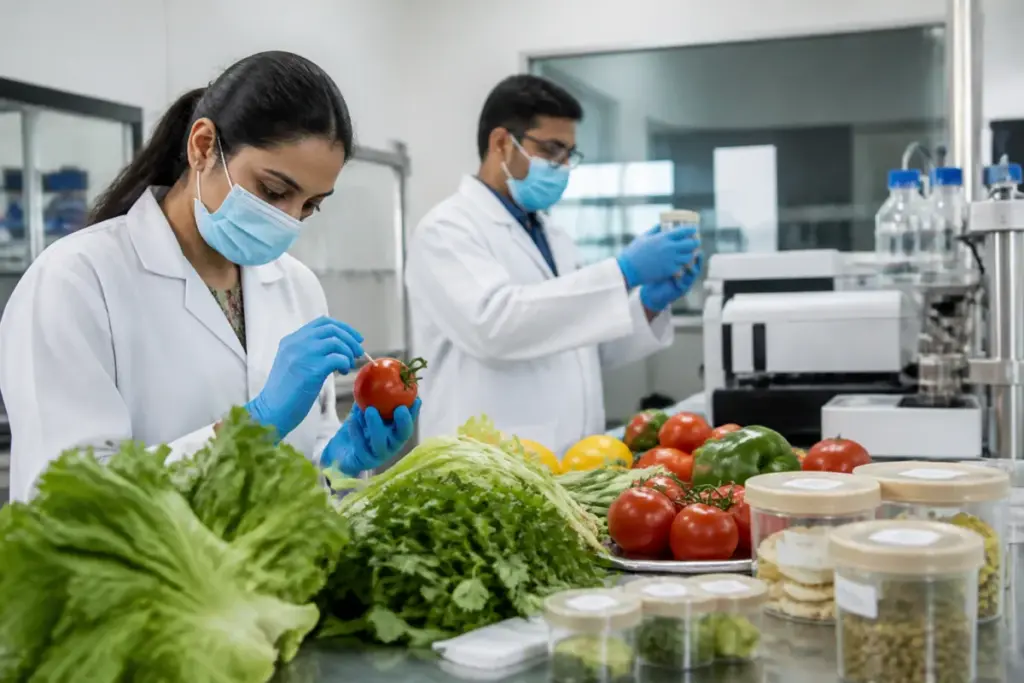
Pesticide residues in vegetables have become a food-safety concern in Gujarat, with 170 of 6,035 vegetable and fruit samples tested in the state between 2023 and 2026 found to contain residues above prescribed limits, according to figures reported by Gujarat Samachar. Across 23 states, 70,652 samples were examined and 3.1% reportedly exceeded the permitted level. The numbers do not mean that all vegetables are unsafe, but they expose a more consequential question: whether controls are working consistently from the farm and wholesale market to the household kitchen.
The Gujarat figure is significant because it places food safety within a wider urban supply-chain problem. Most city consumers have little visibility into which pesticide was used, in what quantity, when the crop was sprayed or how long it remained between spraying and harvest. The market presents the final product, while the decisions that determine residue levels are often made much earlier, on farms and within distribution networks. That distance makes routine testing and traceability central to consumer protection.
The reported data also require careful reading. The presence of pesticide residues and the presence of residues above the legally prescribed maximum limit are not the same thing. Agricultural chemicals may be detected without necessarily exceeding the permitted threshold. The more serious finding is the identification of samples above that limit, because it can indicate problems with the choice or quantity of pesticide, failure to follow the required interval between spraying and harvesting, or the use of substances that are not approved for a particular crop.
For Gujarat, 6,035 samples were reportedly tested during the period covered by the report, the fourth-highest sample count among the states listed. Karnataka recorded 9,176 samples, Telangana 8,198 and Punjab 6,582, while Himachal Pradesh recorded 5,765. Gujarat also recorded 170 samples with pesticide levels above the limit. Telangana reported the highest number in that category with 486, followed by Karnataka with 334 and Maharashtra with 260; Haryana was reported to have 152.
These rankings should not be treated as a simple league table of safer and less safe states. A higher number of detected violations may partly reflect a larger testing programme, wider coverage or the kinds of commodities selected for examination. Conversely, fewer reported violations may reflect fewer samples rather than a cleaner supply chain. The available figures establish the scale of testing and the number of samples above limits, but they do not provide enough information to compare the underlying risk between states or districts.
That limitation is important for urban readers. A sample-based surveillance system can identify a problem, but it cannot by itself show how frequently unsafe produce reaches a particular neighbourhood, market or household. The reported figures do not specify the crops involved, the pesticides detected, the exact locations of collection, the quantities of individual residues or the enforcement action taken in each case. Without that information, consumers can see the warning but not the full chain of accountability.
The institutional responsibility is divided. Farmers are expected to use pesticides approved for the crop, follow label instructions, apply the correct quantity and observe the waiting period between the final spray and harvest. The report also stresses the importance of protective equipment during spraying. These are not only matters of individual behaviour. They depend on access to clear technical advice, reliable product information, enforcement against prohibited chemicals and incentives that do not push growers towards excessive chemical use.
Food-safety authorities have a different but connected role. They are expected to collect samples regularly from markets and supply networks, send them for testing and act when residues exceed permitted limits. For urban consumers, this surveillance is the main institutional bridge between agricultural production and the retail market. Its effectiveness depends not only on the number of samples collected but also on how representative they are, how quickly results are processed and whether violations lead to traceable action.
The report’s health explanation also calls for precision. Exposure to high levels of some pesticides can cause symptoms such as nausea, vomiting, abdominal pain, dizziness, excessive sweating and nervous-system problems. The potential seriousness depends on the chemical, the amount and the duration and route of exposure. The report notes that concerns have also been raised about prolonged exposure to certain chemicals and possible effects on organs such as the liver and kidneys. These statements do not establish that eating a particular residue-positive vegetable will cause a specific illness. They show why the level and type of residue matter.
Children and pregnant women require particular care because exposure can have different consequences depending on body weight and vulnerability. But a risk-based response should not become a blanket warning against eating vegetables. The reported figures support stronger control of production and distribution, not the conclusion that consumers should abandon an essential part of their diet.
Household washing can reduce soil, dust and some surface residues when vegetables are cleaned under running water. Separating and washing leafy vegetables, removing damaged outer leaves and peeling produce where appropriate may also help. However, washing cannot be assumed to remove every residue, particularly chemicals absorbed into the vegetable or strongly attached to its surface. Cooking can reduce some biological risks, but heat does not destroy every pesticide. The report also cautions against using soap, detergent or household cleaning chemicals on vegetables.
For cities, the larger issue is the opacity of the food system. Consumers are asked to make safe choices largely through appearance, smell and household preparation, even though normal appearance does not prove that produce is free of pesticide residues. The burden therefore cannot rest primarily on the buyer. Safety has to be built into the chain through farm-level guidance, market inspections, laboratory capacity, enforcement and information that links a failed sample to a corrective response.
The available figures confirm that samples above prescribed pesticide limits were found in Gujarat and in several other states. They do not, by themselves, establish the prevalence of unsafe vegetables across the entire market or identify the specific commodities and chemicals responsible. The next questions for public agencies are how samples were selected, what action followed the reported violations and whether testing is being used to improve practices at the farm and market levels. Until those details are available, the data are best understood as a warning about the need for stronger farm-to-table food-safety oversight rather than as a reason to treat all vegetables as hazardous.


