

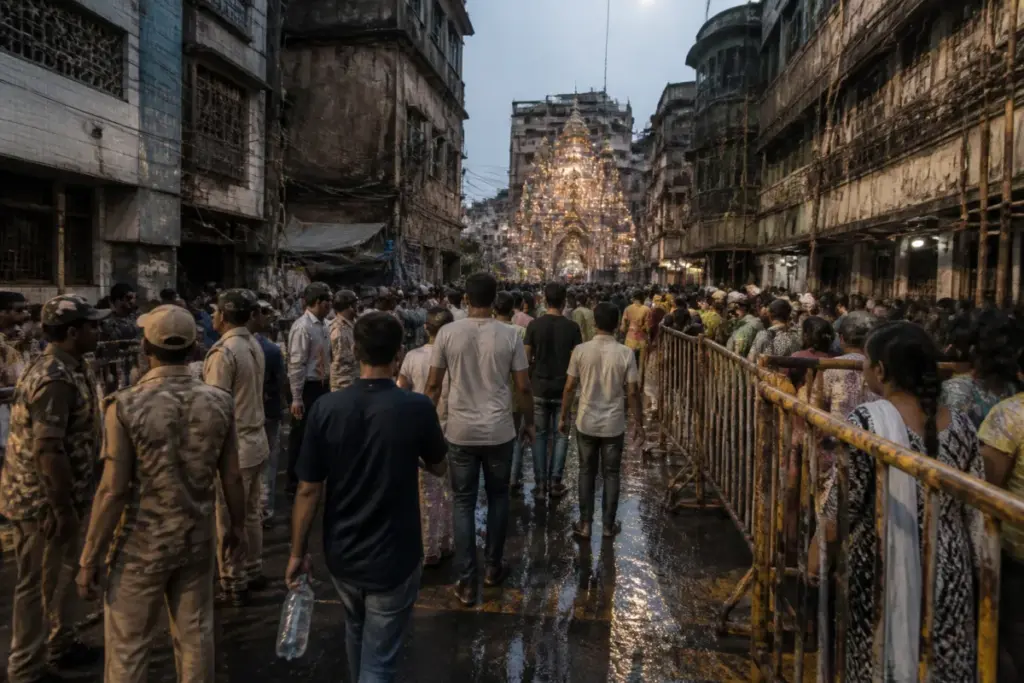
A reported stampede at the Chorbagan Sarbojanin Durga Puja in central Kolkata has brought the city’s festival crowd-management systems under scrutiny, after a media report said 19 people died and 25 were injured during heavy footfall on the evening of 17 October. The supplied report attributes the casualty figures to recent reports, while police are said to be investigating the circumstances and the role of an announcement warning that the pandal might collapse.
The incident reportedly occurred between about 7 pm and 8 pm, when rain began in an already crowded area around Ram Mandir, Chittaranjan Avenue and Radha Madhab Saha Lane. Chorbagan’s 91st Durga Puja was attracting visitors because of its theme, ‘Beyond Sound’, conceived by artist Sushanta Sibani Paul. The concept sought to create a quiet, reflective environment away from the noise and pressure of the city. The reported disorder, however, has shifted attention from the installation’s artistic design to the safety of the public space around it.
The supplied report says the pandal is located in an area marked by narrow lanes and limited movement space. Local people reportedly told the publication that some stretches allow only three or four people to walk alongside one another. Such constraints become significant during a festival in which visitors arrive in large numbers, queue for long periods and attempt to move towards the same destination. The nearest Metro access mentioned in the report is Mahatma Gandhi Road station.
The reported sequence points to the interaction of several crowd pressures rather than a single confirmed cause. Rain may have prompted people to move towards the pandal or seek shelter. At the same time, the existing crowd was already placing pressure on the narrow access routes. The article says that an announcement about the pandal being in poor condition or at risk of collapsing is being investigated. It also refers to whistles used by private security personnel and to questions over whether these signals or messages created confusion and panic.
These details remain subject to investigation. The report does not provide a primary police statement, hospital record, municipal document or official casualty bulletin confirming the death and injury figures. It also does not establish whether the alleged announcement was made, who made it, whether it was factually justified or whether it directly caused people to move suddenly. Those distinctions are important in determining responsibility and in separating the confirmed event from preliminary accounts.
Even with those limitations, the reported incident illustrates why crowd safety at major urban festivals cannot be treated as an arrangement added after the visual design is complete. A popular pandal is a temporary public venue. Its planning involves the movement of large numbers of people through roads and lanes that may have been designed for ordinary neighbourhood traffic, not festival-scale visitor flows. The safety challenge therefore extends beyond the structure itself to the entire approach network, queue system, entry points, exits, weather response and emergency access.
The article raises questions about how the crowd was monitored, how many police personnel, private guards and volunteers were deployed, and whether their roles were clearly defined. It also asks whether entry and exit routes were separated, whether the number of visitors inside the pandal was controlled and whether medical assistance could reach the site quickly. None of these questions can be answered conclusively from the supplied material, but they form the operational core of any investigation into a crowd incident in a constrained urban setting.
The Chorbagan case also draws attention to emergency communication. In a dense crowd, a loudspeaker message, whistle or instruction can alter movement within seconds. If people believe that a structure is about to fall, they may try to leave simultaneously. Where exits are narrow or obstructed, individual attempts to move quickly can create pressure on those ahead. The report says police are examining whether the announcement and security personnel’s whistles contributed to confusion. Establishing the exact wording, source, timing and authorisation of any such message will be necessary before drawing conclusions.
The reported arrests add an institutional dimension to the case. According to the supplied article, reports published on 18 October said that seven people had been arrested and that police had registered a case relating to culpable homicide. The article also says a special investigation team was reportedly formed. These details require confirmation from the police or another authoritative agency, but if verified, they indicate that the investigation is examining both individual actions and the wider organisation of the event.
A credible inquiry would need to reconstruct the site and the movement of visitors minute by minute. It would need to examine the approved safety plan, the number and location of security staff, arrangements for emergency evacuation, the availability of medical support, weather conditions and communications between the puja committee, private security agency and police. It would also need to establish whether the expected crowd had been assessed in advance and whether any threshold existed for slowing or stopping entry.
The public-safety issue cannot be reduced to visitor behaviour. The supplied report discusses queue-cutting, pushing, blocking exits and ignoring directions as possible risks during pandal visits. Public cooperation is necessary in crowded events, but it does not replace institutional planning. When an organiser expects a large turnout in a narrow lane, responsibility also lies with the event management system to regulate access, keep escape routes open, train personnel and provide clear instructions during a sudden change in conditions.
This is especially relevant to Kolkata’s contemporary puja culture, in which pandals combine religious observance, public art, lighting and large-scale visitor movement. A theme can make a neighbourhood destination more attractive, but the same popularity can turn the surrounding streets into a temporary transport and crowd-management problem. The success of such an event cannot be assessed only by the number of visitors or the visual impact of the installation. Safe movement is part of the event’s basic civic infrastructure.
The report’s account also shows the limits of judging a tragedy through symbolism. Chorbagan’s ‘Beyond Sound’ theme was intended to create a space of quiet and spiritual reflection. But public safety depends on less visible systems: verified announcements, trained personnel, controlled queues, usable exits, adequate lighting, weather contingencies and coordination with emergency services. These systems do not necessarily appear in photographs of a pandal, yet they determine whether a crowded public celebration remains manageable.
At this stage, the central facts require authoritative confirmation. The reported number of deaths and injuries, the precise cause of the crowd surge, the role of rain, the alleged collapse warning, the adequacy of security deployment and the legal status of those detained should be established through police, hospital, administrative and investigation records. The special investigation team, if formally constituted, will be central to clarifying those points.
What the supplied report establishes is the seriousness of the public-safety questions surrounding the Chorbagan event. What remains unresolved is how the crowd reached a dangerous level, which decisions shaped the movement of people and whether the failure was individual, organisational or systemic. Those findings will determine whether the incident becomes only a criminal investigation or also leads to a broader review of safety planning for Kolkata’s high-footfall festivals.


