

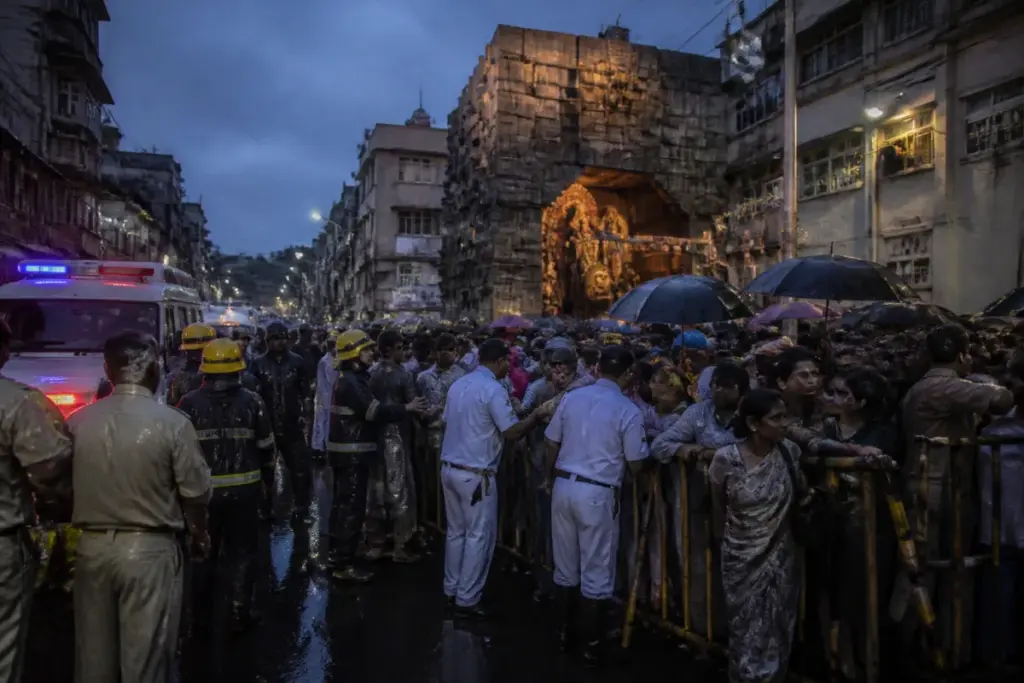
The Chorbagan stampede in north Kolkata has killed 19 people and injured more than 35 others after heavy rain triggered a surge of visitors at the Chorbagan Sarbojanin festival pandal on Saptami evening, according to a report by Sangbad Pratidin. Doctors cited in the report said many of the victims appeared to have died from suffocation caused by crowd pressure. The death toll could rise.
The incident unfolded in a densely built part of north Kolkata where the pandal was located inside a narrow lane and visitor numbers had increased from the afternoon. The venue’s popularity had reportedly spread through media coverage and videos by social-media creators, drawing large crowds. By around 6.30 pm, queues were said to have extended along Central Avenue towards Mahatma Gandhi Road Metro station.
Heavy rain began at about 7 pm. According to eyewitness accounts cited by the newspaper, visitors waiting to enter the pandal began moving forward in a rush to escape the weather. Sangbad Pratidin reported that part of the pandal structure collapsed amid the pushing, prompting people on an elevated section to scramble towards a staircase leading down. The stampede reportedly occurred around 7.20 pm as people tried to descend.
The first bodies began reaching Medical College around 7.40 pm, the report said. Chief Minister Shubhendu Adhikari, Industries Minister Tapas Roy, the director general of police and the police commissioner reached the hospital at about 9 pm, according to the report.
The precise sequence of events has not yet been established through an official investigation. Police had not issued a formal statement at the time of the report’s publication. Eyewitnesses and local residents raised questions about crowd-control arrangements, the length of time visitors were held in queues and the management of separate VIP access. The report also cited claims that announcements from inside the pandal were confusing and may have added to the disorder.
Local residents alleged that the number of police personnel deployed was inadequate despite the crowd being a regular feature of the festival. Questions were also raised about the experience of volunteers managing the queues and about the availability of ambulances after the incident. These claims remain part of the preliminary accounts cited by the newspaper and have not been independently established in the supplied material.
A police source cited in the report said the administration had been attempting to control the crowd from the beginning, but that the volume of visitors became excessive and the rain pushed the situation beyond control. The account does not provide details of the number of police personnel, volunteers or ambulances deployed at the site.
The incident has placed immediate focus on the safety of temporary festival structures and on how narrow streets, large queues, rain-related shelter-seeking and emergency access are managed during Kolkata’s major public celebrations. The next formal steps are expected to include an official account of the deaths and injuries, clarification of the crowd-control arrangements and an assessment of the pandal structure and emergency response.


