

Karnataka’s 2025 law banning the Devadasi system marks a significant legal break with a practice that has survived despite the state’s 1982 prohibition. But the experience of families in north Karnataka shows why ending dedication on paper is only the first stage of rehabilitation. The harder task is addressing the poverty, stigma, missing legal identities, insecure housing and limited livelihoods that have carried the system’s effects across generations.
The story of Chandalinga Kalalabandi, a 38-year-old activist from Kushtagi taluk in Koppal district, illustrates this institutional gap. The grandson of a Devadasi, he grew up watching women in his family and community face sexual exploitation, abandonment and social exclusion. He now runs the Vimukta Devadasi Mahila Vedike, an organisation that has documented the condition of Devadasi families and worked with other groups in Bengaluru to seek better living conditions and policy support.
The Devadasi system is described in the supplied account as a religious-social practice in which girls, often from Dalit and other marginalised communities, were dedicated to a local deity in a ritual resembling marriage. After dedication, women were traditionally barred from marriage and expected to serve the temple, perform ritual music and dance, and provide sexual services to patrons. In practice, the system became a form of caste-based sexual exploitation, reinforced by poverty, debt and superstition.
Its consequences were not confined to the moment of dedication. Women faced stigma, poverty, vulnerability to trafficking and HIV, and the absence of legal paternity for their children. Their children often entered schools and official systems carrying a social disadvantage that was both visible and difficult to formally address. Chandalinga recalled children being asked for their father’s name at school and leaving education because they could not provide one without facing humiliation or exclusion.
This is where the issue becomes a question of governance rather than only social reform. A law can prohibit dedication, but it cannot by itself supply a house, land, education, employment, documentation or community acceptance. The experience recorded in north Karnataka suggests that the state must treat rehabilitation as a multi-generational public programme rather than as a single welfare payment or a one-time administrative exercise.
The first major gap was between the 1982 law and conditions on the ground. Karnataka enacted the Devadasis (Prohibition of Dedication) Act in 1982, but the practice continued to affect communities in Belagavi, Koppal, Raichur, Ballari, Vijayanagara, Bagalkot and Dharwad. The earlier law prohibited dedication but, according to the report, did not provide adequate relief for the families already living with its consequences. As a result, the formal prohibition did not remove the economic and social conditions that made women and girls vulnerable.
Chandalinga’s activism helped bring the intergenerational dimension into public view. In 2018, his organisation held a mass marriage for 32 couples who were children of Devadasis in Kushtagi. Marriage itself did not solve the structural problems facing these families, but the event challenged the assumption that the children of Devadasis had to remain socially isolated or excluded from ordinary family and community life. It also drew media and government attention to the broader condition of the community.
The state subsequently announced a survey of Devadasis. The report cited in the account identified about 23,395 Devadasis in Karnataka. Chandalinga was appointed to the state survey committee, which found that 91.79 per cent of Devadasi women were illiterate. The committee recommended incentives for Devadasis extending up to three generations and proposed that mentioning the father’s name should not be mandatory in schools, colleges and various application forms.
These recommendations reveal the breadth of the problem. Literacy is not only an education indicator in this context. It is connected to access to welfare, employment, legal documents and the ability to navigate public institutions. Similarly, removing the compulsory father’s-name field from forms addresses a practical barrier, but it also acknowledges that government systems can reproduce the stigma faced by children from single-parent or socially excluded households.
The 2025 legislative reform attempted to move beyond prohibition. In August 2025, the Karnataka government tabled the Devadasi (Prevention, Prohibition, Relief and Rehabilitation) Bill, which was passed by both houses of the state legislature. The measure replaced the 1982 law, completely outlawed the Devadasi system in all forms and included relief and rehabilitation programmes. The change in the law’s title is significant because it places relief and rehabilitation alongside prevention and prohibition rather than treating them as secondary concerns.
However, the implementation record described by Chandalinga remains incomplete. He said special packages had been announced and ordered, but that housing and other schemes were still pending. According to his account, Devadasi children were receiving Rs 5 lakh, while housing support had not yet been fully delivered. This contrast captures a recurring problem in welfare administration: a benefit can be sanctioned, but the wider system required to convert it into secure living conditions may remain fragmented or delayed.
Housing is particularly important because land and shelter provide more than physical protection. For families historically pushed to the margins, a secure home can reduce dependence on exploitative employers, support children’s education and create a base for livelihoods. Without housing, other assistance may not produce durable independence. The report does not establish the scale or district-wise status of pending housing benefits, but it clearly records that implementation remains a concern for community representatives.
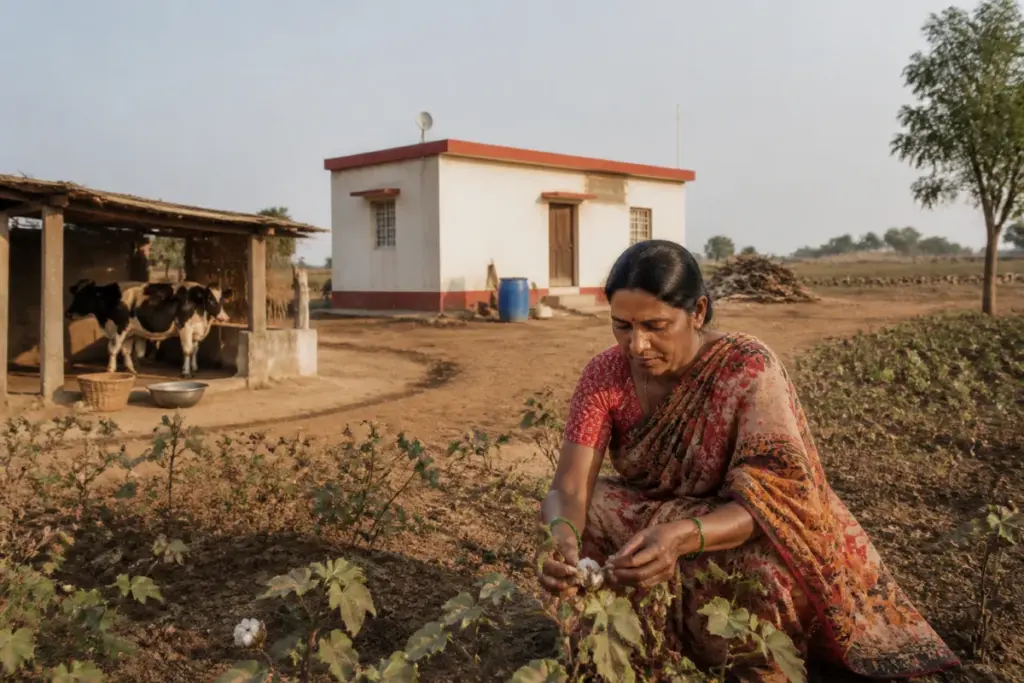
Land access offers one example of what rehabilitation can look like when it reaches the level of household assets. Vijamma, who was forced into the system at about 12 years of age, has been rehabilitated and is among 1,039 people who received land from the government. She now grows cotton on agricultural land and runs a dairy business. Her experience indicates that rehabilitation can involve productive assets and livelihood opportunities, not only compensation or symbolic recognition.
At the same time, one successful account cannot stand in for a system-wide outcome. The available material does not provide a current assessment of how many eligible women and children have received land, housing, education support or the announced financial assistance. It also does not establish whether benefits are reaching all the districts where the practice has been reported. Those gaps matter because the community is spread across several districts and because the survey itself identified a large population requiring sustained support.
The administrative challenge is therefore one of coordination. The law concerns social justice, but its implementation touches education departments, local administration, housing and land authorities, livelihood programmes and institutions responsible for legal documentation. The recommendation on fathers’ names also requires changes in the forms and procedures used by schools, colleges and public agencies. A legal prohibition can be monitored through enforcement, but rehabilitation requires departments to identify beneficiaries, process claims, transfer assets, resolve documentation issues and follow up over time.
The account also shows why community-led documentation has become important. Chandalinga began by registering the experiences of marginalised families and recording ground realities. This work helped make visible problems that are often absent from official categories: children without accepted paternal identification, women abandoned after exploitation, families excluded from marriage and employment, and survivors lacking secure land or housing. Administrative systems can only deliver targeted benefits when the people affected are properly identified and their needs are recorded.
The urban connection is less about the location of every affected family than about the movement between rural and urban economies. Chandalinga worked with organisations in Bengaluru, while accounts in the report include women travelling to cities to earn money and families depending on urban employment when rural support failed. Bengaluru and other cities therefore form part of the rehabilitation chain, even when the original vulnerability is concentrated in north Karnataka. Urban institutions, employers and civil-society organisations encounter the consequences of rural social exclusion through migration, informal work and the search for health, education and income.
The legal reform also raises a question about how the state measures success. A decline in new dedications would be important, but it would not show whether older generations have secured homes, land, education and livelihoods. Nor would it reveal whether children continue to face discrimination in schools and official forms. The evidence in the account suggests that prevention and rehabilitation require different indicators. Prevention concerns whether the practice continues; rehabilitation concerns whether families can live without the economic and social conditions that once sustained it.
Karnataka’s 2025 Devadasi law has therefore created a stronger formal framework than the earlier prohibition, but the supplied evidence points to an unfinished implementation process. The state has conducted a survey, recorded the scale of the affected population, passed a new law and provided land to at least 1,039 women. Yet housing and other promised measures remain pending in the account, while the broader status of education, financial support and multi-generational rehabilitation is not established.
The next test will be whether the new legal framework can move from prohibition to durable public provision. That means tracking the delivery of announced packages, housing and land, ensuring that children are not excluded by documentation requirements, and maintaining attention on communities across north Karnataka after the legislative moment has passed. Chandalinga’s journey from a child who witnessed exclusion to an organiser pressing for reform shows how lived experience can influence policy. The effectiveness of that policy will ultimately be judged by whether families can secure dignity and livelihoods without carrying the Devadasi system’s stigma into another generation.


