

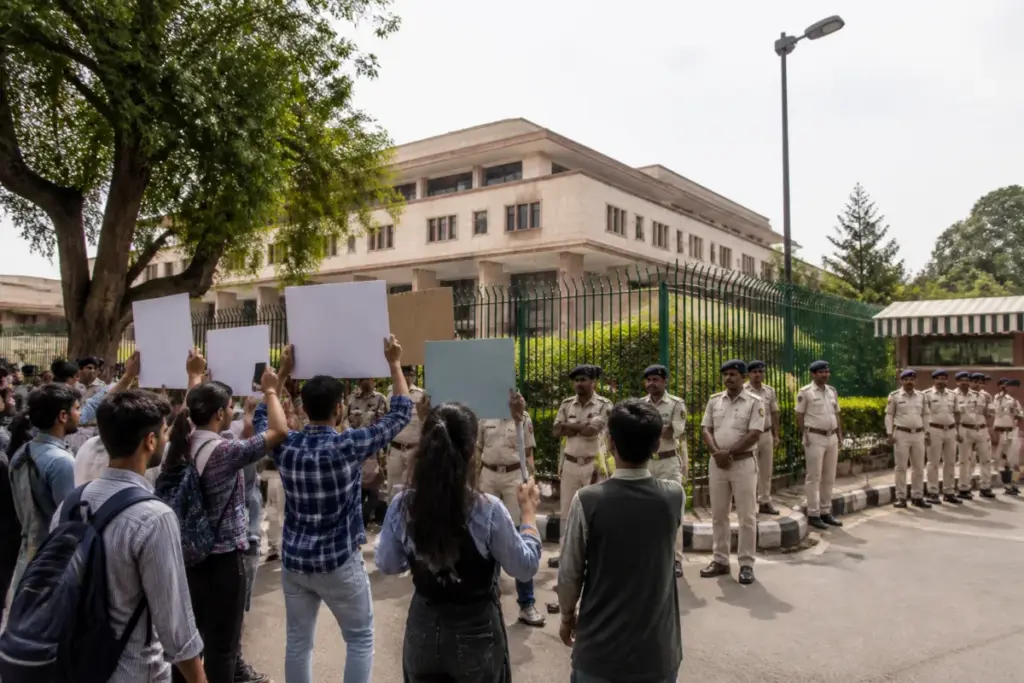
The Delhi High Court has quashed a first information report against a student who attended a protest over alleged irregularities in examinations, holding that mere participation in a demonstration does not establish an intention to disobey lawful police directions or obstruct police personnel in their work.
The student, who was preparing for the Staff Selection Commission examinations, had joined the protest at Delhi’s Ramlila Maidan on 24 August 2025. The demonstration had been organised against alleged irregularities in examinations. The FIR was registered at the Kamla Market police station.
The court’s reasoning, as reported by Jagran, centred on the distinction between being present at a protest and sharing a criminal intention with others accused in the case. It said that participation in a demonstration alone cannot prove that a person intended to disregard lawful police instructions or interfere with police duties.
The court also examined the application of Section 3(5) of the Bharatiya Nyaya Sanhita, which concerns the principle of common intention. The provision requires the criminal act to have been carried out in furtherance of the shared intention of the people being held jointly responsible, the report said.
The case relates to a protest for which permission had been granted for 24 and 25 August 2025, between 10 am and 5 pm. The permission details were placed before the court during the proceedings. The report does not state that the student was accused of a separate, specific act of violence or obstruction beyond participation in the protest.
The prosecution told the court that a chargesheet had already been filed against 29 people, while further investigation concerning other protesters was continuing. The High Court’s order in the student’s case therefore addresses the basis on which an individual participant can be prosecuted alongside others involved in a public demonstration.
The ruling has relevance beyond the individual FIR because public protests in Delhi frequently take place in designated grounds and other heavily policed public spaces. Such demonstrations involve arrangements concerning permissions, crowd management, traffic movement and police directions. The court’s observation draws a legal line between those arrangements and the criminal attribution of a shared intention to every participant.
The decision does not, on the facts available in the report, rule that all conduct during a protest is protected from prosecution. It concerns the evidentiary basis for proceeding against this student under the provisions invoked in the case. The prosecution’s statement that chargesheets had been filed against 29 people and that investigation into others was continuing remains part of the record described in the report.
The next legal position for the other accused protesters will depend on the proceedings in their individual cases and on the evidence collected during the continuing investigation.


