

Delhi’s Special Intensive Revision (SIR) of electoral rolls has moved into a corrective phase, with booth-level officers (BLOs) directed to identify eligible voters left out of the draft rolls and help them apply through Form 6. The exercise is not a minor administrative follow-up: the draft process classified around 47.5 lakh electors as “uncollectible”, while another 33.1 lakh people included in the draft roll were issued notices to establish their eligibility for the final list.
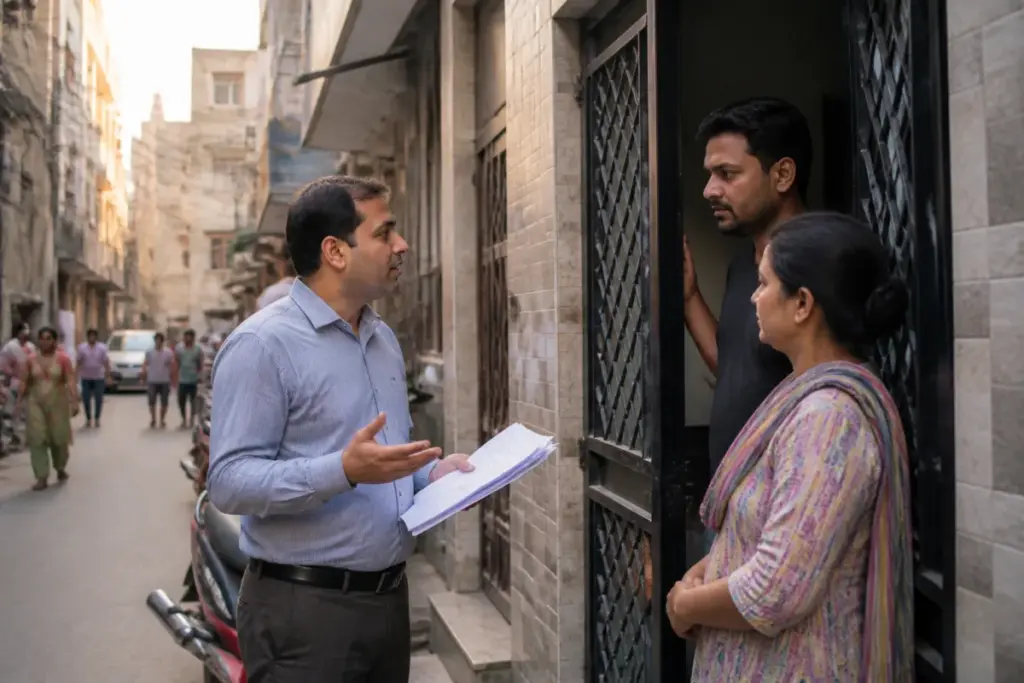
The Delhi Chief Electoral Officer’s office ordered a special re-verification drive on October 14, according to a report by The Indian Express. BLOs were asked to revisit electors marked absent, shifted, dead or duplicate — categories collectively described as ASDD — and check whether any names had been removed incorrectly. Where an elector marked absent or shifted is found living at the recorded address, the officer is expected to obtain a Form 6 application for enrolment.
The instructions place the BLO at the centre of a process that combines verification, correction and fresh enrolment. The officers have been asked to conduct 100% re-verification of the ASDD list within seven days, maintain records of the people contacted and carry blank Form 6 applications during house visits. The CEO’s office has also directed officials not to refuse physical Form 6 applications and to digitise them within two days of receipt.
That combination of duties is significant because the SIR process has created two distinct administrative problems. The first concerns people who were left out of the draft roll after being classified as absent, shifted, dead or duplicate. The second concerns people whose names appear in the draft but whose eligibility has been questioned through notices. The latest instructions seek to address both issues through field-level verification, but they do so under a compressed timeline before the final roll is scheduled to be published on December 4.
The numbers show why the revision has become a governance challenge rather than a routine voter-list update. Delhi had around 1.45 crore electors before the SIR began in June. Of these, 97.5 lakh were included in the draft electoral roll published on August 31. Around 47.5 lakh were classified as uncollectible after BLOs found them absent, shifted, dead or associated with duplicate entries, among other reasons.
The size of the excluded group is especially important because an electoral roll is not only a database maintained by an institution. It is the administrative gateway through which residents exercise a constitutional right. When a name is removed or omitted, the burden shifts to the individual to discover the problem, understand the relevant procedure and submit documents within the prescribed period. The re-verification order acknowledges that this burden cannot be managed entirely through office-based notices or hearings.
The CEO’s office had already been conducting house-to-house visits to collect documents from electors who received notices. Among the 33.1 lakh people issued notices, 13.79 lakh were flagged because they could not link themselves to the electoral roll of the last SIR, while 19.33 lakh were identified through what the authorities described as “logical discrepancies” in their enumeration forms. The office said 26 lakh of these cases had been resolved.
The figures also reveal how the revision has produced different forms of uncertainty. Some electors were not present at the address when verification took place. Others may have moved, died or appeared in duplicate records. A separate group remains on the draft roll but has been asked to prove eligibility. These categories may have different administrative explanations, yet they converge at the point where the voter must establish a continuing relationship with the electoral record.
This is where the role of the BLO becomes crucial. The latest instructions do not merely ask officers to process applications received from residents. They require them to identify eligible people who may not approach the system themselves. The direction to carry sufficient blank Form 6 applications and to facilitate enrolment “wherever the person is found to be eligible” turns the field visit into an active outreach exercise.
The reported communication, however, also points to an institutional weakness. Multiple BLOs told The Indian Express that they had received instructions verbally or through WhatsApp groups but had not received a formal order. The report also cited a communication from an Electoral Registration Officer directing 100% re-verification of the ASDD list. This distinction matters in a process where officers must handle identity, residence and eligibility records, preserve documentation and meet a defined deadline. Informal communication can transmit an instruction quickly, but formal documentation establishes the authority, procedure and record against which implementation can later be assessed.
The administrative timeline leaves limited room for error correction. The last date for filing Form 6 for new voter enrolment is October 31, while the final SIR roll is scheduled for December 4. Between August 31 and October 16, only 2.3 lakh Form 6 applications had been filed, according to official data cited in the report. That number cannot by itself establish how many eligible people remain outside the roll, but it shows that the re-enrolment channel had received a relatively small volume of applications before the special drive was reported.
The response has also expanded beyond ordinary office-based procedures. Special camps have been held every weekend in Delhi since September 20, including camps aimed at groups identified as particularly vulnerable to exclusion: homeless people, those displaced by demolitions, transgender people and sex workers. These groups often face difficulties maintaining a stable address or producing documents that align neatly with administrative records. Their inclusion in the outreach effort indicates that the revision is being treated, at least in part, as a question of access to the enrolment process rather than only a question of record cleaning.
The issue extends beyond Delhi. The Indian Express previously reported that the Election Commission of India had directed 20 states and Union Territories where the exercise had been completed to conduct special drives to enrol voters left out of the rolls. Civil society groups and political parties have raised concerns that eligible electors may have been deleted from electoral rolls. The Delhi case therefore offers a view of a wider administrative pattern: an intensive verification exercise can remove or flag large numbers of records, after which the system must create mechanisms to identify and restore eligible residents.
The evidence supplied in the report does not establish how many of the 47.5 lakh people classified as uncollectible are eligible voters who were wrongly excluded. Nor does it establish how many of the 33.1 lakh notices will ultimately result in deletions, confirmations or corrections. Those outcomes will depend on the re-verification process, the documents submitted, the decisions of election officials and the final roll. What is established is the scale of the exercise and the fact that the authorities have introduced an additional field-level effort to locate and enrol people who may have been left out.
That distinction is important for understanding the policy problem. A clean electoral roll requires the removal of entries that are genuinely duplicated, invalid or no longer applicable. An accessible electoral roll also requires that eligible residents are not excluded because they were unavailable during a visit, moved after enumeration, lacked information about the process or could not navigate a notice-and-hearing system. The SIR’s next phase must therefore perform two administrative functions at once: improve the accuracy of the list and protect the continuity of eligible voters’ registration.
For residents, the immediate question is procedural. People who believe they have been left out can potentially use Form 6 before October 31, while those who have received notices must respond through the process specified by election officials. The reported instructions say physical applications should not be refused, should be digitised within two days and should not be rejected on frivolous grounds. These safeguards are central to whether the re-enrolment exercise becomes a meaningful correction mechanism or simply another layer of paperwork.
Delhi’s SIR now stands at the intersection of electoral administration and urban mobility. The capital’s population includes residents who move between neighbourhoods, tenants who change addresses, people displaced by demolitions and citizens who may not have a stable relationship with official records. The revision process has exposed how those everyday urban conditions can affect the apparently simple question of whether a person’s name appears on a voter list.
The final roll, scheduled for December 4, will provide the next major test. Until then, the available evidence confirms a large-scale revision, a substantial number of exclusions and notices, and an official attempt to find and re-enrol eligible electors. It does not yet show how many people were wrongly left out or how effectively the special verification drive resolved that problem.


