

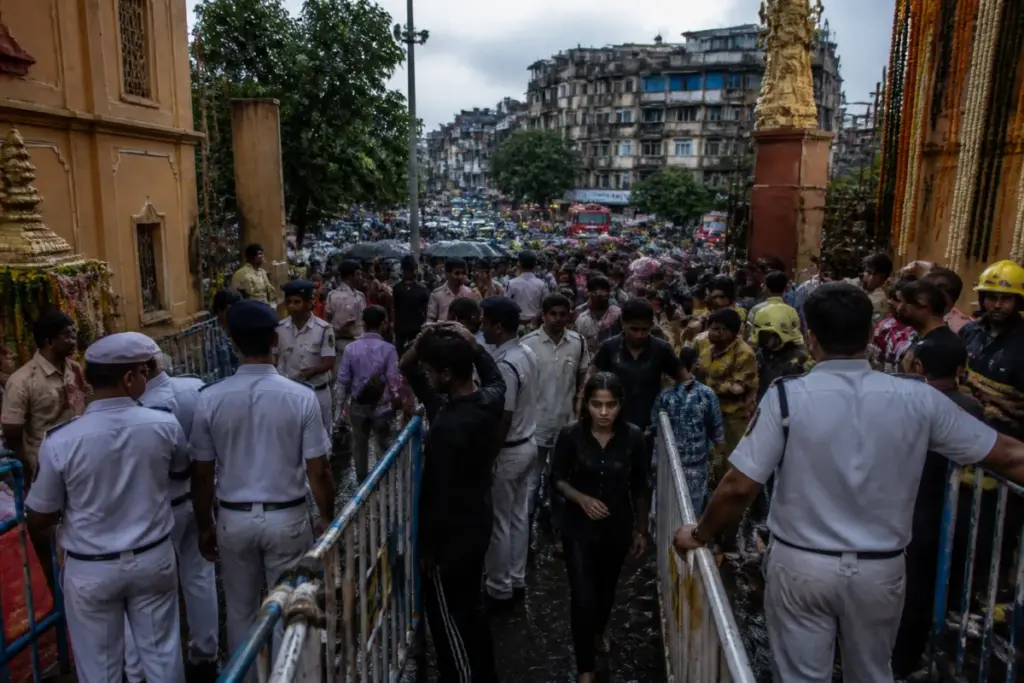
The Kolkata stampede at the Chorbagan Durga Puja pandal has left 19 people dead and 25 injured, prompting an investigation into crowd-control arrangements, emergency response and the management of major festival venues across the city. Police have detained 14 people, including members of the organising committee, while several prominent pandals were asked to temporarily stop admitting visitors.
The incident occurred around 7.30pm on Saturday after a sharp spell of rain drove visitors towards the pandal for shelter. The venue, located inside the narrow Radha Madhab Saha Lane in north Kolkata, had already been drawing heavy crowds for several days. Visitors had been queuing along Central Avenue and the approach lane, while temporary restrictions on movement had reportedly been imposed on multiple occasions to stagger the rush.
According to the report, the rain lasted for nearly an hour. People who had entered the pandal were reluctant to leave, while those waiting outside continued to press forward. Eyewitnesses said a surge developed near a flight of stairs close to the exit, causing several people to fall. Others fell on top of them as the crowd intensified. Some visitors escaped after local residents dismantled part of the pandal, while others were pulled out from the crush.
Ram Sarkar, whose wife Arati died in the incident, told the newspaper that the couple arrived after seeing videos of the pandal’s interiors on social media. He said the queue had extended to Central Avenue and that the crowd moved towards the entrance as the rain grew heavier. According to his account, volunteers removed barricades and allowed more people to enter. He described the interior as dark and tightly packed, and said he became separated from his wife after people began pushing from behind.
Sarkar also alleged that no volunteers, police personnel or organisers came forward to assist people immediately after the fall. He said an ambulance was not available at once and that it took more than an hour to arrange one. Other families similarly alleged that victims had to be transported to Calcutta Medical College and Hospital in private cars and taxis because emergency arrangements were inadequate.
The pandal’s physical layout is among the issues being examined. Visitors descended from an upper deck by a flight of stairs to a lower level near the exit, potentially complicating movement during the surge. Questions have also been raised about the narrow approach lane, the placement of barricades, announcements about entry and exit, the number of police personnel and volunteers, and whether security deployment was concentrated near a VIP entrance.
The sudden weather change added to the pressure. H R Biswas, deputy director general of meteorology, said the showers were linked to the retreating monsoon. A weather official said the rain made the ground soggy and affected footing, while its persistence for more than 45 minutes contributed to the conditions in which the crowd surge unfolded. The report said the Met office had forecast sporadic rain, but the evening spell was sharper and longer than expected.
The emergency department at Calcutta Medical College and Hospital was overwhelmed as injured visitors arrived from around 8pm and continued to be brought in late into the evening. Police restricted access to parts of the hospital, leaving relatives seeking information about missing family members. Among the victims were 18-year-old Tania, who had gone pandal-hopping with friends, 21-year-old Suman Sonkar and 20-year-old Priya Samaddar from Madhyamgram.
Investigators have collected CCTV footage and are questioning the puja committee, police personnel and staff involved in crowd management. A forensic team visited the pandal late on Saturday night, and investigators have sought the list of security guards and other workers deployed at the site. The chief minister, Suvendu Adhikari, visited the hospital and met families of the deceased. He said an initial assessment suggested that an announcement made by the puja committee may have contributed to the incident, while also stating that the investigation would examine the roles of organisers, homeguards, temporary workers, police personnel and private security guards.
The state government has announced compensation of Rs 25 lakh and a government job for the next of kin of each person who died. Each injured person is to receive Rs 5 lakh. Adhikari also urged puja organisers to follow safety guidelines and ensure adequate illumination inside pandals, particularly where elaborate themes result in dimly lit installations.
The administration has begun reviewing crowd-management arrangements at other major Durga Puja venues. Tala Pratyay, Alipore Sarbojanin, Chetla Agrani and Ballygunge Sarbojonin were among the prominent pandals asked to suspend entry, while the show at Allen Park was cancelled. Santosh Mitra Square reduced visitor numbers, and major pujas in Salt Lake were also asked to stop entry as a precaution.
At Chetla Agrani, organisers said volunteers raised concerns after rain led to a sharp increase in the crowd inside. Police assessed the situation and ordered an evacuation. The organisers closed entry gates, opened exits and removed barricades to help visitors disperse, saying the situation had not reached the point of a stampede. Tala Pratyay said it would reassess lighting, entry and exit points and crowd-management arrangements before reopening. Other organisers said they were increasing volunteer deployment and monitoring crowd movement.
The Chorbagan tragedy is the deadliest major crowd incident reported during Kolkata’s Durga Puja in the period covered by the report. Investigators are now examining how the venue’s narrow access, temporary crowd controls, rain-driven demand for shelter and difficulties at the exit combined during the surge. Authorities are expected to review arrangements with organisers before deciding when the affected pandals can resume admitting visitors.


