

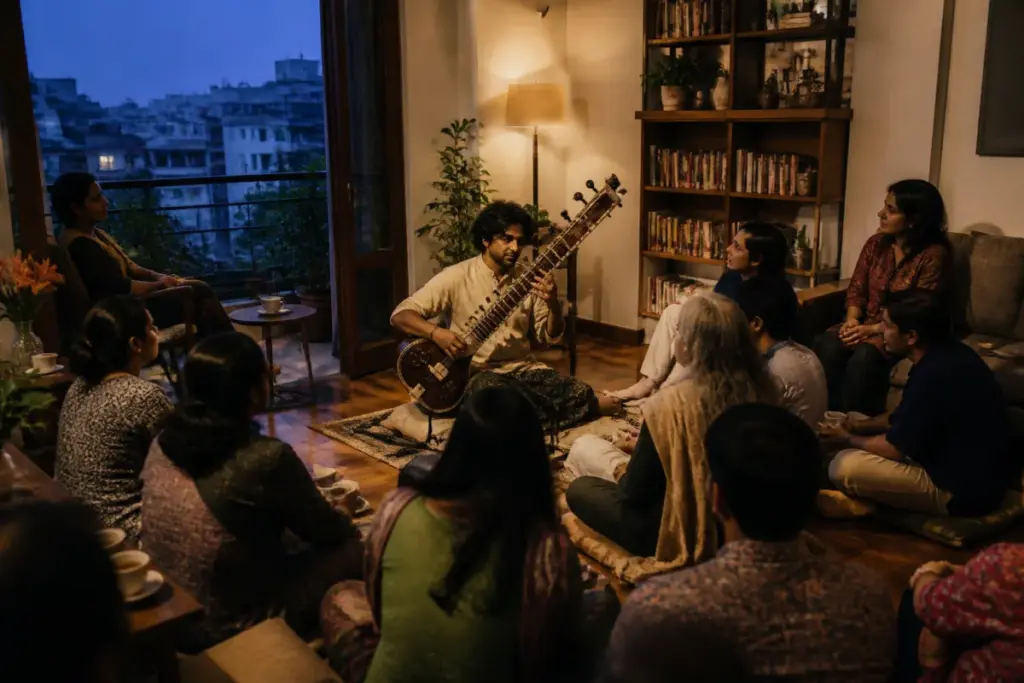
India’s intimate music gigs are turning homes, terraces, cafes, farmhouses and rented apartments into a parallel cultural network. The rise of ticketed baithaks and mini-concerts is not only changing how musicians meet audiences; it is also exposing a shortage of accessible, welcoming places where urban residents can gather without the scale, noise or distance of conventional entertainment venues.
The format ranges from classical music in a Delhi apartment to informal performances in Navi Mumbai service apartments and family-friendly Sunday concerts in Bengaluru. The settings differ, but the proposition is similar: a small group pays for a carefully organised experience that combines music with conversation, food, storytelling and participation.
That proposition has found a paying audience. Upstairs With Us, started by Sukanya Banerjee and Tejas Jaishankar in their Vasant Kunj home in 2018, initially charged Rs 500 for an evening. After organising 15 concerts, the initiative went on hold in 2019 and resumed in early 2025 from a ground-floor flat. It has now organised around 50 concerts, while its Instagram following has grown from 200 to 41,000. Its ticket price has risen to Rs 3,000, including dinner, and its audiences are largely working professionals aged 25 to 45, many of whom are encountering Indian classical music for the first time.
The change in price and scale matters because it shows that these events are moving away from the idea of the home concert as an informal act of hospitality. Banerjee and Jaishankar’s original decision to charge audiences was based on the need to pay musicians rather than place the entire burden on hosts. The ticket therefore functions as both an entry fee and a mechanism for distributing the cost of cultural production across a group of listeners.
This is a different urban economy from the one associated with large auditoriums, commercial venues or nightlife districts. The venue is often borrowed or rented, the organiser may be operating a side venture, and hospitality remains part of the experience. Artist fees for some gatherings typically range from Rs 20,000 to Rs 40,000. Food is often sponsored by hosts, while sound equipment can become an additional expense. The model is intimate, but it is not costless.
The spread of the format also reflects differences between cities. Once Upon India, founded in Noida in 2024 by Arpita Sharma, Malini Arora and Shiva Sureka, began with home baithaks for about 50 people featuring music, storytelling and high tea. It has since expanded to nearly 20 cities, with some performances drawing 500 to 600 people. The organisers argue that intimacy is not determined only by headcount. Seating, decor, hospitality, storytelling and the relationship between performers and audiences can make a larger gathering feel personal.
That interpretation is important for understanding the built environment of these events. A home, cafe, farmhouse or auditorium becomes a cultural venue not simply because it can hold people, but because its design and management allow interaction. The distance between performer and audience is reduced. Guests may return, recognise other attendees and develop relationships beyond the performance itself. In this sense, the venue is a social arrangement as much as a physical space.
In Agra, Riya Agarwal’s Agra Jamming Club began with 15 to 20 people and now attracts 100 to 150 participants to sessions in cafes, farmhouses, auditoriums and living rooms. Tickets cost Rs 299 to Rs 500, and the programme includes Bollywood songs, Sufi music, ghazals and bhajans. The range of formats indicates that the market is not limited to classical music or a single demographic. It is built around the desire to spend time with others in a setting that feels more participatory than a conventional performance.
Tiny Room Concerts, started by three college friends from Navi Mumbai, uses a similar proposition at a higher ticket price of Rs 1,000 to Rs 1,500. Its gatherings bring 40 to 50 guests to rented villas and apartments around Mumbai. Audience members may listen, socialise, play games or perform themselves. More than half of attendees return, according to co-founder Aditya Patil. That repeat attendance suggests that the value lies not only in the programme but also in the recurring community created around it.
The demand is particularly visible in the search for alternatives to established nightlife. Patil describes the gatherings as an option for people who do not want the noise and social pressure of clubs or raves. In Bengaluru, Home At Last extends the same logic to families. Its Sunday morning concerts bring together about 35 adults and 12 children, including children as young as six months, with a home-cooked meal and a fixed contribution towards artist honorariums.
These examples point to a gap in the conventional urban social infrastructure. Large cultural venues can provide professional facilities and greater capacity, but they may also involve distance, formal behaviour, travel and fixed programming. Clubs and nightlife venues serve a different audience and atmosphere. The intimate gig occupies the space between the private home and the commercial venue, creating a third place where participation is structured but not overly formal.
Yet these spaces remain dependent on fragile arrangements. In Gurgaon, Naadyatra organiser Sangeeta Chopra hosts 30 to 40 listeners every six weeks from her home, charging Rs 1,500 with high tea included. Tehzeeb Ka Aangan, also in Gurgaon, holds monthly gatherings for 30 to 35 people featuring dhrupad, Kabir vani, ghazals and thumri. Its founders say the supply of artists is not the main problem; attracting audiences is. Around 90% of their effort currently goes into getting people to attend.
Property is another constraint. Short-term rentals may prohibit gatherings, while larger venues are more expensive. Tiny Room Concerts found that its sold-out Bandra events cost twice as much as those in Navi Mumbai because of rent. This makes the location of cultural participation inseparable from the cost of real estate. The same format can be viable in one neighbourhood and difficult in another, even when demand exists.
The source material does not establish a common regulatory framework for these events, nor does it indicate how municipal authorities classify them. But the reported restrictions on gatherings in short-term rentals show that organisers operate within rules designed for residential occupation rather than cultural use. The events therefore depend on finding spaces that can legally, financially and practically accommodate audiences without losing the qualities that make them attractive.
There is also a question of whether the model can scale without losing its defining feature. Once Upon India has demonstrated that the experience can reach 500 to 600 people, while other organisers deliberately remain below 50. The challenge is not simply to increase capacity. It is to preserve the sense of welcome, proximity and participation that audiences are paying for. Sharma’s view that intimacy depends on thoughtful design rather than headcount offers one possible explanation for how the format can expand, but the evidence supplied here does not establish a single successful model.
For musicians, the emerging circuit could create more regular routes to audiences outside major concert halls. Banerjee describes the possibility of a baithak circuit through which artists tour Indian cities using small venues and earn meaningful fees. That idea remains an ambition rather than an established national system, although the source notes that baithak tours are already taking place. The immediate evidence is more local: organisers are building audiences, paying artists and testing combinations of ticketing, hospitality and programming.
The broader urban significance lies in what these gatherings reveal about access to community. In each case, organisers are responding to a perceived absence: a lack of accessible concerts, family-friendly cultural venues, quieter alternatives to nightlife or places where strangers can meet without the pressure of a large public event. The response is not a new public building but the temporary conversion of existing private and commercial spaces.
That makes intimate music gigs an indicator of how cities are using their underutilised or adaptable spaces. A living room can become a venue, a farmhouse can become a performance site and a rented apartment can become a social setting. The model expands cultural access through flexibility, but it also leaves organisers responsible for solving the underlying questions of rent, permissions, sound, attendance and artist payment.
The evidence confirms that ticketed home and small-venue concerts are no longer isolated experiments. Their audiences, locations and formats are multiplying across Delhi, Noida, Gurgaon, Agra, Bengaluru, Navi Mumbai and the wider Mumbai region. What remains uncertain is whether they will develop into a stable cultural circuit or remain a collection of organiser-led side businesses. That next phase will depend on whether cities can accommodate these hybrid spaces without forcing them into the economics of either a private home or a large commercial venue.


