

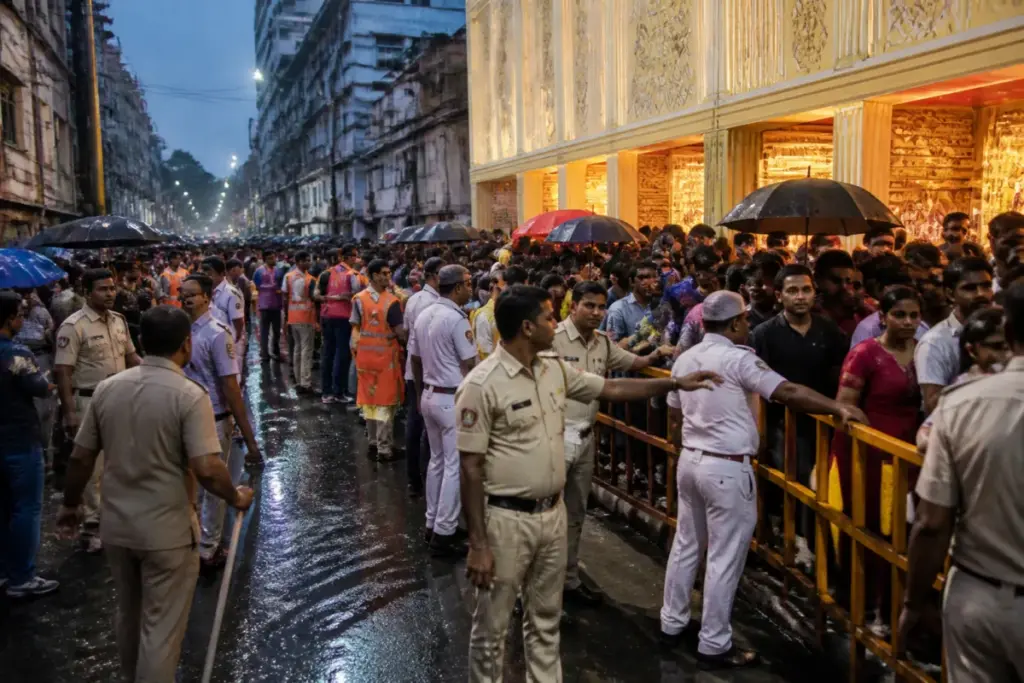
A reported crowd disaster at the Chorbagan Sarbojanin puja in north Kolkata has raised serious questions about festival crowd management, emergency access and the safety of temporary public structures. Sangbad Pratidin reported that 19 people had died and more than 35 were injured after heavy rain was followed by a rush at the venue on Saptami evening, but also noted that Kolkata Police had not issued an official statement at the time of publication.
The report attributed the account of the incident to eyewitnesses, local sources and police sources. It said the venue had attracted unusually large crowds after its reputation spread through media coverage and videos by vloggers. By about 6.30 pm, the queue reportedly extended along Central Avenue towards Mahatma Gandhi Road Metro station. The report said heavy rain began at around 7 pm, after which visitors attempted to enter the pandal at the same time.
According to the timeline published by the Bengali-language outlet, part of the pandal allegedly collapsed at around 7.15 pm amid pushing and crowd pressure. The report said visitors then tried to move down from an elevated structure on which the pandal had been built. At around 7.20 pm, people were reportedly crushed while descending a staircase from an elevated corridor. Bodies and injured people were said to have begun reaching Medical College Kolkata by about 7.40 pm.
These details remain subject to official confirmation. The source report itself said that most deaths appeared to have resulted from suffocation under crowd pressure, citing doctors, and warned that the death toll could rise. It did not provide an official casualty bulletin, hospital statement, police case details or a formal account from the organisers. Those gaps are significant because casualty figures and the precise mechanism of death can change during the first hours of a mass-casualty incident.
The reported setting presents several known operational challenges. The pandal was described as being inside a narrow lane with limited internal space. The report also alleged that visitors were held for long periods and that management attention may have been concentrated on a VIP queue. Local sources cited by the outlet said the sudden rain led large numbers of people to seek shelter or enter the pandal simultaneously. The report further said that confusing announcements may have increased uncertainty among visitors, although that claim was not independently confirmed in the supplied material.
Crowd safety at large public gatherings depends on more than the number of police personnel deployed. It requires a coordinated system for controlling inflow, separating entry and exit routes, keeping emergency corridors open, managing weather-related surges and ensuring that temporary structures do not create bottlenecks. In a narrow urban setting, a queue extending towards a major road and a metro station can also affect traffic movement, pedestrian circulation and the ability of ambulances to reach the site.
The report raised questions about the role of the police and administration, saying local residents believed that the expected scale of the crowd should have prompted a larger deployment. It also alleged that volunteers lacked the experience needed for crowd control and that ambulances were insufficient after the incident. Police sources, however, were quoted as saying that the administration had attempted to control the crowd from the beginning, but that the volume of visitors became unmanageable after the rain.
The conflicting accounts underline why an official reconstruction is necessary. Authorities would need to establish the number of people present, the approved capacity and design of the pandal, the locations of entry and exit points, the deployment plan, the sequence of announcements and the time taken to evacuate and provide medical assistance. CCTV footage, emergency call records, hospital registers, eyewitness accounts and the organisers’ permissions would be central to such a reconstruction.
The incident also exposes the difficulty of treating popular festival venues as temporary attractions rather than high-footfall public spaces. A pandal may operate for only a limited period, but during peak evenings it can function like a transport interchange: thousands of people arrive, wait, change direction, seek shelter and leave through constrained streets. Any failure in circulation design can quickly convert a queue into a dangerous compression point.
The available report does not establish whether the alleged structural failure, rain, crowd density, announcements, police deployment or ambulance availability was the decisive cause. It presents these as possible contributing factors or allegations from different sources. It also does not establish whether any organiser, contractor, official or volunteer has been formally held responsible. Those questions should not be answered through inference before authorities publish verified findings.
A formal police statement, hospital-confirmed casualty figures and an administrative inquiry would clarify what happened at Chorbagan and whether safety protocols were followed. Until those records are available, the reported deaths and injuries, the timeline and the competing explanations should be treated as provisional. The immediate public-interest priority is accurate casualty information, followed by a documented review of crowd planning, temporary construction safety and emergency response at the venue.


