

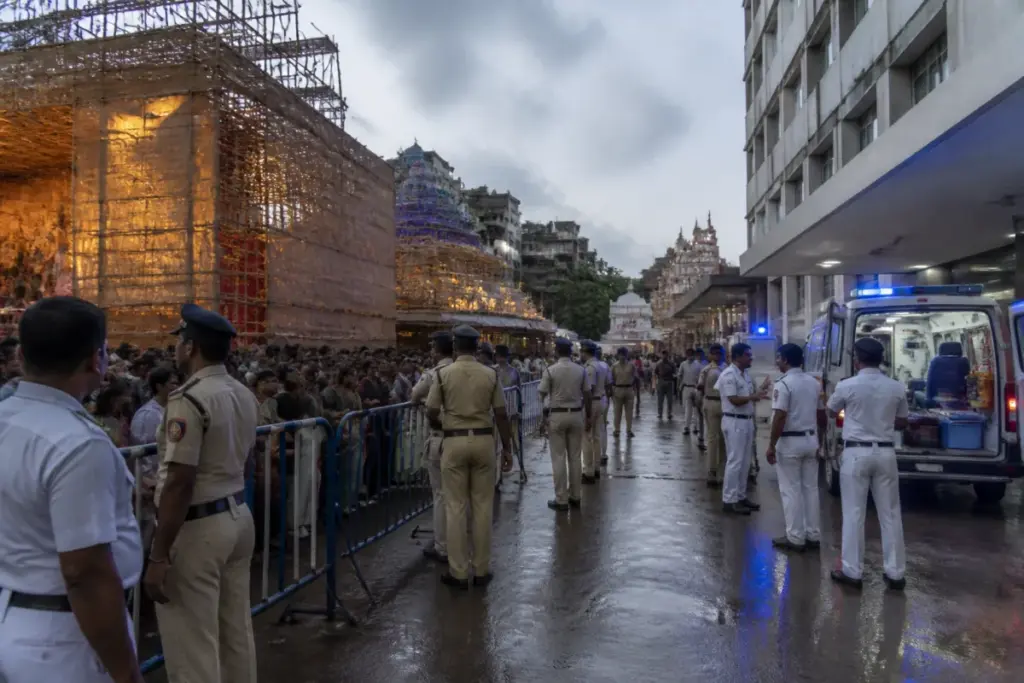
A reported stampede at a puja mandap in Kolkata has left the number of people who died unclear, with a Bengali report citing 13 women and three men in its summary, while a hospital worker quoted in the same report described 13 women, three men and one child among the bodies brought to Kolkata Medical College. The account has not been independently confirmed in the supplied material.
The report, published by Bartaman Patrika, identifies the location as the Chorbagan puja mandap and describes the arrival of multiple bodies at the emergency department of Kolkata Medical College on Saturday evening. It quotes Dipak Mallik, a worker responsible for carrying bodies, who said he was on duty from 2 pm to 9 pm and received a telephone call asking him to report urgently to the emergency department at about 8 pm.
Mallik said bodies began arriving one after another. He described taking them to a room on the second floor of the emergency department, where he counted 13 women, three men and a child. He also said that some relatives had arrived during the night and identified several of the deceased, while others had not yet been identified at the time of his account.
The discrepancy is significant because the number and identity of victims are central facts in any public-safety incident. The report’s original summary refers to 13 women and three men, totalling 16 people. The quoted account adds a child, taking the number to 17. The supplied material does not explain whether the child was included in a separate count, whether the summary was prepared from an earlier update, or whether one of the figures was reported incorrectly.
The account also does not provide an official statement from the police, the Kolkata Municipal Corporation, the hospital administration, the organisers of the puja mandap or the state government. It does not establish the precise time of the incident, the number of people present at the venue, the cause of the crowd movement, the size or design of the mandap, the availability of entry and exit routes, or whether emergency services had been alerted before the injured and deceased began reaching the hospital.
Those details are essential to understanding what happened. A crowd-related death at a religious or cultural venue is not only a matter of casualty reporting. It also raises questions about how temporary public spaces are planned, how visitor movement is controlled, how emergency access is protected and how organisers coordinate with civic and police authorities. None of those questions can be answered conclusively from the supplied account alone.
Mallik’s testimony provides a view from inside the hospital’s mortuary and emergency system. He said many of the bodies showed no substantial external injuries. In his account, the damage in such incidents can occur internally when people fall on top of one another. This is a general observation attributed to his experience, not an official medical conclusion about the deaths reported from Chorbagan.
The report says that bodies were being placed in a room on the second floor of the emergency department and that identification was taking place as relatives arrived. Mallik described the next administrative steps as recording names in the wardmaster’s office register, informing the police, issuing documents, conducting post-mortems and handing the bodies to families. These procedures, as described, indicate the importance of accurate identification and documentation after a mass-casualty event.
The account also records the emotional and administrative pressure faced by hospital workers handling the aftermath. Mallik said his duties included carrying and counting bodies, even as relatives arrived to identify family members. He described the work as socially difficult but necessary, saying that some tasks are performed by people whom others may not wish to undertake. His testimony brings attention to a group that is usually absent from public accounts of disasters: the workers who receive, count, document and transfer the dead.
For families, however, the first requirement is certainty. They need an official casualty list, a functioning identification process and clear information about where bodies have been taken. The supplied report says several people had been identified by the night of the incident, but it does not state how many remained unidentified, how families were being informed, or whether a dedicated help desk had been established.
The same lack of information applies to those who may have been injured. The report focuses on the bodies taken to the hospital and does not provide the number of injured people, the hospitals where they were treated, or the severity of their injuries. It also does not state whether any people were missing after the incident.
Temporary religious venues and festival installations can create complicated movement patterns because visitors often arrive in groups, stop to view installations, queue at narrow points and move at different speeds. But the supplied material does not establish which of these conditions existed at Chorbagan, nor does it identify a specific failure in venue design or crowd control. Any conclusion about the cause of the stampede would therefore be premature without an official inquiry, police account, site assessment or other documentary evidence.
The incident also demonstrates why casualty figures should be released through a coordinated official channel. A difference between 16 and 17 reported deaths is not a minor editorial variation when families are searching for relatives and authorities are preparing post-mortem and handover records. The difference may eventually be explained by a revised count, a separate category or an error in the initial report, but the supplied material does not resolve it.
The available account confirms only a limited set of facts: a crowd-related incident was reported at the Chorbagan puja mandap; bodies were taken to Kolkata Medical College; a hospital worker described receiving 13 women, three men and one child; some people had been identified by relatives; and police notification, documentation and post-mortem procedures were expected to follow. The official death toll, the number of injured, the precise circumstances of the incident and the accountability process remain unconfirmed in the material provided.
Before publication as a fully confirmed report, the casualty count should be checked against the hospital register, police records, post-mortem documentation and an official statement from the relevant authorities. Clarification is also needed on the venue, the sequence of events, the number of people affected and the arrangements made for families. Until those details are established, the report should be treated as an important but incomplete account of a serious public-safety incident.


