

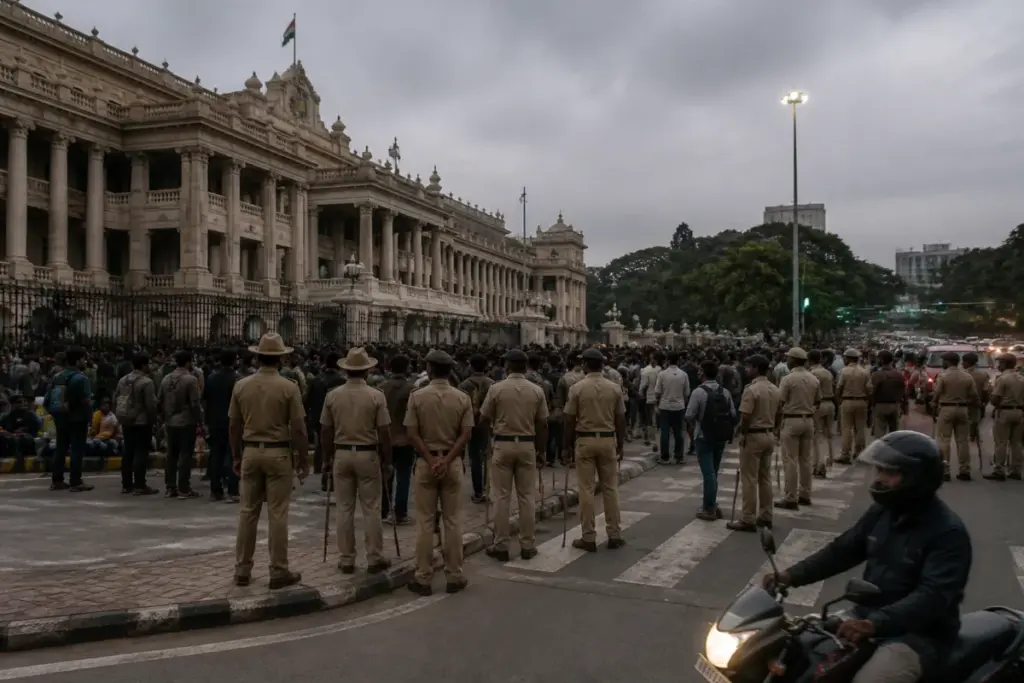
Bengaluru police detained hundreds of youngsters, including members of the All India Students’ Association (AISA) and activists from the Cockroach Janta Party, after they attempted to protest against the ongoing special intensive revision (SIR) exercise outside Town Hall on Saturday evening.
The proposed demonstration went ahead despite police denying permission for a gathering at the central Bengaluru location. Police cited High Court orders that restrict protests and agitations in the city to Freedom Park, and advised the organisers to shift the event there instead.
AISA had earlier approached the jurisdictional police at Ulsoor Gate police station seeking permission to hold the protest outside Town Hall. The application was turned down on the ground that demonstrations were not permitted at the proposed venue under the court-linked restrictions, according to the report.
The restriction placed the choice of venue at the centre of the dispute. While the organisers sought to use Town Hall as the site of their demonstration, the police position was that Freedom Park was the designated location for protests in the city. The incident therefore involved both opposition to the SIR exercise and a disagreement over where that opposition could be publicly expressed.
AISA subsequently announced on social media that its members would gather outside Town Hall despite the denial of permission. Hundreds of youngsters and activists then assembled at the venue, where police detained them after they attempted to proceed with the protest.
The SIR exercise was the stated subject of the demonstration. The supplied report does not provide further details about the organisers’ specific objections to the revision process, the duration of the detentions, the number of people detained individually or whether any cases were registered against the protesters.
The episode highlights how Bengaluru’s rules governing public demonstrations operate at street level. A restriction that identifies Freedom Park as the permitted location affects not only whether a protest can take place, but also the venue available to organisers seeking visibility in a different part of the city. In this case, the police said the Town Hall gathering could not be allowed, while the organisers chose to assemble there after being directed to another site.
The report also shows the role of advance permission procedures in managing public demonstrations. AISA’s request was submitted to the local police, the application was rejected, and the organisers later used social media to announce a gathering at the denied location. The subsequent detentions followed that sequence of permission, refusal and assembly.
The supplied report does not record a further police statement on the detentions, any response from the High Court, or the organisers’ account after the incident. It also does not state whether the protesters were released or whether the demonstration continued at Freedom Park. The immediate next steps for the police and the organisers were not specified.


