

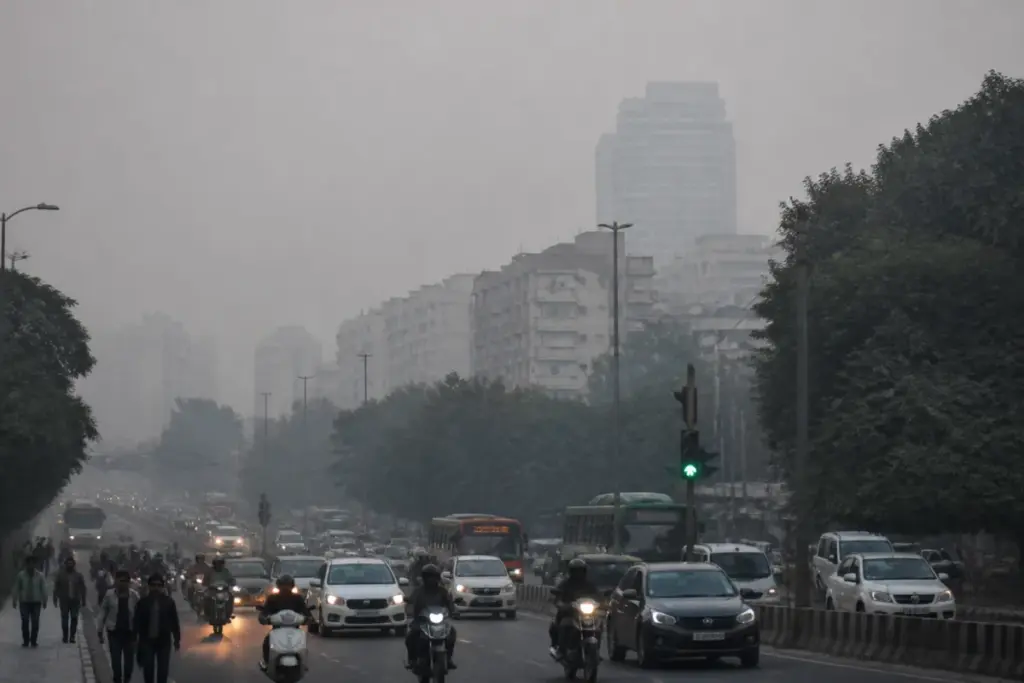
Delhi’s AQI rose sharply from 90 to 159 in 24 hours, while air quality in 12 areas crossed into the poor category on Saturday evening, according to data cited by Live Hindustan. With no rain expected across Delhi-NCR over the next three to four days, pollution levels may remain elevated, particularly during the morning and evening when wind speeds are expected to be lower.
The city’s average AQI was recorded at 159 on Saturday, placing it in the moderate category under the Central Pollution Control Board’s air-quality classification. A day earlier, the average AQI had stood at 90, representing a rise of 69 points within 24 hours. The 12 locations that crossed 200 included residential areas and places with heavy traffic movement.
The change was also visible in hourly readings cited from AQI.in. On October 16, Delhi’s AQI stood at 135 at 10.30 am before improving to 65 later in the day. The improvement did not last, however, and the reading rose to 240 by the evening. At 10.30 am on October 17, the AQI was recorded at 216.
Weather conditions are expected to provide limited relief in the immediate term. The report, citing the India Meteorological Department, said Delhi is likely to remain clear on Sunday, with the maximum temperature expected to be around 31 to 33 degrees Celsius. Winds may reach 10 to 15 kmph during the afternoon, but are expected to slow during the morning and evening.
The IMD forecast cited in the report said daytime wind speeds could remain between 15 and 20 kmph from October 19 to October 22. However, weaker winds in the morning and evening could allow pollutants to accumulate during the periods when many residents travel to work, schools and markets. The report also said maximum temperatures could remain around 32 to 34 degrees Celsius through October 23, with no significant fall expected.
Traffic linked to Durga Puja celebrations, along with dust and fireworks, was identified in the report as an additional factor that could affect air quality. The report did not provide a quantified contribution from any of these sources, but the combination of traffic activity, dust, fireworks and limited dispersion is being monitored as Delhi enters a period of deteriorating air quality.
Separately, PTI reported that Delhi Environment Minister Manjinder Singh Sirsa said the capital had recorded 211 days so far this year with air quality in the good, satisfactory or moderate categories. According to the figures cited, this was the best performance since 2016, excluding 2020. Delhi recorded 200 such days in 2025, 209 in 2024, 206 in 2023, 159 in 2018 and 110 in 2016.
The immediate forecast remains focused on dry weather, slower morning and evening winds and the possibility of further AQI increases across Delhi-NCR over the next three to four days.


