

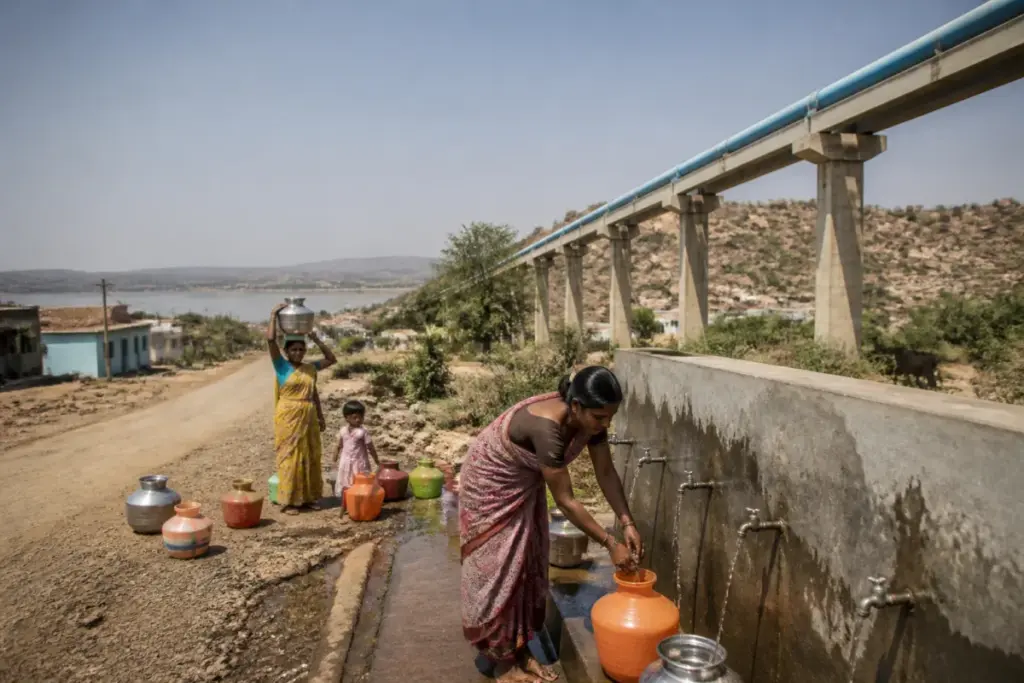
Telangana’s drinking-water network could face mounting pressure before the 2027 monsoon, with government estimates cited by Deccan Chronicle showing severe or partial supply problems across thousands of rural habitations and below-normal supplies in several urban local bodies. The state has prepared an emergency protocol under Mission Bhagiratha, requiring officials to track reservoirs daily and activate local or tanker-based alternatives when the main network is disrupted.
The risk extends beyond Hyderabad, which receives water from the Krishna, Godavari and Manjeera systems. The report said the more immediate challenge is expected in rural areas and urban local bodies supplied through Mission Bhagiratha, a state-wide drinking-water scheme whose network depends substantially on surface-water sources and reservoirs.
According to the figures cited in the report, Mission Bhagiratha serves 24,011 rural habitations and 145 urban local bodies. Of the rural habitations, 23,465 are described as dependent on surface-water sources, including 14 irrigation reservoirs in the Krishna basin and 20 in the Godavari basin. A further 536 isolated or scattered habitations and 386 newly formed habitations are described as dependent on groundwater sources.
The report classified 1,664 rural habitations in the red category, indicating no supplies or complete water shortages. Another 1,077 were placed in the yellow category for partial supplies, 2,630 in the orange category for above-average supplies and 18,094 in the green category for fully supplied status. The category figures total 23,465, matching the number of surface-water-dependent habitations cited in the report, but not the separately stated overall figure of 24,011 rural habitations. The relationship between the 536 groundwater-dependent habitations, the 386 newly formed habitations and the total requires clarification from the state authorities.
The district-level figures show that Vikarabad has the largest number of rural habitations in the red category, at 361, followed by Yadadri with 262 and Kumram Bheem Asifabad with 233. Sangareddy and Mancherial each have 101, while Mahbubnagar has 114, Khammam 98 and Adilabad 90. In the yellow category, Vikarabad has 305 habitations, followed by Ranga Reddy with 118, Jagitial with 84, Bhadradri Kothagudem with 93, Mahabubabad with 69 and Sangareddy with 58.
The position of urban local bodies is uneven. Five—Kagaznagar, Bellampalli, Parigi, Alair and Yadagirigutta—were listed as receiving no Mission Bhagiratha water. Twenty-two were reported to be receiving less than normal supplies, including Kamareddy, Devarakonda, Adilabad, Mahbubnagar, Ibrahimpatnam, Adibatla, Pedda Amberpet, Thukkuguda, Shamshabad, Shankerpally, Chevella, Moinabad, Narsingi, Tandur, Vikarabad, Pochampally, Dundigul, Gundla Pochampally and Jagitial. The report said the remaining 118 urban local bodies were receiving their full normal supplies.
The reservoir position is a key factor in the supply outlook. In the Krishna basin, the report listed Udayasamudram with an estimated 46 days of supply, Palair with 65 days, Ramanpadu with 120 days, Gopaldinne with 124 days, Rangasamudram with 149 days, Wyra with 192 days and Sankarasamudram with 292 days. Koilsagar, PD Pally, NS Tailpond, Jurala and Srisailam were listed at 365 days.
In the Godavari basin, Singur was listed at 23 days of supply, the shortest figure in the table, followed by Alisagar at 38 days. Medaram was listed at 160 days, Bheem Ghanpur at 155, Dharmasagar at 180, Salivagu at 126, Bellal at 162, Chittakodur at 180, Dhummugudem at 240 and Gaddenna Vagu at 250 days. Several reservoirs, including the Sri Ram Sagar Project, Kadem, Komaram Bheem, Yellampalli, the Manair reservoirs, Ramappa, Mulugu Ghanpur, Kinnerasani, Mallannasagar and Boli Cheruvu, were listed at 365 days.
The emergency protocol requires officials to monitor reservoir levels every day and coordinate with irrigation authorities. Where supply interruptions are caused by source problems, officials have been instructed to make local sources functional, including hand pumps, single- and three-phase pumping schemes and open wells. The protocol also permits officials to examine the hiring and transportation of alternative sources when tanker-based supplies are required.
A significant part of the protocol concerns communication. Officials have been told to inform the relevant MLA and other elected representatives when supplies are interrupted, while sharing information through WhatsApp groups involving gram panchayats, self-help groups, panchayat secretaries, sarpanches and linemen. They have also been instructed to tell end users why supplies have stopped and provide a tentative restoration timeframe.
The report said Mission Bhagiratha officials must identify critical habitations, supervise daily supplies, arrest pipeline leakages immediately and assess alternative transportation arrangements. It also listed chronic problems affecting habitations, including electricity issues in 26 locations, flood damage in 60, head-related problems in 46, low supply in 24, maintenance issues in 20, pipeline damage in 40 and pipeline leakages in 45.
The figures indicate that Telangana’s drinking-water challenge is not limited to the availability of water in major reservoirs. It also concerns the reliability of the last-mile network, the condition of pipelines, electricity for pumping, the availability of local backup sources and the speed with which residents are informed during interruptions. Mission Bhagiratha’s emergency arrangements place responsibility on district and local officials to coordinate across water supply, irrigation, electricity and local-government systems.
The supplied report does not establish how long the listed reservoir estimates will remain valid, whether the figures have since changed or how the state government calculated the projected requirement up to the 2027 monsoon. It also does not include the underlying government document or an official statement clarifying the discrepancy in the rural-habitation totals. Those details should be verified before the figures are treated as a definitive statewide assessment.


