Mansa drug abuse protests have moved beyond a family’s mourning over the killing of anti-drug activist Parwinder Singh Jhota. Five days after his death, his father Bhim Singh is refusing to allow the cremation to take place until he believes justice has been delivered. The continuing protest at Tinkoni has drawn religious institutions, farmer organisations, political representatives and social groups into a public confrontation over drug abuse and the state’s response to it.
The immediate dispute is centred on the demand for justice for Jhota. But the developments described from the protest site also show how a local killing can become a wider test of institutional credibility. The gathering has become a place where several forms of authority are being brought together: the bereaved family’s moral authority, the action committee’s mobilisation, the Akal Takht’s religious endorsement, the SGPC’s institutional support, farmer unions’ organisational networks and the Union home minister’s intervention on drug abuse.
That combination matters because the protest is not limited to a private demand for accountability. Bhim Singh has publicly linked the refusal to cremate his son’s mortal remains with the expectation that justice must be delivered. His position has given the protest a continuing focus and ensured that the killing remains connected to the wider question of drug abuse in Punjab. The report does not establish the circumstances of the killing beyond describing Jhota as an anti-drug activist who was slain, but it records the extent to which the incident has become a public issue.
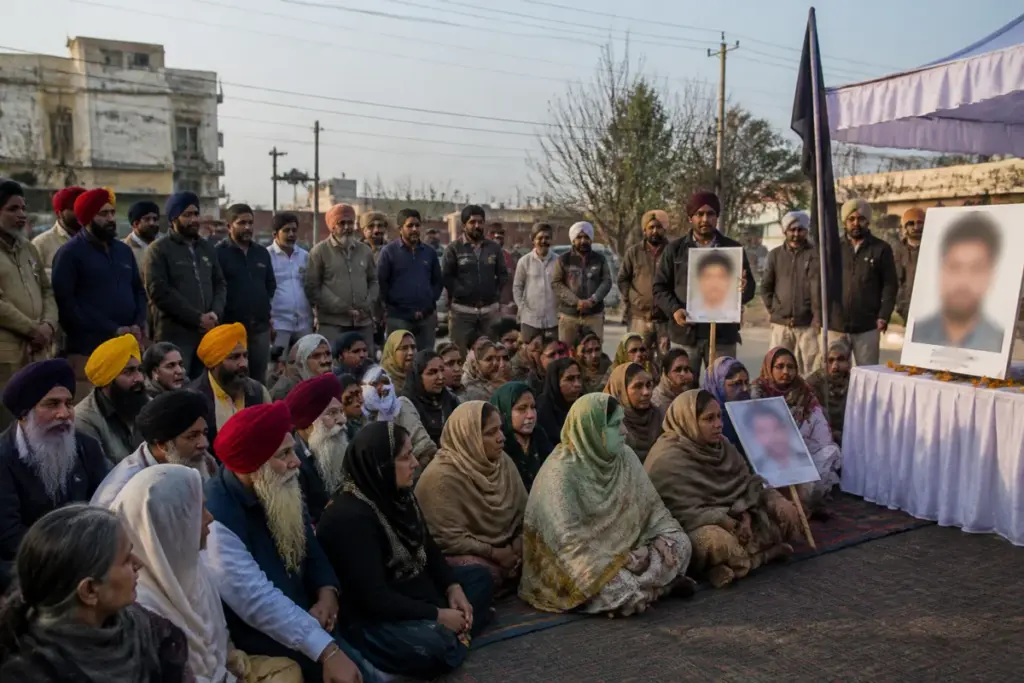
The protest’s physical location at Tinkoni, Mansa, is significant in practical terms. It has created a visible civic space where visitors, supporters and representatives can meet the family and register their position. According to the report, the mood there is solemn but upbeat, reflecting the tension between bereavement and mobilisation. The gathering is simultaneously a site of grief, a protest platform and a channel through which different institutions are attempting to demonstrate solidarity.
The most direct sign of the protest’s institutional reach is the support received from the Akal Takht jathedar and the Shiromani Gurdwara Parbandhak Committee. The jathedar declared Parwinder Singh a martyr of the Sikh Qaum, while SGPC president Harjinder Singh Dhami announced that the activist’s picture would be displayed in the Central Sikh Museum. These steps place Jhota’s memory within established religious and community institutions rather than leaving the incident only within the boundaries of a police or criminal-justice response.
The SGPC’s role has also exposed a distinction between symbolic and material support. Bhim Singh reportedly declined the organisation’s offer of financial assistance and instead asked it to help four other people injured in the shootout. That response shifts attention from compensation for the bereaved family to the condition of the other victims. It also indicates that the family is using the protest to make a broader claim about the responsibilities owed to everyone affected by the incident.
Two of Jhota’s associates are undergoing treatment at Mansa civil hospital for injuries caused by bullet splinters, according to the report. Their treatment is one of the few concrete continuing consequences identified in the account. The injured associates connect the protest to the functioning of the local public-health system, because the hospital has become part of the immediate response to the shooting. The report does not provide details about their medical condition, the treatment being administered or the financial arrangements for their care.
Farmer organisations have added another layer to the mobilisation. Bhim Singh welcomed Bharatiya Kisan Union Ekta Ugrahan president Joginder Singh Ugrahan and Bharatiya Kisan Union Ekta Sidhupur president Jagjit Singh Dallewal at the protest site, referring to their contributions to farmers’ movements. Their presence demonstrates how established movement networks can provide public visibility and organisational support when a local grievance expands into a broader campaign. The supplied account does not specify whether the unions have announced a programme of action or whether they are formally part of the action committee.
Political involvement has also become visible. Politicians and social organisations have travelled to Mansa to express solidarity with the family and protest against the ruling Aam Aadmi Party government. This introduces a governance dimension, but it must be distinguished from an established finding of administrative failure. The report records opposition to the state government and the arrival of political actors; it does not provide an investigation report, court order, police account or official explanation establishing responsibility for the killing or assessing the government’s performance.
The intervention from Union home minister Amit Shah has widened the administrative frame further. Shah wrote to the Punjab government seeking a response on the issue of drug abuse. For the protest, Bhim Singh viewed the letter as strengthening his position. Institutionally, the reported exchange places the state government under pressure to respond to a problem that is being discussed simultaneously as a law-and-order concern, a public-safety issue and a social crisis. The report does not reproduce the letter’s contents or identify a deadline for the Punjab government’s response, so the precise administrative demands remain unclear.
This absence of detail is important. A letter seeking a response is not the same as a completed investigation, a new enforcement measure or a judicial determination. Similarly, public support from religious and farmer institutions can increase pressure and visibility but does not itself establish the facts of the shooting. The continuing protest therefore sits between public mobilisation and formal accountability. Its future credibility will depend on what official institutions do next and whether their actions address the family’s demand as well as the condition of those injured.
The family’s conduct has also shaped the protest’s meaning. Bhim Singh is described as continuing to care for his two grandchildren while encouraging them to read the scriptures and stand up for a noble cause. This detail places the protest within a family setting rather than presenting it only as an organised political event. It shows how a public campaign is being sustained alongside ordinary responsibilities and mourning. At the same time, the account does not establish how long the refusal to cremate will continue or what specific conditions the family has set for ending the protest.
For Mansa, the immediate urban and civic question is how a public institution responds when confidence in justice is expressed through a continuing gathering rather than through a private legal process alone. The protest has brought together a family, an action committee, religious authorities, farmer organisations, political actors, social groups and a hospital treating the injured. Each represents a different route through which citizens seek recognition and protection. The case therefore illustrates how formal governance can be challenged or supplemented by networks of community authority when a security issue generates distrust.
The available evidence remains limited. It confirms the killing of Parwinder Singh Jhota as described by the report, the ongoing refusal to permit cremation, the presence of injured associates at Mansa civil hospital, institutional support from the Akal Takht and SGPC, visits by farmer leaders, and the Union home minister’s request for a response from the Punjab government. It does not establish the identity or motive of the attackers, the status of any arrests, the findings of an investigation, the government’s detailed response or the legal position of the family’s demand.
Those are the developments that deserve monitoring. The next significant markers will be the Punjab government’s response to the Union home minister, any official investigation updates, the treatment and support provided to the injured, and whether the authorities engage directly with the family and the action committee. Until those steps are documented, the Mansa drug abuse protests remain both a demand for justice over one killing and a visible measure of how institutions respond to public anger over drug abuse and safety.