

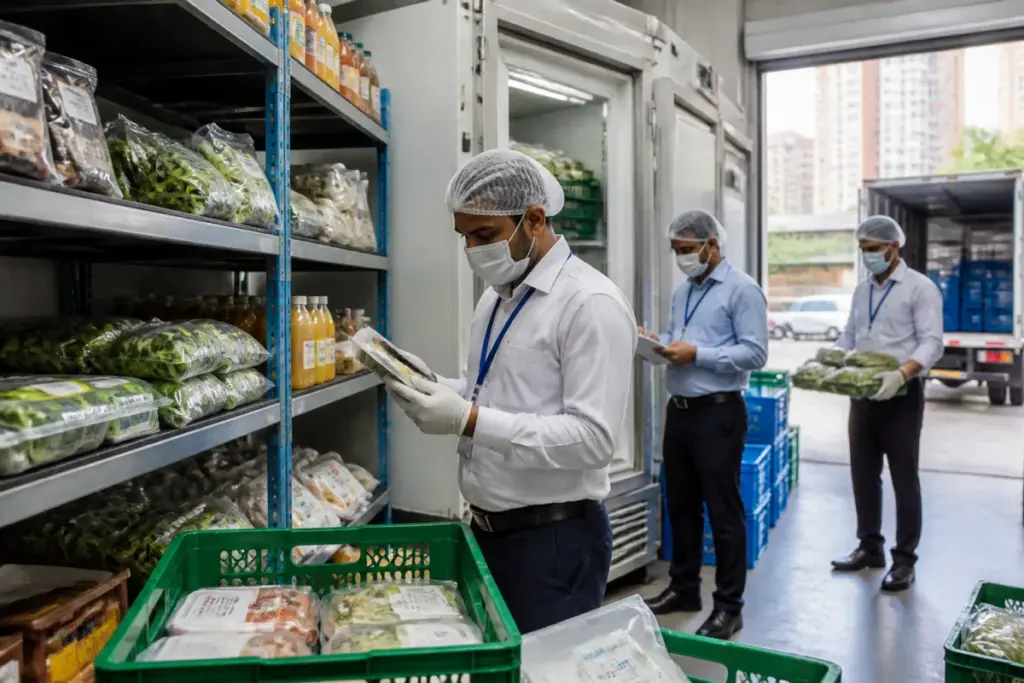
Delhi food safety inspections have found expired food products, pest infestations, unhygienic storage and temperature-control failures at facilities operated by online food delivery and retail companies, prompting improvement notices and further enforcement action ahead of the festival season.
The inspections were conducted by the Delhi government’s Food Safety Department, which also collected food samples from the premises. The department’s findings were cited in an official statement issued after the enforcement drive. Chief minister Rekha Gupta has directed officials to tighten monitoring of markets, food storage facilities and establishments supplying food products.
At a food company’s facility in Uttam Nagar, officials found expired frozen green peas, Greek yoghurt, eggless chocolate-chip brownies and cow ghee products, according to the Chief Minister’s Office. The inspection also recorded failures to maintain the required storage temperatures at several premises.
At another facility in Wazirpur Industrial Area, officials found flies, mosquitoes, a lizard and spider webs. The premises did not have a cleaning schedule or the corresponding checklist, the statement said. These findings formed part of a wider inspection of storage conditions and pest-control arrangements at facilities handling food products for online delivery and retail operations.
At a major online food aggregator’s facility in Daryaganj, inspectors found dirty crates and dust in food storage areas. Rat traps had not been placed at appropriate locations, and officials said the number of traps was inadequate. At the company’s Rohini store, inspectors found no arrangements to segregate food items, creating a risk of cross-contamination, according to the official statement.
The enforcement drive also covered desi ghee samples. Of the 59 samples tested, 19 were found to be unsafe, while four failed to meet food safety standards. The official statement said action was being taken in accordance with the rules based on the deficiencies identified during inspections.
The department issued improvement notices to the establishments concerned. Food samples were collected for examination, although the supplied statement did not specify the names of the companies, the individual products represented by the samples or the penalties, if any, imposed after the inspections.
The inspections come as Delhi authorities prepare for increased activity in markets and food businesses during the festival season. Online delivery and retail facilities form part of the city’s increasingly important food distribution network, connecting consumers to packaged, chilled, frozen and prepared products through decentralised storage locations.
The department’s findings place attention on the operational controls that support this network, including expiry-date checks, temperature maintenance, pest management, cleaning documentation and physical separation of food items. The official statement did not provide a consolidated figure for all premises inspected or a timeline for compliance with the improvement notices.
Officials are expected to continue monitoring markets, food storage facilities and establishments supplying food products under the direction issued by the chief minister. Further action will be based on the deficiencies identified and the results of the collected food samples.


