

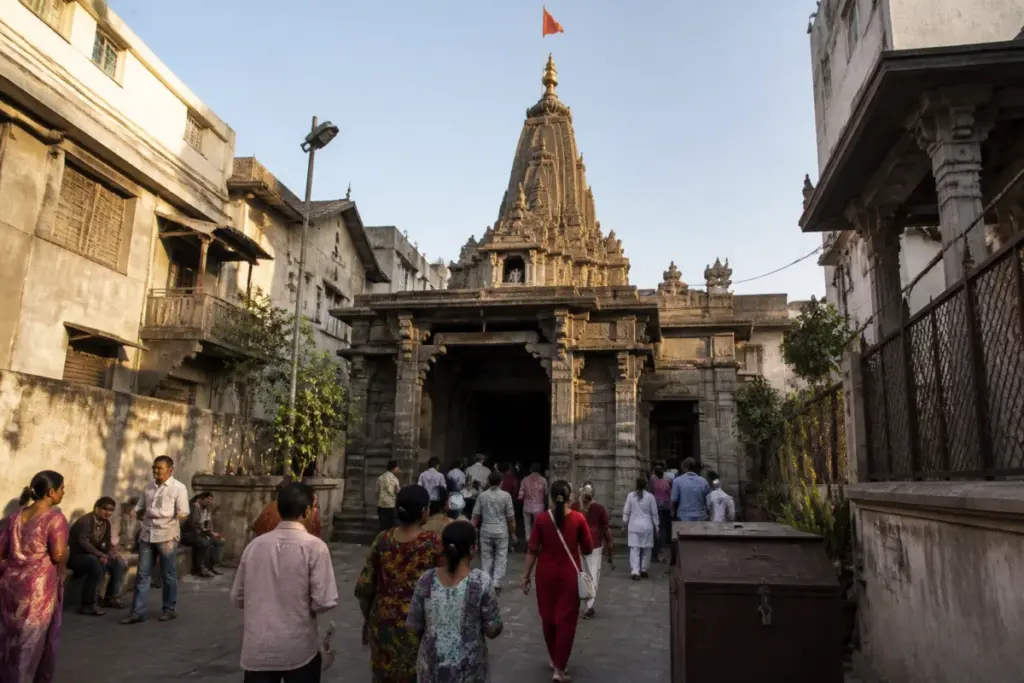
The Bombay High Court has stayed a Joint Charity Commissioner’s order concerning worship arrangements at Pune’s historic Kali Jogeshwari Temple, allowing the existing system of पूजा and abhishek to continue until the appeal is decided. The interim order preserves the Bhide family’s role in performing the rituals while restricting the appointment of another person for पूजा or अभिषेक.
Justice Aarti Sathe observed that there had been no change in circumstances since 2023 that required the existing arrangement to be altered. The court also found that the first appeal raised issues requiring consideration and stayed the challenged order until the appeal reaches a final decision.
Under the arrangement continued by the court, the Shri Devdeveshwar Sansthan from Parvati and Kothrud may place a signboard and donation box within the temple premises. However, it cannot appoint any person to perform पूजा or अभिषेक. Trustees and devotees will continue to be allowed to enter the temple and offer prayers. The religious rituals will be conducted according to the interim directions currently in force.
The dispute concerns competing claims over the management of the temple and the Bhide family’s alleged hereditary right to conduct its religious rituals. The High Court has not delivered a final ruling on ownership, management authority or the claimed hereditary rights.
Advocate Chaitanya B. Nikate, appearing for the appellants with advocates Isha Malik and Prajit S. Sahane, told the court that the Bhide family claims a tradition of performing पूजा, worship, offerings and अभिषेक at the temple for around 120 years, across five generations. The family maintains that its association with the temple began before the establishment of the institution and that its ancestors performed the rituals without receiving remuneration from it.
The family has challenged the institution’s interpretation of a scheme prepared on 16 March 1971. According to its written submissions, the scheme distinguishes between properties owned by the institution and ancient temples receiving financial grants. The family argues that Kali Jogeshwari Temple does not appear in Schedules A, B or C, which relate to institutional properties and specified temples, but is listed at number 20 in Schedule D, which records ancient temples receiving grants. It has argued that inclusion in a grant-related schedule does not establish ownership or give the institution exclusive control over religious rituals.
The family has also relied on municipal and property-tax records dating from 1937, along with historical documents, to support its long-standing connection with the temple. Its submissions state that the temple was established around 1825, while the institution was formed in 1952.
The Shri Devdeveshwar Sansthan has maintained that the temple belongs to it and that the Bhide family was appointed to provide religious services. The institution had filed proceedings under Section 41E of the Maharashtra Public Trusts Act, 1950, seeking restrictions on alleged interference in its administration, including the appointment of priests and employees, organisation of religious ceremonies and collection of donations. The High Court’s interim order keeps the present arrangement in place until the appeal is finally decided.


