

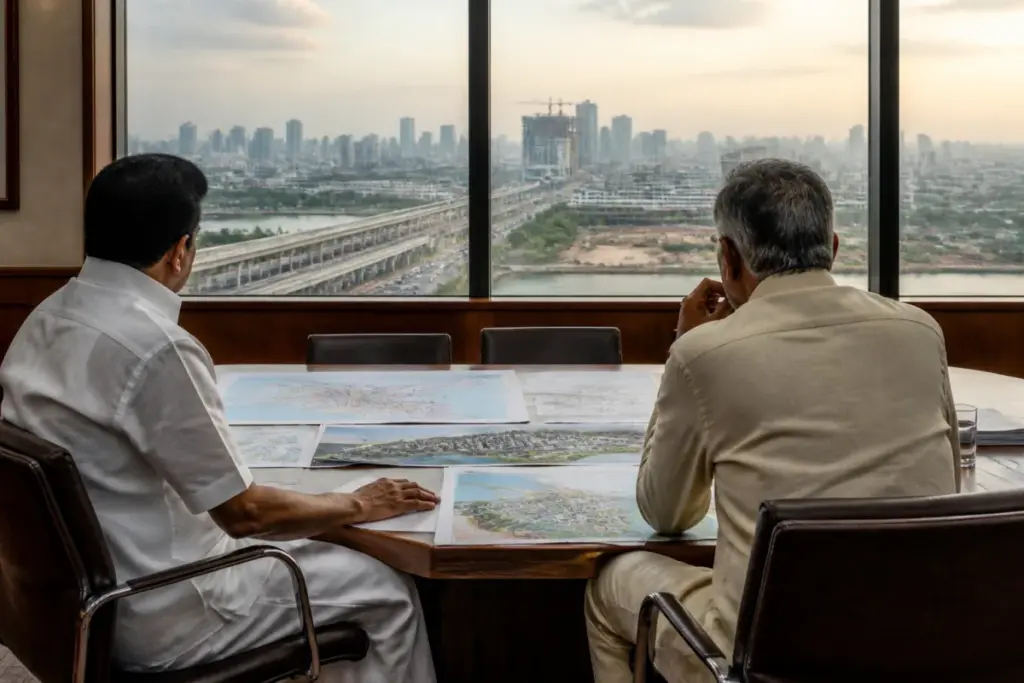
Tamil Nadu’s reported effort to seek greater Centre-state coordination on infrastructure projects follows a meeting between Chief Minister Vijay and Andhra Pradesh Chief Minister N Chandrababu Naidu, but the account remains dependent on unnamed government sources and has not been supported by an official meeting record or statement.
According to a report by Dinamalar, Vijay met Naidu in Vijayawada last week after travelling to Andhra Pradesh. The report says the meeting lasted about 90 minutes and included a discussion on the proposed Godavari-Krishna-Cauvery river-linking project. It also says Vijay urged the Andhra Pradesh government to release water to Tamil Nadu through an agreed procedure.
The reported meeting came after Prime Minister Narendra Modi visited Chennai and inaugurated projects valued at Rs 13,000 crore, the report says. Modi and Vijay are also reported to have held a private 30-minute conversation at Chennai airport. The report attributes the decision to visit Andhra Pradesh to that interaction, although no direct statement from Vijay, Modi or the Prime Minister’s Office has been provided in the supplied material.
Dinamalar’s account says Naidu explained to Vijay how Andhra Pradesh had secured and implemented large infrastructure projects with financial support and cooperation from the Union government. The projects reportedly discussed included infrastructure works worth Rs 58,000 crore in Amaravati, the Polavaram national irrigation project covering the Godavari irrigation system, railway works valued at Rs 10,134 crore, 74 projects involving new railway lines, doubling works and railway stations, and proposed airports in cities including Kuppam.
These figures and project descriptions are significant because they connect political coordination to the way major urban and regional infrastructure is planned and financed. However, the supplied report does not identify the individual projects included in the Amaravati figure, provide the sanctioning authority for the railway package, or specify the status, funding structure and implementation timelines of the proposed airports. It also does not provide project documents or statements from the Union government, Andhra Pradesh government or railway authorities.
The report presents Naidu as advising Tamil Nadu that cooperation with the Union government could help the state obtain funding and new projects. It further claims that officials in Tamil Nadu have begun preparations to seek central funding for projects across departments. This claim is also attributed to unnamed government sources. The report does not identify the departments involved, the projects under preparation, the funds being sought or the administrative process through which proposals will be evaluated.
That gap matters because central funding is not a single mechanism. Large infrastructure projects may involve budgetary allocations, centrally sponsored schemes, special-purpose vehicles, state contributions, loans, viability-gap support or approvals from sector-specific ministries and agencies. The supplied material does not establish which of these mechanisms are relevant to the projects reportedly being discussed between the two chief ministers.
The account also links the issue to Tamil Nadu’s recent political and administrative relationship with the Union government. It alleges that the previous Dravida Munnetra Kazhagam government maintained an adversarial approach towards the Centre, which, according to the report, affected the state’s ability to obtain support for education, urban infrastructure, metro rail in second-tier cities and highways. These are political and administrative assertions from the report, not independently documented findings in the supplied material.
The report also says that senior Indian Administrative Service officers previously found it difficult to secure higher allocations and new projects through meetings with Union ministers and secretaries. It does not cite specific officials, ministry correspondence, rejected proposals, funding decisions or comparative allocation data to substantiate that claim. Without such evidence, it is not possible to determine whether any shortfall resulted from political relations, project readiness, fiscal constraints, institutional criteria or other factors.
The urban significance of the report lies in the way it presents infrastructure as a product of inter-governmental coordination rather than only an engineering or construction exercise. Metro systems, railways, highways, airports, irrigation networks and urban expansion projects depend on multiple approvals, land arrangements, funding commitments and operating agencies. A change in political coordination may affect access to discussions and proposals, but it does not by itself demonstrate that a project has been approved, financed or scheduled for construction.
The reported Amaravati package illustrates this distinction. A stated infrastructure value of Rs 58,000 crore may refer to a broad development programme rather than a single project. The supplied article does not clarify whether the amount represents approved expenditure, estimated project cost, committed funding or a collection of proposals. It also does not state the timeframe over which the projects would be implemented. Those distinctions are essential for assessing the practical impact on residents, land markets, public services and regional connectivity.
The same issue applies to the reported Rs 10,134 crore railway package. New lines, line doubling and station redevelopment have different objectives and implementation requirements. New lines can expand regional connectivity, doubling can address capacity constraints on existing routes, and station works can improve passenger access and operations. Treating them as one combined figure without project-level details makes it difficult to assess what has actually changed on the ground.
The river-linking discussion introduces another layer of institutional complexity. The Godavari-Krishna-Cauvery proposal involves inter-state water management and would require technical assessment, agreements between participating states, environmental and legal clearances, financing decisions and implementation arrangements. The report records that the issue was discussed and that Vijay sought regulated water releases from Andhra Pradesh, but it does not establish whether any agreement was reached or whether a formal process has begun.
For Tamil Nadu, the reported focus on central support could have implications for urban infrastructure, particularly if the state seeks funding for metro systems, roads, rail connectivity and projects in cities beyond Chennai. Yet the article does not identify any newly approved Tamil Nadu project. It therefore cannot support a conclusion that the state has secured additional funding or that specific infrastructure programmes will now move forward.
The immediate public-interest question is not simply whether Tamil Nadu adopts a more cooperative political approach towards the Centre. It is whether the state can convert that approach into documented project proposals, clear funding commitments and measurable implementation milestones. Those steps require administrative preparation, technical feasibility, financial structuring and formal approval, none of which are detailed in the supplied report.
The report’s central claims should therefore be treated as provisional. Confirmation would require an official account of the Vijay–Naidu meeting, details of any water-related understanding, project-wise information on the Amaravati and railway figures, and documentation showing which Tamil Nadu departments are preparing proposals for central assistance. Until those records are available, the reported infrastructure benefits and the claimed shift in Tamil Nadu’s funding strategy remain unverified.


