

Crude oil prices crossing $110 a barrel is not only an energy-market story. For India’s cities, where transport, construction, manufacturing and household consumption depend on fuel-intensive supply chains, a sustained rise can become a wider cost-of-living and operating-cost problem. The immediate question is not whether one day of volatility will automatically raise every price, but how long the shock lasts and how deeply it passes through the urban economy.
Brent crude reached $110 per barrel on October 16, its first return to that level since May, before closing at $109.86, according to the report by Aaj Tak Business. US West Texas Intermediate rose 3.5% to close at $101.41 a barrel. During the week, WTI gained more than 10%, while Brent increased by about 5%. The movement followed geopolitical tensions in the Middle East and eastern Europe, including reported disruption risks around the Strait of Hormuz and Bab al-Mandeb and continuing uncertainty around regional production, exports and refining infrastructure.
The figures establish a sharp market movement, but they do not by themselves establish how much Indian consumers or businesses will pay. That depends on the duration of the rise, currency movements, import costs, domestic tax and pricing decisions, and the response of fuel retailers and manufacturers. The supplied report does not provide a new Indian retail-price revision, an official government response or a forecast for inflation. Those limits matter because the urban consequences of crude volatility are transmitted through several stages rather than appearing simultaneously.
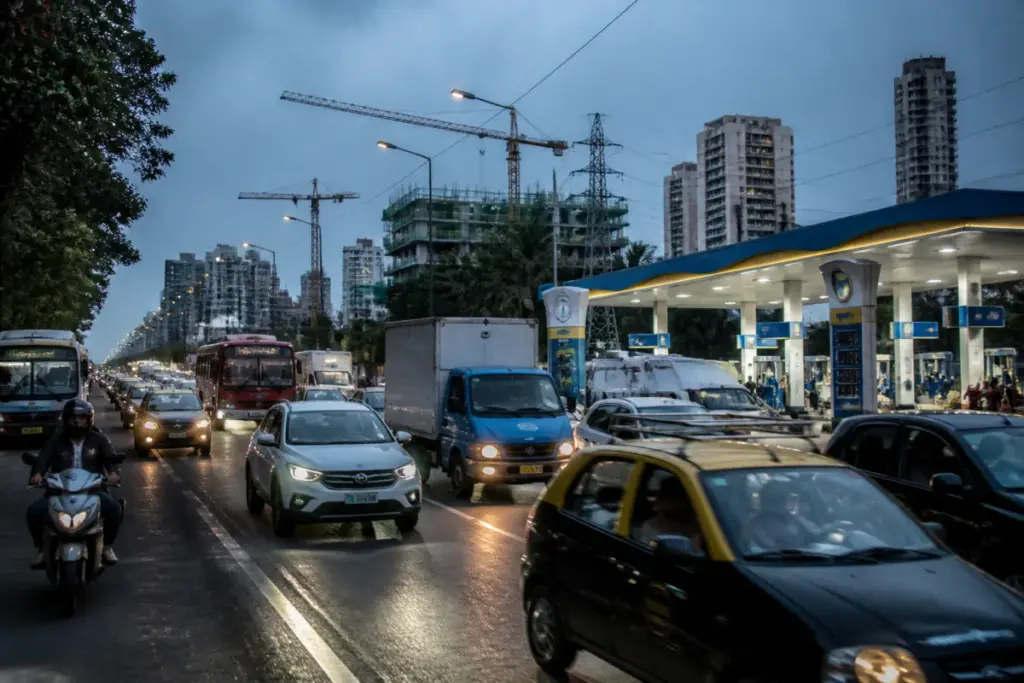
The first transmission channel is mobility. Petrol and diesel prices influence the cost of private travel, buses, commercial vehicles, goods carriers and last-mile delivery. A sustained rise in fuel costs can put pressure on household budgets and on operators whose expenses are tied directly to diesel or petrol. In cities, the effect is not restricted to motorists. Goods moving into wholesale markets, food distribution centres, construction sites and neighbourhood shops also depend on transport networks.
The report specifically links higher crude prices to rising transport expenses. That connection is significant for urban administration because the cost of moving people and goods affects the functioning of the city itself. A fuel shock can influence the operating economics of delivery fleets, taxis, buses, freight vehicles and service providers. However, the report does not quantify the exposure of any particular city transport system, nor does it state whether fares or freight rates have changed.
The second channel is manufacturing. A rise in crude prices can affect companies through fuel used in transport and through petroleum-linked inputs used across production and distribution. Aaj Tak Business reports that manufacturers may increase product prices if transport costs rise. The report does not identify specific industries, companies or products, so the effect should be understood as a possible pass-through mechanism rather than an established price increase in a particular market.
This distinction is important for cities because manufacturing and logistics are spatial systems. Industrial areas depend on road movement, warehouses depend on regular freight flows, and retail districts depend on deliveries from outside the immediate neighbourhood. Higher operating costs can therefore affect both formal businesses and smaller urban enterprises. The supplied material does not include company-level cost data or evidence of closures, reduced services or job losses. It supports the broader point that energy prices can put pressure on the networks that connect production to consumption.
Housing and construction can also be exposed to an energy shock, although the supplied report does not measure this effect directly. Construction sites rely on the movement of workers, aggregates, cement, steel, equipment and finished materials. Fuel is one component of these operations, alongside labour, finance, land and material costs. If transport costs rise for a prolonged period, developers and contractors may face additional operating pressure. That does not mean project prices or completion schedules will immediately change; no such outcome is reported in the source.
The geography of the shock is external, but its urban consequences are local. The reported risks centre on major maritime corridors, including the Strait of Hormuz and Bab al-Mandeb. These routes matter because disruption concerns can alter how markets assess the security of oil shipments and regional export infrastructure. The report attributes the price rise to a combination of Middle Eastern tensions and the continuing conflict in eastern Europe, including reported attacks involving regional infrastructure and a stated intention by Ukraine to continue targeting Russian refineries.
The market response reflects uncertainty about supply and movement, but the supplied article does not establish the volume of oil actually removed from global supply or the duration of any shipping disruption. It also does not provide a formal assessment from an energy regulator, oil ministry, shipping authority or international energy agency. That means the geopolitical explanation should remain attributed to the source rather than presented as a complete account of the market’s behaviour.
For India, the exposure identified by the report comes from dependence on imported crude oil. Aaj Tak Business states that India meets most of its energy requirement through crude oil and imports it from other countries. The report does not provide an import percentage, a current account estimate or the amount of additional expenditure associated with the latest price movement. Even without those figures, the structure of the risk is clear: when an imported energy input becomes more expensive, the pressure can enter domestic transport, production and consumption costs.
The institutional response will determine how much of the market movement reaches households and businesses. Fuel retailers, taxation authorities, the central government, state governments, transport agencies and private operators each influence different parts of the chain. The source does not report any new policy intervention, change in fuel taxation, subsidy announcement, fare order or official inflation assessment. It therefore cannot support a conclusion that prices will rise by a specific amount or that the government has decided on a particular response.
The key policy issue is the difference between a short-lived price spike and a prolonged energy shock. The article reports that Brent briefly reached $110 before closing below that level, while WTI recorded a larger weekly increase. A single closing price captures the market at one point in time; it does not show how long elevated prices will persist. For urban households, businesses and public agencies, duration is critical. Temporary volatility may be absorbed through existing budgets, while a sustained increase can require changes to fares, freight charges, procurement costs and operating plans.
The available data also reveals what is missing from the public picture. There are no city-level figures on fuel consumption, no comparison of exposure between public and private transport, no evidence on freight-rate changes and no breakdown of the effect on food, housing or construction costs. There is also no information on whether Indian fuel prices had already changed in response to the reported movement. These gaps prevent a precise estimate of the urban impact, but they also identify the indicators that require monitoring: domestic retail fuel prices, transport charges, manufacturing input costs and inflation readings.
The larger urban question is how resilient city systems are to shocks that originate far outside municipal boundaries. Cities do not control international crude prices, shipping routes or geopolitical conflict. They do, however, experience the consequences through mobility networks, supply chains, public transport budgets, household expenses and the cost of delivering infrastructure. The reported spike therefore matters not because $110 is automatically a new price floor, but because it tests how quickly external energy volatility can move through the systems on which urban life depends.
What the current evidence confirms is a sharp rise in global crude prices amid reported geopolitical tensions, with a plausible risk of pressure on fuel, transport and manufacturing costs in India. What remains unestablished is the scale and duration of the domestic impact. The next developments to watch are sustained Brent and WTI prices, any change in Indian retail fuel rates, official inflation assessments, and evidence of higher transport or production costs across urban markets.


