

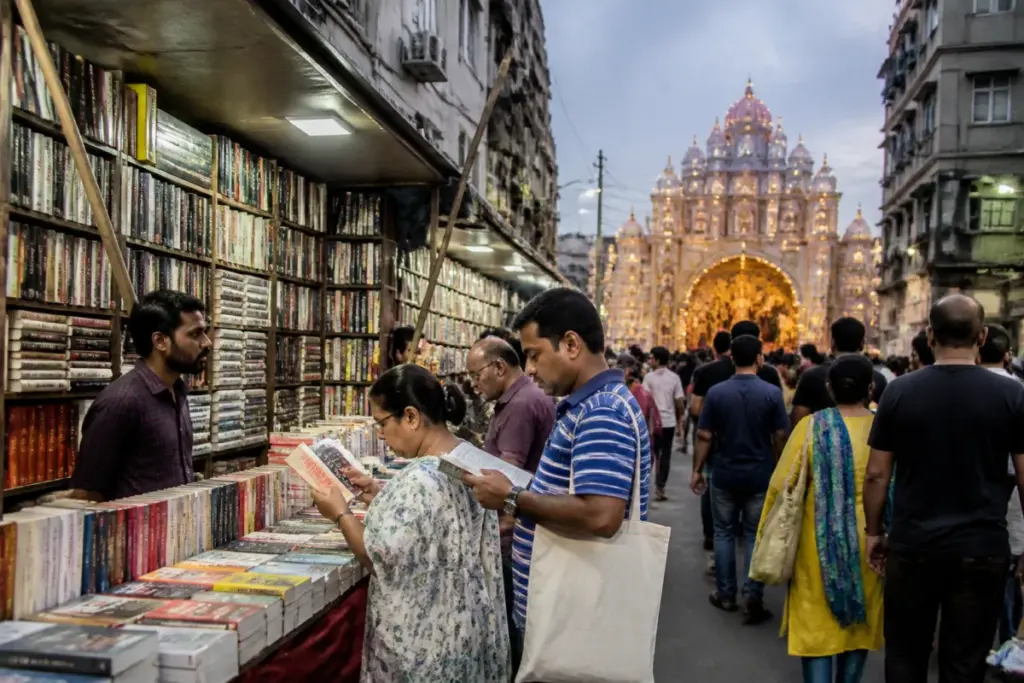
The dispute over Left-affiliated book stalls at Durga Puja pandals in West Bengal is becoming a test of how public festival spaces are managed, who may use them for civic expression and where the boundary lies between religious celebration and political activity. A report by The Hindu says restrictions and alleged attacks on such stalls have emerged as a new flashpoint in the State’s political contest, but the specific incidents and official basis for the restrictions remain insufficiently established in the material available for verification.
The practice itself is not new. Left parties, including the Communist Party of India (Marxist), have traditionally installed book stalls near Durga Puja pandals. The stalls sell books on politics, secularism and related subjects, while also creating a point of contact between party workers, readers and residents visiting neighbourhood celebrations. The Hindu describes the activity as a long-standing practice that allows parties that do not directly associate themselves with the ritual aspects of Durga Puja to participate in the social and public life surrounding the festival.
That distinction is important. A Puja pandal is not only a temporary structure for religious observance. In Kolkata and across West Bengal, it is also a neighbourhood gathering point, a space for cultural programming, informal commerce and public interaction. The presence of a book stall therefore raises questions that extend beyond party politics: who controls access to the space, whether permissions are issued consistently, and whether temporary civic uses are treated differently depending on the political identity of the organiser.
According to the supplied report, CPI(M) State Secretary Md. Salim inaugurated a book stall in Kolkata’s Tollygunge area. The report also says that book stalls set up by the National Book Agency registered a 20% increase in sales this year. That figure indicates continuing public interest in the stalls, although the available material does not provide the sales baseline, the number of stalls surveyed, the period of comparison or whether the increase applies across West Bengal or only to the stalls mentioned in the report.
The reported conflict has emerged amid a broader political realignment in the State. The article places the alleged crackdown after the BJP came to power in May 2026 and describes the Left as a newly targeted political adversary following the weakening of the Trinamool Congress organisation. These are politically consequential claims, but the supplied material does not identify the government notifications, administrative instructions or local decisions that would establish a coordinated crackdown. Nor does it provide a detailed response from the State government, puja organisers or the BJP.
The report refers to allegations of attacks on Left book stalls and to restrictions on their presence at pandals. It also mentions that the Calcutta High Court stayed a previous order that had allowed such stalls. The available text does not specify which court issued the earlier order, when it was passed, the legal grounds for the stay, the parties before the court or the precise effect of the order. Those details are central to understanding whether the dispute concerns political activity on private premises, the use of public land, municipal permissions, policing or the administration of festival committees.
This missing institutional detail matters because pandals operate through overlapping forms of authority. A puja committee may control the immediate premises, while municipal agencies, police authorities and local administrative bodies may regulate public land, traffic, safety, temporary structures and commercial activity. A book stall can therefore be treated as a political installation, a temporary shop, a cultural display or an element of public assembly, depending on the rules applied by the relevant authority. Without the permission documents and court order, it is not possible to determine which framework was used in the reported cases.
The dispute also illustrates how the governance of temporary urban spaces can become politically sensitive. Unlike permanent public infrastructure, a pandal is assembled for a limited period and may occupy a street, pavement, open plot or community area. Decisions made during that short period can determine who gets visibility, which activities are permitted and how residents experience the neighbourhood. If permissions are clear and uniformly applied, the process can be assessed through ordinary administrative rules. If similar activities receive different treatment based on political affiliation, the question becomes one of equal access and institutional neutrality.
The available evidence does not establish whether the restrictions were imposed by puja committees, local authorities, police personnel or other actors. It also does not show whether the affected stalls had applied for permission, whether any applications were rejected in writing, or whether organisers were given reasons. These are not minor procedural details. They determine whether the issue is primarily a dispute between political groups and festival committees or a wider question involving public administration and the use of common urban space.
The sales increase reported by the National Book Agency adds another dimension. The stalls appear to perform both an ideological and a commercial function: they disseminate political and social literature while responding to demand from visitors. The supplied material does not establish why sales rose, whether the increase reflects higher footfall, a larger number of stalls, changes in pricing or greater interest in political books. It does, however, show that the stalls are not merely symbolic structures. They are part of the temporary cultural economy around the festival.
The conflict is also linked in the report to criticism of the West Bengal government over painted flyovers in Kolkata and a subsequent decision to remove the paint and install anti-skid barriers after motorbikes skidded. That episode is separate from the book-stall dispute, and the supplied material does not establish a direct connection between them. Its inclusion nevertheless places both developments within a broader account of contested public decision-making, in which city spaces become visible sites of political debate and administrative response.
For residents, the immediate concern is not only which party can operate a stall. It is whether temporary public spaces remain accessible to a range of lawful civic and cultural activities under predictable rules. Book stalls, exhibitions, performances and community information points all depend on permission systems that are often informal or locally negotiated. When those systems are unclear, the same festival space can appear open to one group and closed to another without a transparent explanation.
The Calcutta High Court proceedings may provide the clearest route to establishing the facts, provided the relevant order and subsequent filings are examined. They could clarify the legal status of the stalls, the authority responsible for granting permission and the reasons for restricting or allowing them. Administrative records from the concerned puja committees, municipal bodies and police units would also help establish whether the reported incidents were isolated disputes or part of a wider pattern.
At this stage, the supplied report supports a clear conclusion about significance but not a complete conclusion about responsibility. It establishes that Left-affiliated book stalls at Durga Puja pandals have become a political and civic flashpoint, that Md. Salim inaugurated a stall in Tollygunge, that the National Book Agency reported a 20% sales increase and that court proceedings have affected the stalls’ operation. It does not yet establish the full sequence of restrictions and alleged attacks, the official rationale behind them or the extent of the phenomenon across Kolkata and West Bengal.
The next developments to monitor are the detailed Calcutta High Court order, any government or municipal clarification, responses from puja committees and evidence identifying the locations and dates of the reported incidents. Those documents will determine whether the dispute remains a contest over festival permissions or becomes a wider case about political expression, equal access and the governance of Kolkata’s temporary public spaces.


