

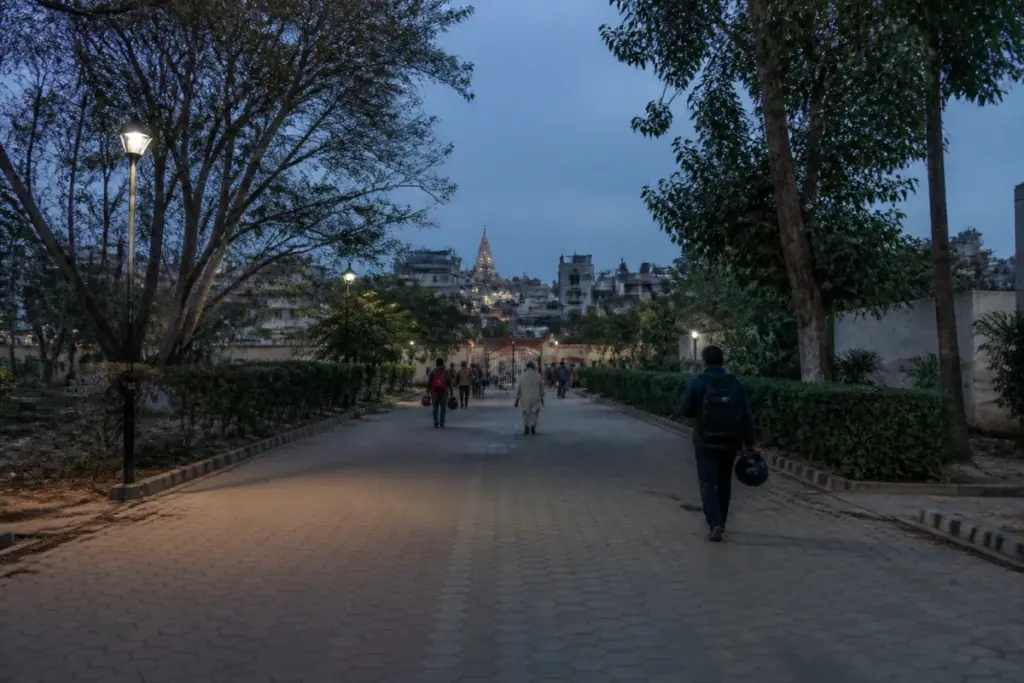
The latest alleged gang-rape at Astha Kunj Udyan has brought attention to a problem that extends beyond one criminal investigation: Delhi’s public parks are being asked to serve as recreational spaces, pedestrian shortcuts and informal transit corridors without the security systems required for any of those roles. The 143-acre park in southeast Delhi connects the Lotus Temple, ISKCON temple and Kalkaji temple, but its large size, dark spots, open access and limited surveillance have repeatedly exposed visitors to risk.
According to the Times of India report, a teenage girl and her male friend entered the park through Gate No. 7 on September 21 after visiting Kalkaji Mandir. Three men allegedly posing as policemen separated them and took the girl to a secluded area, where they threatened her with a firearm and knife. A police response was recorded at around 8.45pm, and the case was registered under the Bharatiya Nyaya Sanhita and the Protection of Children from Sexual Offences Act. The allegations remain subject to investigation and legal process.
The incident is significant because it did not occur in a forgotten fringe of the city. Astha Kunj is embedded in a dense and heavily visited part of Delhi, surrounded by religious destinations and used by people moving between neighbourhoods, temples and public transport. At dawn, the park attracts retirees, yoga groups and walkers. During the day, children and families use its lawns. After dark, the same landscape changes as visitors thin out, visibility falls and internal paths become harder to monitor.
That transition exposes a basic planning problem. A public park is not safe merely because it has gates, guards or a formal closing time. Safety depends on whether people can see and be seen, whether help can reach isolated locations quickly, whether access points are controlled, and whether the authority responsible for the land can verify that these systems function in practice.
The reported staffing numbers illustrate the gap between nominal security and effective coverage. The Delhi Development Authority, which has jurisdiction over Astha Kunj, told reporters that nine guards per shift are deployed at strategic locations, with supervisory and patrolling arrangements. The park has 27 guards across three shifts. Even if all posts are staffed, nine people on foot cannot continuously cover 143 acres, multiple gates, internal paths and secluded corners. The number is more meaningful when viewed spatially: the park is not a compact enclosure but a large open landscape connected to several urban destinations.
The DDA also stated that lighting is functional and regularly inspected. Yet the latest incident occurred amid reports of dark spots, while the Times of India report also refers to non-working CCTV. This difference between institutional assurance and visitor experience is central to the issue. A system can be described as functional at an administrative level while remaining ineffective at the exact location and time when a crime occurs. For public safety, the relevant question is not whether lights and cameras exist somewhere in the park, but whether they cover internal paths, gates and secluded areas consistently.
The park’s gates create a second institutional conflict. Delhi Tourism lists its operating hours as 4am to 9pm. A guard told the newspaper that efforts to clear visitors after 8pm often fail. A police officer explained that the gates are left open through the night because the park is used as a shortcut between the metro station, Garhi village and Okhla Sabzi Mandi. Closing the gates, the officer said, could lead people to jump over the barriers.
This makes Astha Kunj more than a park with a closing-time problem. It is also a piece of pedestrian infrastructure. People use it to shorten their journeys, regardless of whether its formal purpose is recreation. Once a park becomes a route, its security requirements change. It needs predictable lighting, visible wayfinding, monitored entrances and a safe alternative for people travelling after dark. Simply instructing guards to remove visitors cannot resolve the underlying movement pattern.
The surveillance record is equally revealing. In the August 2025 murder of Dharam alias Gunga, PTI reported that there was no CCTV coverage inside the park. Police relied on cameras along Raja Dhir Singh Marg near the temple, which showed three youths arriving by auto and heading towards the park. External cameras can help reconstruct events, but they cannot replace coverage of the internal spaces where incidents take place. The distinction matters for both prevention and investigation.
The reported crime history reinforces the concern, although it does not by itself prove that poor infrastructure caused each incident. ANI reported that a 28-year-old US national was stabbed and robbed while walking through the park with a friend on the night of June 25-26, 2025. Police arrested two alleged attackers after a gunfight in which bullets struck police personnel’s bulletproof jackets. PTI reported the August 2025 killing of a mute homeless man who lived near the ISKCON temple, allegedly after a confrontation over staring. Days later, police reportedly found a 20-year-old man hanging from a tree in the park area.
Two other October 2025 cases cited in the report involved police operations near the park rather than crimes inside it. In one, a Nepal-based criminal wanted in a doctor’s murder was shot dead after allegedly opening fire at a joint Delhi-Gurugram police team. In another, an arms supplier wanted in connection with Diwali-night firing was injured after allegedly firing at police. These cases should not be treated as evidence that every part of the park is equally unsafe. They do, however, show how frequently the surrounding area appears in police activity and why local residents may perceive the wider zone as insecure.
A comparison with other Delhi parks in the report offers a more useful institutional lesson. A police audit found that Swarn Jayanti Park in Prashant Vihar had 27 guards and four gates but insufficient lighting and CCTV, along with several dark spots. Rohini’s District Park reportedly had no CCTV and a damaged boundary wall, and had seen cases under the Arms Act, Gambling Act and Narcotic Drugs and Psychotropic Substances Act. By contrast, Roshanara Bagh had 21 CCTV cameras, 12 guards, good lighting and intact boundaries, and reported no crime in the audit. DDU Park and Amruth Park, where lighting and boundaries were considered satisfactory, also reported no crime.
The comparison cannot establish a direct cause-and-effect relationship. Parks differ in location, footfall, surrounding land use, policing, design and the kinds of incidents that get reported. But the pattern points to a measurable safety framework. Guards, lighting, cameras, boundary walls, vegetation management and gate timings are not cosmetic maintenance issues. Together, they determine whether a public landscape has visibility, controlled access and a realistic chance of rapid intervention.
Delhi Police has now directed its units to audit all parks of one acre or more—nearly 300 large parks and more than 800 smaller ones—against these parameters. The audit is expected to examine guards, high-mast lighting, CCTV, boundary walls, overgrown bushes and gate-closure timings. Police have also ordered enhanced patrolling, including mounted personnel in hard-to-reach areas, and directed all deputy commissioners of police to ensure effective security measures.
The scale of the audit is important because the problem is unlikely to be limited to Astha Kunj. Delhi’s parks vary widely in size and management, while responsibilities are divided among agencies such as the DDA, municipal bodies and police. The audit could therefore become useful only if it produces location-specific accountability: which agency must repair a light, install a camera, clear vegetation, strengthen a boundary or redesign a pedestrian connection, and by when.
There is also a social dimension that infrastructure alone cannot resolve. The report links some accused persons to drug use, financial hardship, interrupted schooling and homelessness, based on police accounts in individual cases. Those accounts do not explain every crime, nor can they be used to generalise about disadvantaged groups. They do show that enforcement after an incident addresses only one part of urban safety. A park may require guards and cameras, but the city’s wider response also involves access to education, shelter, treatment and livelihoods.
The alleged impersonation of police officers in the latest case adds another layer. Uniforms and official authority are powerful signals in public spaces, particularly for young visitors who may comply when approached by someone claiming to be a police officer. This makes visible, verifiable security important: marked patrols, functioning emergency communication, clear signage and a public understanding of which personnel are authorised to intervene.
Astha Kunj’s central challenge is therefore not simply that it needs more guards. It is that a large public landscape has accumulated several urban functions without a matching operating model. It is a spiritual garden, a neighbourhood park, a tourist link and a pedestrian shortcut. Each role produces different patterns of movement and different periods of use. A security plan designed only for daytime recreation will fail when the same space remains open at night because people depend on it for daily travel.
The Delhi Police audit provides a formal opportunity to test whether the city can move from incident-driven enforcement to routine management of public-space safety. What it confirms about lighting, CCTV coverage, boundaries, gate operations, staffing and patrols will determine whether Astha Kunj becomes an isolated case or a warning about hundreds of other parks. The evidence supplied in the report establishes the infrastructure and governance gaps; the next test is whether the agencies responsible convert the audit into documented, time-bound action.


