

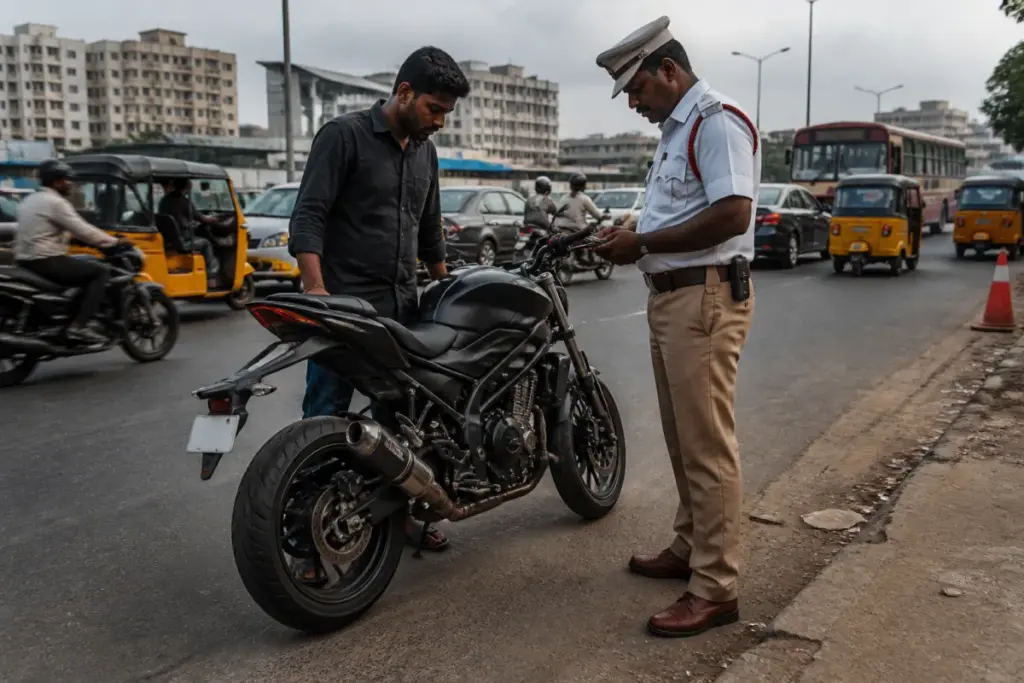
Chennai’s illegal bike modifications are not only a matter of louder exhausts or more aggressive styling. They reveal a gap between a growing performance-customisation market and the regulatory system responsible for ensuring that motorcycles remain safe, insurable and compliant on public roads.
The issue came into sharper focus after at least 50 bikers gathered on Valluvar Kottam High Road two weeks ago to perform wheelies, stoppies and drifts. Greater Chennai Police tracked and arrested at least 21 of them, according to a report by The Times of India. The motorcycles used in the stunts had reportedly been modified, with some modifications costing several lakhs of rupees.
The arrests were linked to visibly dangerous behaviour. But the larger question is not limited to road stunts. It concerns what happens when a factory-built vehicle, designed around a calibrated balance of power, torque, fuel efficiency, emissions and safety, is altered after purchase and then used in ordinary city traffic.
A motorcycle modification can begin as a cosmetic or performance upgrade and still create legal and operational consequences. Factory motorcycles are manufactured to comply with prescribed standards, including Bharat Stage VI emission norms. Changes to the exhaust, air intake or engine settings can alter how the vehicle performs and may affect emissions, reliability and safety.
That distinction matters in a city such as Chennai, where motorcycles operate in mixed traffic alongside buses, cars, autorickshaws, pedestrians and commercial vehicles. A change that may be manageable on a controlled track can have different consequences on a crowded urban road, particularly when it affects acceleration, braking, handling or noise levels.
The modification market described in the report is wide-ranging. Wider, high-grip tyres can cost between Rs 10,000 and Rs 20,000 per tyre. They may improve grip and cornering performance, but can affect mileage and fuel efficiency and may require changes to the swingarm or fender. Air filters priced between Rs 2,000 and Rs 6,000 can increase airflow and improve throttle response, although the reported gains are limited without other modifications.
Exhaust systems costing Rs 10,000 to Rs 20,000 are marketed for a deeper and louder sound, reduced weight and improved exhaust flow when properly tuned. The same change can create a legal problem if the resulting noise exceeds prescribed standards. The issue is therefore not simply whether a component is sold openly, but whether the modified motorcycle continues to meet the requirements applicable to vehicles on public roads.
Engine control unit tuning is another important intervention. The report puts the cost of ECU tuning between Rs 8,000 and Rs 22,000. It can change fuel injection and other parameters to improve throttle response or power delivery. Incorrect tuning, however, can reduce engine life and affect reliability. A quick shifter, costing around Rs 15,000 to Rs 20,000, allows clutch-less gear shifts, but requires proper installation and ECU compatibility.
Suspension upgrades, which cost between Rs 15,000 and Rs 40,000, can improve handling, stability and ride quality when correctly selected and installed. Custom paint, wraps and graphics are generally appearance-focused and can cost between Rs 5,000 and Rs 25,000. Yet even cosmetic changes have to remain within legal requirements, particularly where a modification affects registration particulars or vehicle identification.
The Motor Vehicles Act provides the regulatory boundary. Section 52 restricts alterations that make a vehicle’s registration particulars differ from those specified by the manufacturer. Section 190(2) addresses violations of prescribed safety and noise standards. These provisions place responsibility not only on riders who use modified motorcycles but also on the broader ecosystem in which modifications are designed, sold, installed and promoted.
The enforcement challenge is that not every modification is equally visible or equally dangerous. A custom paint job may have little relationship to road behaviour, while ECU tuning, exhaust replacement, tyre changes and suspension work can alter the vehicle’s operation. A policing system that relies mainly on observing loud noise, speeding or stunts may detect the most obvious violations but miss less visible changes that affect safety or emissions.
The report also points to a gap in public understanding. Arjun Kumar, a pit stop owner in Pudupet, said customers spend between 18% and 25% more to enhance engine tuning, while warning that improper work could affect mileage and engine life. He also said modified bikes are not covered by insurance. That claim is significant because it connects the modification decision to financial risk after a crash, although the precise insurance treatment can depend on the policy, the nature of the alteration and the circumstances of a claim.
For riders, the attraction is not necessarily limited to speed. Karthik, a track rider from Coimbatore, told The Times of India that riders want motorcycles that reflect their personality and respond differently during acceleration, braking and cornering. This helps explain why the market persists even when riders understand that some changes may be unlawful. Customisation is part of the identity and consumption culture surrounding motorcycles, while the law is concerned with whether the resulting vehicle remains safe and compliant in shared public space.
That tension is central to the urban issue. A motorcycle is privately owned, but its effects are public. Excessive exhaust noise reaches residents, pedestrians and other road users. Altered acceleration or braking can increase risk in mixed traffic. Unsafe tyres or poorly installed suspension components can affect not just the rider but anyone nearby. Emissions from a modified vehicle add to the burden carried by a city already managing traffic pollution and dense roadside activity.
The enforcement response in Chennai also raises an institutional question: how should authorities distinguish between legal personalisation and illegal alteration at scale? Section 52 and safety and noise provisions establish the framework, but effective enforcement requires roadside checks, technical expertise, access to vehicle records and clarity for workshops and owners. Without that combination, enforcement can remain concentrated on spectacular incidents such as group stunts rather than the full chain of non-compliant modifications.
The economics of the market make the issue harder to resolve through punishment alone. The reported prices show that modifications range from relatively affordable air filters and custom paintwork to expensive engine work and suspension upgrades. The market includes specialist workshops, parts sellers, riders, track enthusiasts and customers seeking better performance or appearance. A blanket assumption that all customisation is dangerous would ignore the differences between cosmetic changes, track-oriented equipment and alterations that compromise public-road compliance.
At the same time, the existence of a commercial market does not make a modification legal. A component may be available for purchase and professionally installed while the completed motorcycle still fails to meet the conditions under which it was registered. The relevant test is the vehicle’s compliance after alteration, not simply the buyer’s intention or the workshop’s ability to perform the work.
Chennai’s recent arrests therefore represent more than a response to a group of riders performing stunts on a busy road. They bring attention to a layered urban governance problem involving road safety, vehicle standards, emissions, insurance, workshop practices and enforcement capacity. The immediate incident was visible because it combined a large gathering with dangerous riding. The less visible issue is how many altered vehicles move through everyday traffic without clear public understanding of where legal customisation ends and unlawful alteration begins.
The evidence in the report confirms that modifications can affect performance, emissions, reliability and safety, and that Indian law restricts alterations that change a vehicle’s registered particulars or breach safety and noise standards. It does not establish the scale of modified motorcycles across Chennai, the number of road crashes linked specifically to modifications, or how frequently insurance claims are rejected on that ground. Those are the next facts needed to assess whether the city is facing isolated enforcement incidents or a wider compliance problem.


