

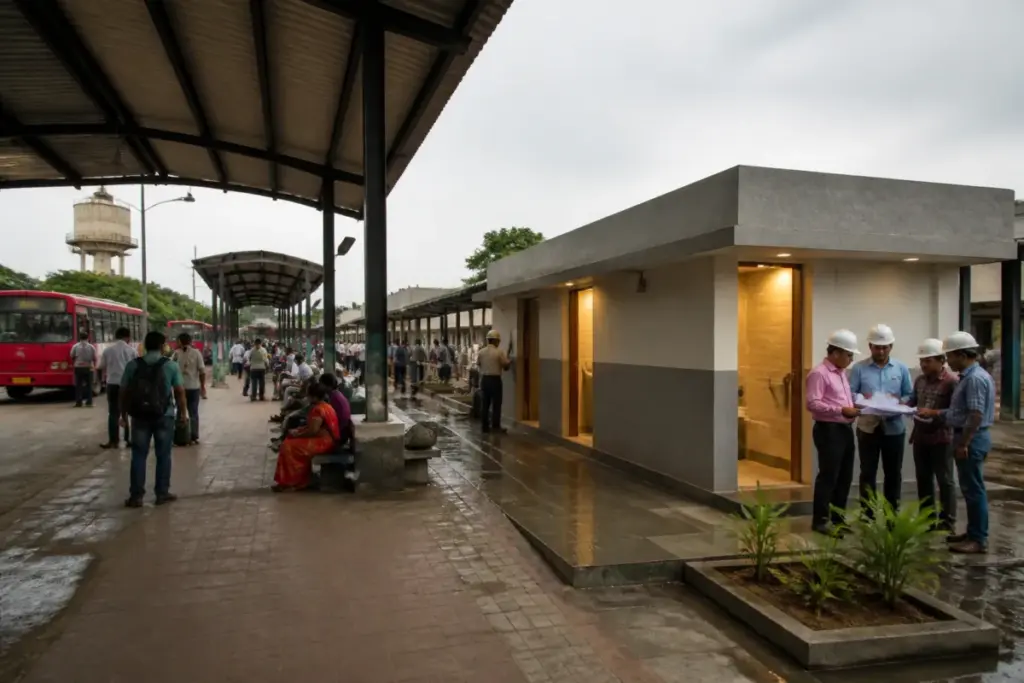
Maharashtra’s approval of Rs 9.76 crore for dedicated toilets for transgender people at MSRTC bus stations is a significant step in making public transport facilities more accessible, but the decision’s value will ultimately depend on how administrative approval becomes usable infrastructure. The proposal covers bus stations across six regional divisions—Mumbai, Pune, Nashik, Chhatrapati Sambhajinagar, Amravati and Nagpur—and now moves into the planning, costing and technical approval stages.
The Transport Department issued a government resolution on October 14 after Minister of State Madhuri Misal directed the departments concerned to expedite the proposal. The decision followed instructions to the Maharashtra State Road Transport Corporation (MSRTC) to arrange dedicated toilets at its bus stations. According to the report, the absence of separate facilities has created social and physical difficulties for transgender passengers, particularly while travelling.
The announcement therefore concerns more than the construction of individual toilets. It places an inclusion-related requirement within the operating network of a major state transport corporation and links public infrastructure to the experience of passengers who may not find existing facilities usable or dignified. The supplied material does not establish the number of stations covered, the design of the facilities or the implementation schedule. Those details will have to emerge through the next administrative steps.
The institutional chain behind the approval is important. MSRTC prepared the proposal for construction at various locations, and its vice-chairman and managing director submitted proposals to the state government on February 10 and September 22, 2026. Misal then directed authorities to grant administrative approval on priority and arrange funding through the Social Justice and Special Assistance Department. The Transport Department has now approved the proposal administratively.
This process shows that the project is not being treated only as an MSRTC construction activity. The transport system is the implementing setting, while funding is being arranged through a scheme for the welfare of transgender people. That division of responsibility matters because public-facility projects often depend on coordination between the department that owns or operates the site and the department that controls the relevant welfare funding.
The approved amount is Rs 9,76,63,195. The government has stipulated that the necessary plans must be approved, detailed cost estimates prepared and technical approval obtained from the respective executive engineers before construction begins. These conditions establish that the administrative approval is not the same as completion or opening. Construction remains subject to design, costing and engineering clearances.
The distinction is especially relevant for a project spread across six regional divisions. A statewide or multi-division announcement can appear uniform at the policy level while requiring site-specific decisions at individual bus stations. The supplied report does not state whether every division will receive the same number of facilities, whether the allocation will depend on passenger volumes or station categories, or how locations will be prioritised. It also does not specify whether the toilets will be newly built structures or adaptations within existing station premises.
Those details will influence how the investment is experienced by passengers. A facility that is technically available but difficult to locate, poorly maintained or inaccessible during operating hours would not fully address the hardship identified in the government’s decision. The source material does not make claims about such conditions at specific stations, so the implementation question remains open rather than a settled criticism of the existing network.
The policy significance lies in the decision to identify a specific user group within a mainstream public transport system. Bus stations are everyday public spaces where passengers may wait, transfer and spend time between services. The government’s stated objective, as quoted by the report, is to enable transgender people to move around public places with dignity. By approving dedicated facilities within MSRTC stations, the state has acknowledged that access to basic amenities is part of the transport experience, not a separate issue outside mobility policy.
The funding route also places the project within a broader welfare framework. The construction expenditure will come from funds available under the department’s scheme for the welfare of transgender people. This means the project combines social-justice funding with transport infrastructure delivery. The available information does not provide the size of the overall scheme, the amount reserved for this project beyond the approved proposal, or the maintenance arrangements after construction. Without those figures, it is not possible to assess the project’s share of the welfare budget or its long-term operating cost.
What is clear is the sequence of accountability. The minister initiated and expedited the proposal; MSRTC prepared and submitted the project documents; the Transport Department granted administrative approval; the Social Justice and Special Assistance Department is connected to the funding source; and executive engineers must provide technical approval before work begins. Each stage creates a separate point at which progress can be assessed.
The numbers in the announcement provide the first measurable outline of the project: Rs 9.76 crore in approved expenditure, six regional divisions and proposals submitted by MSRTC on two dates in 2026. The number of toilets, stations, construction packages and expected completion dates is not included in the supplied material. Those missing figures are important because the same total allocation could represent very different levels of provision depending on the number and size of stations included.
The absence of a stated timeline also means the current announcement should be understood as a policy and funding milestone rather than a completed service improvement. The government resolution creates administrative permission to proceed, but the project must still pass through plan approval, preparation of detailed cost estimates and technical clearance. The report does not say whether tenders have been issued or whether construction has started at any location.
For passengers, the immediate significance is therefore the recognition of a gap in public infrastructure and the commitment of funds to address it. The longer implementation story will be measured through station-level delivery: which locations are selected, when work begins, whether facilities are accessible and usable, and how MSRTC manages them after construction. None of those outcomes is established by the approval alone.
The larger urban question is how public transport systems translate equality commitments into physical design and routine operations. Transport access is often discussed through routes, fares, vehicles and travel time. This decision draws attention to the supporting facilities that determine whether people can use a network with safety and dignity. It also demonstrates the administrative complexity of delivering targeted infrastructure through an existing public agency.
Maharashtra has now created an institutional framework for the proposed facilities, but the evidence supplied confirms only the approval stage. The next developments to monitor are the approval of plans, preparation of detailed cost estimates, technical clearances from executive engineers, identification of stations and the release and use of funds. Those milestones will determine whether the Rs 9.76-crore commitment becomes a functioning improvement across the six MSRTC regional divisions.


