

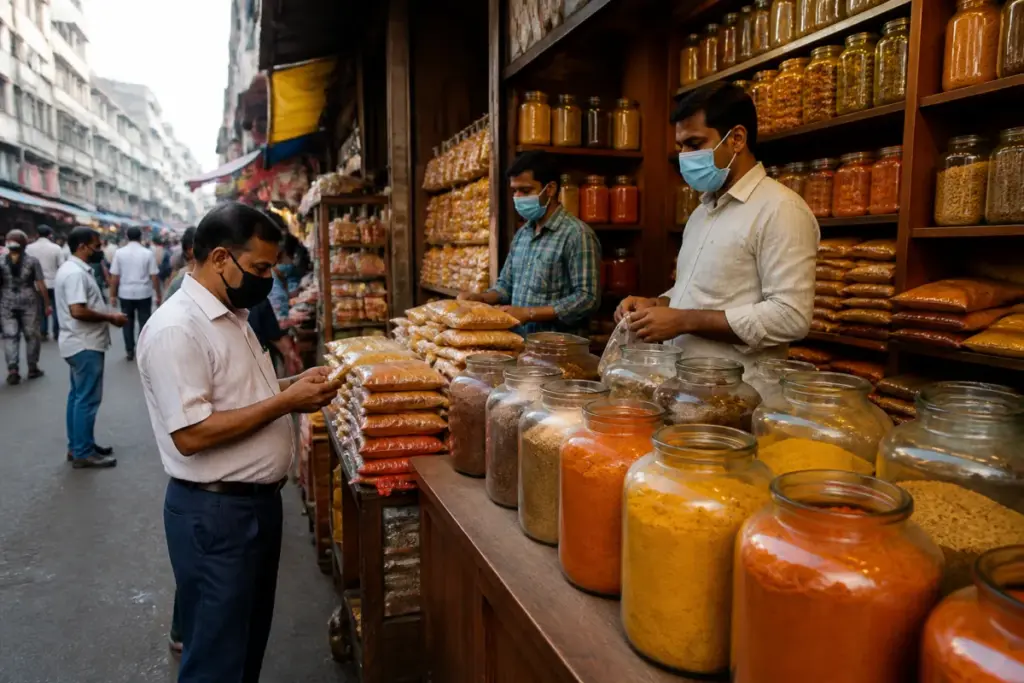
Maharashtra’s loose spices ban is turning Mumbai’s Lalbaug market into a test of whether food-safety regulation can protect consumers without erasing the small-scale retail systems that have supplied them for generations. The state Food and Drug Administration’s order prohibits the sale of spice powders and mixed spices in loose, unpackaged form, requiring them to be packed and sealed at the place of production before distribution and sale.
At Lalbaug, the order has exposed a conflict between two forms of trust. The first is regulatory trust: the assurance that spices have been produced, stored and sold under hygienic conditions, without harmful adulterants or contamination. The second is the relationship between customers and familiar shopkeepers, many of whom sell small quantities of freshly ground spices to families that have returned to the same stores for decades.
The market’s traders are not uniformly opposing the order. Ajit Gaikwad, president of the New Lalbaug Markets Merchants Association, said the traders supported the objective of eliminating adulteration but required clarity on how the rules would work in practice. The association has around 150 registered spice merchants, in addition to an estimated 100 unregistered traders, and has begun discussing implementation concerns with the local food inspector.
The practical question is the scale at which the rule will operate. Gaikwad pointed to customers who need only 10 grams of a spice when packaged products may be available in quantities of 50 grams or more. For a household that buys small quantities, the shift from weighing a product at the counter to purchasing sealed packets changes both the price and the way the transaction works. For a shopkeeper, it can mean cleaning, processing, sealing and labelling each product before sale.
This is not simply a dispute over packaging. It is a question of where responsibility for food safety sits within a fragmented supply chain. The FDA order requires spices to be packed and sealed at the place of production before they reach consumers. It also says spices must not be dried on public roads, drains or near cattle sheds, while storage premises must be clean and products must be protected from contamination.
That approach moves the regulatory focus beyond the final retail counter. It places conditions on production, drying and storage, while also changing the point at which consumers encounter the product. A loose spice sold by weight allows a buyer to choose a small quantity and, according to traders, assess its appearance. A sealed packet provides product information and a standard unit of sale, but removes the counter-level transaction in which the customer asks for a particular quantity and the shopkeeper weighs it.
Several Lalbaug traders told The Indian Express that packaging could increase costs. Naresh Rathod of H B Rathod Masala said every product would need packaging and the required details on each packet, increasing the burden on consumers. He also argued that freshly ground spices could last about a year if stored in airtight conditions, and questioned whether packaged products were necessarily safer in every case. His position was that regulators should also examine concerns about contaminants in branded spices.
The report does not establish whether branded or loose products have different safety outcomes. Rathod’s argument is therefore a demand for a wider regulatory comparison, not evidence that one category is safer than the other. What the dispute does establish is that the order has been received by traders as a change in compliance obligations, not merely as a hygiene advisory.
The burden is likely to be uneven across businesses. Sachin Shinde of Shindraj Masala, a business operating since 1962, said packaging would require additional staff and spending on labelling. Larger manufacturers may be better placed to absorb those costs, while small manufacturers and sellers operating with limited staff may find it harder to reorganise production and sales. The supplied report does not provide price estimates or a formal transition timetable, so the eventual effect on retail prices remains unquantified.
At the smallest end of the market, the consequences are tied directly to livelihoods. A pushcart vendor selling powdered spices in Dadar said the business was his only source of income and that he did not know how he would survive if he could not continue in the same way. The report does not specify the number of vendors who could be affected across Mumbai, but the account illustrates why implementation cannot be assessed only through the formal merchant associations or established shops.
Lalbaug’s retail network includes businesses with long histories and vendors outside formal registration structures. Yusuf Kapasi, 80, owner of Gulab Traders, described packaging every item as practically impossible for his business and argued that enforcement should focus on sellers using harmful chemicals and colours to adulterate spices. At Vivek Stores, Chandrakant Jadhav said loose spices were ground and stored in airtight jars under hygienic conditions, and that forcing all products into packets would prevent customers from assessing quality in the same way.
These claims point to an administrative challenge: a single rule may cover businesses with very different production systems, premises, staffing and customer volumes. The FDA’s stated requirements on hygiene and contamination are specific in principle, but the report records traders asking for clarity on how those requirements will be applied to small retailers, freshly ground products, low-volume transactions and unregistered sellers.
The market’s customer base also complicates the transition. One customer from Pune said his family’s relationship with a Lalbaug shop extended across generations and that he continued to buy there because of that trust. Customers travelling from outside Mumbai to stock up at familiar stores are not simply purchasing a branded commodity; they are using a retail network built around reputation, repeated visits and personal knowledge of products.
That relationship is valuable but difficult to measure through standard compliance systems. It may encourage repeat business and accountability between a shopkeeper and a customer, but it does not substitute for production controls, labelling or inspection. Conversely, packaging can make product information more visible, but it does not by itself resolve every question about the conditions in which spices are sourced, processed or stored. The FDA order’s emphasis on the place of production and storage recognises that distinction.
The regulatory architecture implied by the order therefore has at least three levels. Producers must pack and seal products before distribution. Storage and processing premises must meet hygiene requirements. Retailers must sell products in the required form rather than weighing out loose powders at the counter. Local food inspectors become an important link between the written order and the market, particularly where traders need operational guidance.
The presence of an estimated 100 unregistered traders adds another layer. The report does not state how the FDA will identify, register, inspect or transition those sellers. Nor does it establish whether the order includes a grace period, penalties, assistance measures or exemptions. Those missing details matter because the effectiveness of a food-safety rule depends not only on its stated objective but also on whether the regulated population can understand and comply with it.
For consumers, the immediate issue is choice. People who buy 10 grams of a spice may have to purchase larger packaged quantities, potentially creating additional expense or waste. Customers who value freshly ground products may have fewer options at traditional shops. At the same time, consumers may gain clearer information about the product, its producer and its handling if packaging and labelling are properly implemented. The supplied material does not yet show how prices, product range or customer behaviour will change.
The dispute also reveals a wider feature of urban regulation. Markets such as Lalbaug are not only places where goods are sold; they are networks of small enterprises, informal workers, established manufacturers, family businesses and customers who travel across the city and the state. A rule designed around public health enters that network through shop counters, storage rooms, production units and street-level livelihoods. Its effects will depend on how those different parts of the system are connected.
The evidence currently confirms the order, the FDA’s stated hygiene requirements and the range of concerns raised by traders and customers. It does not establish the scale of adulteration the order is intended to address, the expected compliance costs, the enforcement schedule or the likely effect on retail prices. Those are the facts that will determine whether the measure becomes a workable safety reform or a compliance burden concentrated on the smallest sellers.
For now, the next stage is implementation. Lalbaug’s traders have begun discussing their concerns with the local food inspector, while the FDA’s order sets the formal requirements for packing, sealing, drying and storage. How those discussions translate into inspection, compliance and support for small businesses will decide whether Maharashtra’s loose spices ban improves safety while preserving access to the traditional market system it is now attempting to regulate.


